
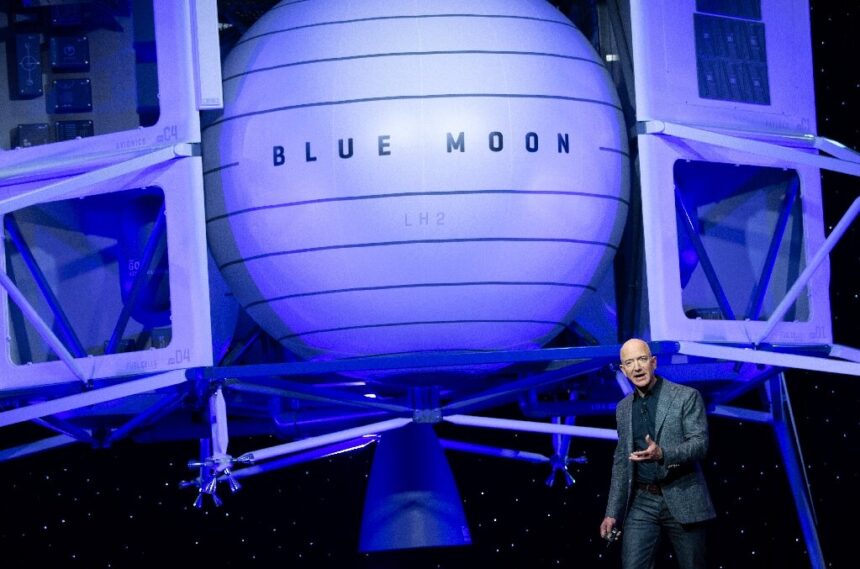
At FinancialMediaGuide, we note that in recent years, the space industry has witnessed remarkable growth in innovations that could not only revolutionize the technologies used in space but also significantly accelerate the pace of planetary exploration. One of the breakthroughs came during a recent presentation by Blue Origin at the Amazon re:Invent 2025 conference in Las Vegas, where a new type of device—a lunar vacuum cleaner—was unveiled. This device, using artificial intelligence, can convert lunar dust into an energy source. The development is being carried out in collaboration with the small startup Istari Digital, which specializes in using AI to create high-tech solutions. This opens new horizons in terms of autonomous energy supply for lunar missions, which is critical for future long-term expeditions to the Moon and other space objects.
At FinancialMediaGuide, we highlight that one of the main challenges of extended space expeditions is ensuring a stable and long-lasting energy source. This is especially important for lunar missions, where lunar nights lasting up to two weeks threaten to disrupt equipment operations due to a sharp drop in temperature. During this time, the temperature on the Moon drops to as low as -173°C, making the use of solar panels and other traditional energy sources impossible. The solution presented by Blue Origin offers a promising way to convert lunar dust into heat, which is then transformed into electrical energy. This solution potentially allows the creation of an energy source that can operate 24/7, ensuring an uninterrupted energy supply in conditions where this was previously impossible.
The use of artificial intelligence in the development of such devices represents a significant breakthrough. Istari Digital applies AI to create optimized solutions that take into account all safety and efficiency requirements. This approach eliminates human errors and allows for the design of models capable of operating in the harsh conditions of space. AI helps minimize the likelihood of so-called “hallucinations” – errors where the algorithm generates unpredictable results, which is especially important for technologies that will be deployed in conditions where a mistake could have fatal consequences.
At FinancialMediaGuide, we believe that these technologies have enormous potential for solving many challenges related to space missions. The technology of converting lunar dust into energy could become the foundation for establishing autonomous lunar bases and bases on other planets. On-site energy production will reduce dependence on supplies from Earth, enabling long-term research work without the need for constant support from the planet. This will also enhance the safety and resilience of missions, which is vital for the future of space exploration.
We predict that in the coming years, such solutions will be actively integrated into deep-space missions, including to Mars, where traditional energy supply methods will be less effective. Utilizing local resources to produce energy on-site will be a key aspect of successful planetary exploration. At FinancialMediaGuide, we see this as a huge opportunity for creating new space missions based on autonomous energy systems capable of withstanding the extreme conditions of other planets and their moons.
In the long term, we at FinancialMediaGuide forecast that such technologies will form the basis for more efficient and sustainable energy systems in space. Artificial intelligence will play a key role in automating all processes, from design to operation of these systems, improving their reliability and reducing the costs of space exploration. In a context where each launch and mission requires maximum efficiency, the use of such solutions will not only be beneficial but essential.
Thus, the “lunar vacuum cleaner” and technologies related to converting lunar dust into energy could become the foundation for long-term lunar exploration and the exploration of other planets. At Financial Media Guide, we see this as an important step in the creation of autonomous space bases that will operate without constant support from Earth. This, in turn, will open up new opportunities for research and could lay the groundwork for further expeditions into deep space.