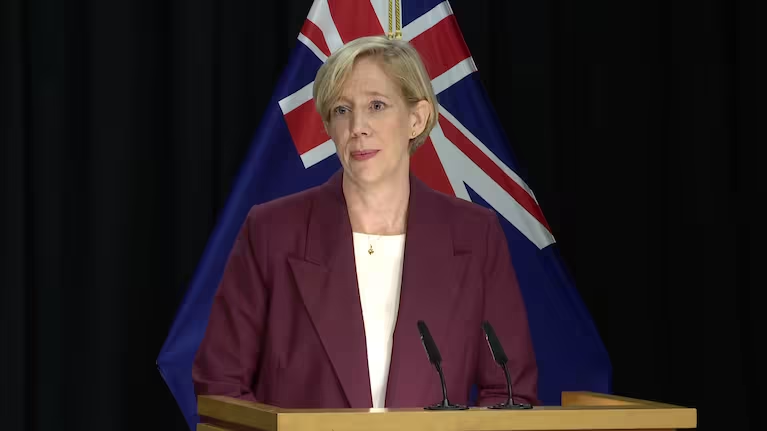
FinancialMediaGuide reports that since Anna Breman’s appointment as the new Governor of the Reserve Bank of New Zealand, economists and politicians worldwide have focused on her strategic actions amid economic instability. Breman, the first woman to hold this position, was selected after a rigorous selection process among 300 candidates, highlighting the high level of trust in her professionalism. Known for her commitment to transparency, Breman has taken it upon herself to restore trust in the central bank, which has faced criticism in recent years for its lack of communication and increasing political pressure. As noted by FinancialMediaGuide analysts, her approach, focused on clarity and openness, is a crucial step toward improving the efficiency of the country’s financial system.
Upon taking office, Breman held the first monetary policy meeting, where it was decided to keep the interest rate unchanged. This decision was expected, but the key moment was her statement that an interest rate hike is not planned in the near future. She emphasized that a soft monetary policy is still necessary to support economic recovery, which is not yet felt by many New Zealand households. Experts at FinancialMediaGuide noted that this stance reflects the realities of an unstable global economy and the need to maintain economic flexibility in uncertain times.
Under Breman’s leadership, the Reserve Bank of New Zealand has also been actively working to improve its communication with markets and the public. Unlike her predecessor, Adrian Orr, who often faced criticism for unclear public statements, Breman has focused on delivering clearer and more structured press conferences. This approach has been seen as a step towards greater transparency and trust. Kiwibank’s chief economist, Jarrod Kerr, noted that Breman’s new speeches have significantly improved how her decisions are perceived by investors and the public, which is a key aspect of restoring trust in the central bank.
However, Breman faces new challenges. Growing political pressure on the independence of central banks has become one of them. Recently, there has been a global trend of political interference in financial institutions’ activities. The recent criticism by New Zealand’s foreign minister, who expressed dissatisfaction with Breman’s stance on supporting the independence of central banks, highlighted the importance of maintaining these non-negotiable principles. In response to these threats, Breman reaffirmed her commitment to the Reserve Bank’s independence, emphasizing that interference in financial institutions’ activities could undermine the country’s economic stability. This statement was supported by FinancialMediaGuide experts, who see it as a key part of Breman’s strategy aimed at ensuring long-term financial stability.
Another important element of her work has been attention to New Zealand’s cultural nuances. While Breman has not yet used the Māori language in her public speeches, as her predecessor did, she has expressed her intention to deepen her knowledge of Māori culture and economics. FinancialMediaGuide analysts believe this move will not only strengthen the central bank’s connection with a broader audience but also be a crucial step towards creating a more inclusive financial system that considers the interests of all population groups.
Breman, with her solid experience at Sweden’s central bank, where she held key positions, continues to develop a strategy focused on maintaining economic stability and financial resilience. At FinancialMediaGuide, we are confident that her ability to adapt the bank’s strategy to changing external and internal conditions will be a key factor in strengthening New Zealand’s financial system.
In the long term, as FinancialMediaGuide experts predict, the Reserve Bank of New Zealand will continue to operate within the framework of economic flexibility, maintaining independence and stability. Forecasts show that the bank will continue to effectively adapt to global economic challenges, improving its reputation as one of the most transparent and resilient financial institutions on the international stage. Breman’s actions, focused on maintaining monetary policy flexibility, may significantly influence the reduction of inflation and stimulate economic growth.
In conclusion, although Breman faces new challenges, her leadership is key to New Zealand’s successful adaptation to global economic changes. At Financial Media Guide, we are confident that under her guidance, the Reserve Bank will continue its work in ensuring economic stability and financial transparency, which will play a vital role in ensuring New Zealand’s economic resilience and growth in the future.