Paintless dent repair (often shortened to PDR) is a non-invasive method of dent repair that restores a vehicle’s panels without sanding, body filler, or repainting. Using specialized tools, lighting, and gentle metal manipulation, paintless dent removal returns panels to their original shape while preserving the factory finish. Because there’s no repainting, PDR helps restore value, retains the original finish, and is widely favored as a body shop alternative for minor dents and dings.
Paintless dent repair in Idaho is used on all makes & models, from trucks and SUVs to sedans and even motorcycle dent repair on tanks and fenders. When performed by certified technicians, PDR delivers quality repairs that bring panels back to pre-accident condition for many small to moderate impacts.
Common Idaho dent types
Hail and auto hail damage
Idaho’s four-season climate makes hail damage a recurring issue in the Treasure Valley, Boise, and Idaho Falls. Auto hail damage typically presents as dozens to hundreds of small, round dings on the roof, hood, and trunk panels. Hail dent repair with PDR is the gold standard because it’s efficient, cost-effective, and preserves the paint, which insurance companies prefer for comprehensive claims.
Door dings and parking-lot bumps
Door ding repair is one of the most frequent requests statewide—from Boise and Garden City to Ada County and Canyon County. These shallow dings usually have intact paint and are perfect candidates for paintless dent removal. Quick quotes and mobile dent repair options make door ding repair convenient for busy drivers.
Winter debris and road gravel
Winter plows, icy debris, and gravel kicked up on rural routes toward Jackson Hole, WY, or West Yellowstone, MT, contribute to minor dents along lower doors and rocker panels. Many of these are accessible for PDR, especially when the paint is not cracked.
The PDR process explained: assessment, access, and lighting, tool techniques (rods, glue pulling), timelines, and quality checks
Assessment, access, and lighting
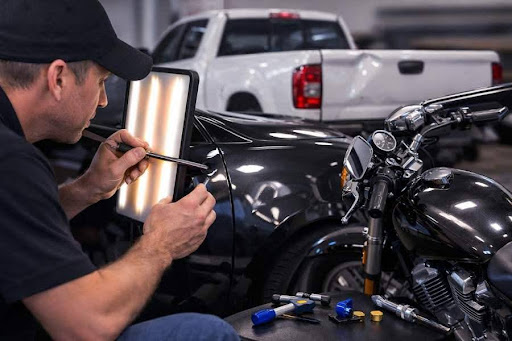
Every paintless dent repair begins with a thorough assessment. Technicians map the dent size, depth, and location; inspect for cracked paint or stretched metal; and determine whether body line damage or panel edges are involved. They’ll remove trim or use factory access points behind the panel and set up specialized LED reflection lighting to read the metal precisely. This step determines feasibility and helps estimate timelines and costs for the repairs and any insurance claim documentation.
Tool techniques and workflow
PDR uses two principal toolsets:
- Push methods: Skilled techs use steel rods, levers, and knockdowns from behind the panel to massage the dent out gradually.
- Glue pulling: When backside access is limited, they apply tabs with hot glue to the exterior surface and use controlled pulling to lift the dent, followed by a precise tap-down to level the area.
For hail dent repair and auto hail damage, technicians typically move panel by panel to keep uniformity. Door ding repair and small crease repair often take less than an afternoon, while larger multi-dent jobs may require a full day.
Quality checks and before & after
Throughout the process, reflection lighting and sightlines are used to verify contours. Shops frequently document before & after images—useful for customers, insurance companies, and lease inspections. Final quality checks ensure the dent removal meets the contour of adjacent panels, preserves the factory finish, and returns the vehicle’s appearance to pre-accident condition where possible.
When PDR wins over traditional body shop work: ideal dent types, cost and time comparisons, paint preservation, insurance, and lease-return advantages
Where PDR beats body shop repairs
- Ideal dent types: Round dents, hail damage clusters, soft body line damage with intact paint, and most parking-lot ding impacts are prime PDR candidates. Shallow creases often qualify for crease repair, particularly when there’s no paint fracture.
- Cost and time: Compared to conventional auto body repair that may require filler and repainting, paintless dent removal is typically less expensive and significantly faster. Many single-dent repairs are same-day, and hail dent repair programs are streamlined for volume and speed.
- Paint preservation: Keeping the original finish prevents color mismatch and overspray, maintains OEM corrosion protections, and helps preserve resale.
- Insurance and lease-return: Comprehensive insurance claim processes often favor PDR for auto hail damage because it reduces parts and materials costs. For lease returns, PDR helps avoid turn-in penalties by addressing each ding without repainting—often the smarter body shop alternative.
Typical Idaho turnarounds
- Door ding repair: 1–3 hours
- Small crease repair: 2–4 hours
- Multi-panel hail dent repair: 1–3 days, depending on volume and access
Limits of PDR: when cracked paint, sharp creases, panel edges, or stretched metal call for conventional repair and repaint
PDR is not a cure-all. Traditional auto body repair is warranted when:
- Paint is cracked, compromised, or excessively chipped.
- Sharp creases have stretched the metal beyond elastic recovery.
- Dents sit on panel edges, double-metal, or bracing with no viable access.
- Severe body line damage has torn or kinked the steel or aluminum.
In these cases, smart shops may combine techniques—using PDR to minimize filler work, then finishing with minor collision repair and repaint for optimal results.
What it costs in Idaho and how to choose a qualified PDR tech: price factors and ranges, insurance tips, mobile vs. shop service, certifications, and warranties
Pricing and how to pick a qualified tech
Costs vary based on dent size, depth, location, panel material (steel vs. aluminum), and the number of dents:
- Door ding repair and small ding removal often range from $125–$250 per dent.
- Moderate dents or accessible crease repair can run $200–$450.
- Hail dent repair is typically estimated per panel or per dent using industry matrices; total tickets range widely depending on storm severity.
Price factors also include whether trim removal is required, if there’s body line damage, and whether the vehicle has sound-deadening pads or double-metal that slow access. Motorcycle dent repair (e.g., gas tanks) and aluminum hoods often price higher due to complexity.
To choose a qualified PDR provider in Idaho:
- Look for certified technicians with industry-leading certifications such as ARC Master Certified (sometimes stylized arc master certified). In the Treasure Valley, you’ll see providers like Dr. Ding PDR, Gem State Dent Repair, and GemState PDR highlight credentials and training.
- Review before & after galleries to gauge consistency on complex dent removal.
- Ask about warranties and customer service policies; many family-owned shops tout satisfaction guaranteed programs on quality repairs.
- Confirm experience—over 10 years of experience is a good benchmark for advanced glue-pulling and body line work.
- Expect clear communication and quick quotes—often via photos or mobile inspections—for all makes & models.
In Boise, Garden City, Ada County, and Canyon County, several shops operate both brick-and-mortar facilities and mobile repairs. For example, Treasure Valley’s Premier Paintless Dent Repair Facility may host larger hail events, while mobile dent repair units handle driveway-friendly door ding repair across the metro. Some teams also serve Idaho Falls and outlying corridors toward Jackson Hole, WY, and West Yellowstone, MT during hail seasons.
Insurance, mobile vs. shop, and credentials
- Insurance tips: For auto hail damage under comprehensive, you can choose the repairer. File the insurance claim promptly after a storm, schedule an inspection, and request PDR when the paint is intact. Many shops coordinate directly with insurance companies to supplement and ensure all dents are captured.
- Mobile vs. shop service: Mobile repairs are ideal for single-dent removal and quick door ding repair; complex hail dent repair, aluminum panels, or extensive crease repair are often better handled in-shop for fixed lighting and controlled environments.
- Credentials and people: Look for ARC Master Certified technicians and shops led by recognized specialists. In Idaho, names like Eric Grubaugh and teams that publicize advanced training lend confidence. Verify that any body shop alternative claims are backed by proper tools, lighting, and documented processes.
When you match the right dent type to PDR, paintless dent repair preserves your factory finish, shortens downtime, and saves money compared to traditional auto body repair. For Idaho drivers dealing with a ding, hail damage, or small crease, paintless dent removal remains the first, best path to restore value—quickly and cleanly.
The post Paintless Dent Repair Idaho: How PDR Works And When It Beats Body Shop Repairs appeared first on Techenger.