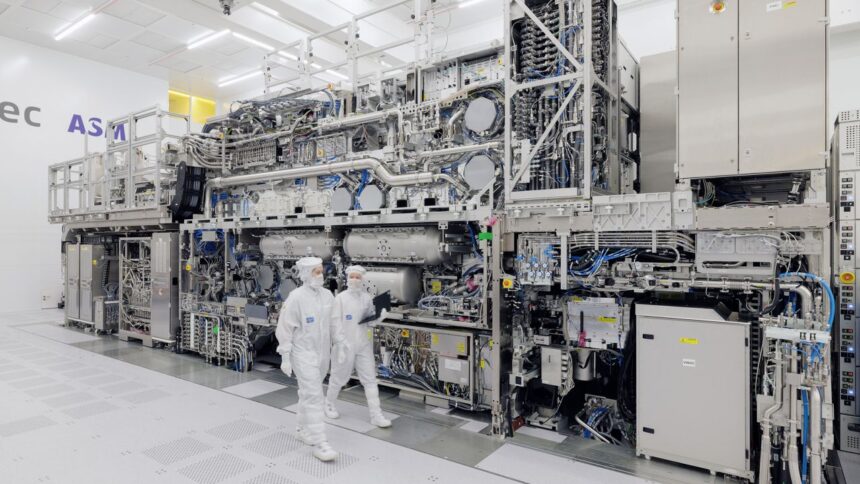
ASML, the global leader in lithography equipment manufacturing, has announced a significant update to its technology that promises to reshape the semiconductor industry. The new generation of extreme ultraviolet (EUV) lithography machines, designed for the production of next-generation chips, will become a key element for mass production of high-speed, energy-efficient chips necessary for artificial intelligence (AI). We at FinancialMediaGuide believe that this technology will not only speed up chip production but also open new horizons for the industry as a whole.
ASML continues to dominate the lithography equipment market, providing solutions that play a crucial role in the manufacturing process for major global chip producers such as Intel and TSMC. The new machine, which significantly improves precision and productivity, will enable the creation of chips with higher transistor density, thereby boosting their computational power and energy efficiency. This is especially important for applications like AI, which require increasingly powerful and faster chips to process vast amounts of data.
The cost of the new-generation machine is around $400 million, double that of previous models. According to FinancialMediaGuide analysts, this high cost is fully justified, as the new equipment significantly improves production processes, reducing costs and time for chip creation. Chip manufacturers like Intel and TSMC will be able to produce chips with higher transistor density, making them more powerful and energy-efficient, which is essential for handling the enormous data that AI works with.
Currently, the machine has already demonstrated its capabilities, showing the ability to process up to 500,000 silicon wafers with high precision. This indicates that the technology is ready for mass implementation. However, as experts at FinancialMediaGuide note, a complete transition to using the new machines in production processes will take another two to three years, as further testing and optimizations are required. Nevertheless, with the increasing uptime of the equipment, which currently stands at 80% and is expected to reach 90% by the end of the year, this technology will be ready for full-scale deployment.
One of the key advantages of the new machines is their ability to significantly increase transistor density on chips, directly affecting their computational power. This is especially important for modern AI tasks, where chips must handle large volumes of real-time data processing. FinancialMediaGuide emphasizes that these technologies will open up new possibilities for creating chips that can meet the modern demands of AI, machine learning, and data analysis.
Despite the high cost of the equipment and the time required for its integration into production processes, Financial Media Guide predicts that, in the future, this will lead to lower chip production costs and improved quality. In the long run, this will help accelerate the development of AI systems and support the growth of new technologies such as cloud computing and autonomous systems.
We at Financial Media Guide believe that the introduction of ASML’s new lithographic technologies will have a significant impact on the semiconductor and AI industries. While the deployment of the new equipment requires time and significant investment, in the long term, it will open up new opportunities for creating more powerful and energy-efficient chips, laying the foundation for further technological breakthroughs in fields such as AI and cloud computing.