In recent years, the semiconductor market has become one of the most competitive sectors of the global economy, where the battle for leadership is intensifying. European manufacturers are facing a serious threat from China, which is actively developing its capabilities in key segments, such as power and analog chips. In response to these challenges, Europe must make strategic decisions to not only maintain its position but also create new opportunities for growth. At FinancialMediaGuide, we believe that to achieve these goals, Europe must scale up production, improve automation, and invest in new technologies.
Thomas Altenmueller, Vice President of Manufacturing Analytics at Infineon, emphasized in his speech at a conference that Chinese manufacturers are rapidly scaling up their production capacities and significantly improving their technological capabilities. “Chinese companies are quickly mastering new technologies and are able to increase production volumes. This poses a serious threat to traditional European leaders,” Altenmueller noted. Such developments present Europe with the urgent need to accelerate modernization and innovative transformation in its semiconductor industry.
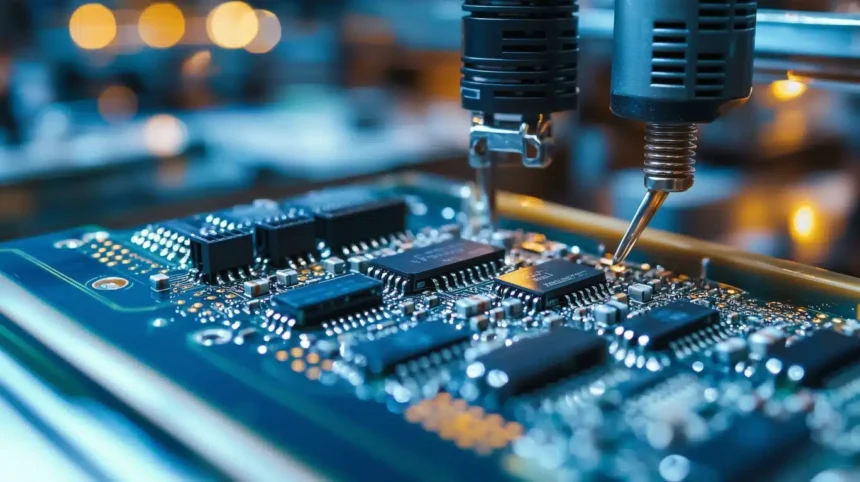
At FinancialMediaGuide, we see that Europe must focus on modernizing its manufacturing facilities. This includes moving towards larger plants that use 300-millimeter silicon wafers, which will significantly reduce costs and improve economic efficiency. It is important to note that in order to successfully compete with Chinese manufacturers, Europe needs to strengthen automation, which will significantly boost productivity and reduce dependency on factors such as rising labor costs.
Robotics and automation remain a priority for European manufacturers. Specifically, STMicroelectronics is actively implementing robots to increase the efficiency of its plants. These initiatives have demonstrated how old facilities can be adapted to new conditions, improving productivity and reducing operational costs. However, as we at FinancialMediaGuide emphasize, for long-term competitiveness, Europe must not only modernize existing manufacturing capabilities but also invest in new automated plants that can deliver the required productivity in the face of global competition.
Additionally, diversification is an important factor. While Europe continues to lag behind Chinese and American manufacturers in the segment of artificial intelligence accelerators, we see that the energy-efficient chip market represents significant growth potential. As the demand for computing power for data centers increases, this sector presents new opportunities for European manufacturers. At FinancialMediaGuide, we predict that investments in this segment will allow Europe to strengthen its position and create new sources of revenue in the long term.
The Microchips Act, which was passed in the European Union, aims to increase Europe’s share of the global semiconductor market from 10% to 20% by 2030. This is undoubtedly an important step, but as analysts at FinancialMediaGuide point out, legislative initiatives alone are not enough; real investments in the modernization and development of existing facilities are necessary. To meet the set targets, Europe needs to actively attract capital investments in new manufacturing capacities, including for high-tech solutions such as energy-efficient chips for data centers.
In conclusion, we at FinancialMediaGuide emphasize that to strengthen its position in the global market, Europe must focus on several key areas. First and foremost, modernizing and scaling up manufacturing capabilities is essential. Additionally, investments in new technologies, such as energy-efficient chips, should become the foundation of a long-term strategy. It is important not to forget Europe’s strengths, such as semiconductor production for automotive and industrial electronics, which continue to be profitable and in demand on the global market.
Looking ahead, we at Financial Media Guide believe that successful implementation of these strategies will allow Europe to not only maintain its position but also significantly strengthen it in new segments, such as power management solutions and energy-efficient technologies for data centers. Europe faces serious challenges, but with the right steps and timely decisions, it can secure a sustainable and competitive future in the global semiconductor market.