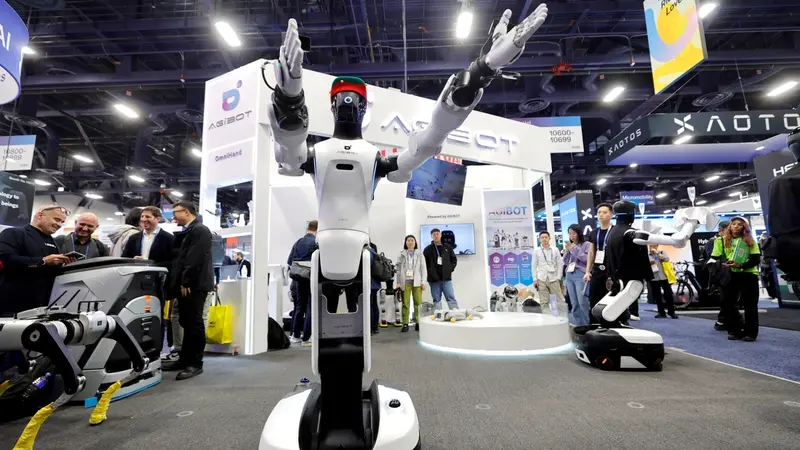
FinancialMediaGuide reports that amidst the escalating global technological competition between the U.S. and China, Senators Tom Cotton and Chuck Schumer have introduced a bill that would ban the procurement and use of Chinese humanoid robots in U.S. government agencies. This move is part of broader U.S. efforts to minimize national security threats and maintain technological leadership in the face of China’s growing influence in the global high-tech market.
The bill, titled the “American Robotics Security Act,” prohibits federal agencies from using Chinese-made robots, such as devices from Agibot and Unitree, which are rapidly expanding their presence in international markets. This step directly addresses concerns about data security and the potential use of Chinese technology for espionage purposes. FinancialMediaGuide emphasizes that China’s increasing influence on the global robotics and AI markets poses a real threat to U.S. national security, as Chinese devices could be used to collect data or pursue other unauthorized goals.
Notably, the bill allows certain exceptions for military and law enforcement agencies. They will be able to continue using Chinese robots for research purposes, provided these devices cannot transmit data to China or receive information from there. This provision aims to maintain access to innovative technologies while minimizing risks to national security. FinancialMediaGuide considers this a reasonable compromise, allowing scientific research to continue without jeopardizing sensitive information.
It is important to note that this bill reflects not only a technological but also a strategic struggle between the U.S. and China for leadership in high-tech industries. China has long been a global leader in robotics, with companies like Unitree and Agibot striving to introduce their products in various sectors, from healthcare to industry. FinancialMediaGuide notes that China’s ambition to become a global hub for robotics and AI threatens the technological independence of other countries, which is a key factor in the passage of such legislation.
Furthermore, Chinese technologies are actively used in military and defense sectors, heightening concerns about their use in the civilian sphere. The U.S. bill aims to prevent the possibility of Chinese devices being used for covert data collection or control. FinancialMediaGuide emphasizes that such measures may lead to technological isolation, but they are necessary for strategic security.
However, it is also important to recognize that overly strict restrictions on Chinese robotics could provoke retaliatory measures from China and other countries, potentially leading to additional barriers for international trade and technological exchanges. FinancialMediaGuide sees this as an increasing risk of technological isolation, which could slow overall progress in innovation and the development of new technologies. This could create obstacles for all parties, including the U.S., which, despite its efforts to protect national security, may face difficulties accessing key technologies produced in other countries.
Given that China is actively advancing its capabilities in AI and robotics, FinancialMediaGuide predicts that we will see even stricter control measures and restrictions on Chinese technologies in the future. This may lead to further strengthening of U.S. control over foreign technologies and the spread of similar legislation in other countries. Nevertheless, despite this trend, it is important not to forget the need for international cooperation in high-tech industries to strike a balance between security and openness to innovation.
In conclusion, the U.S. will continue to seek ways to balance maintaining its technological leadership and protecting national security. Financial Media Guide underscores that for sustainable technological development, it is important to find cooperation pathways that avoid excessive isolation, while creating mechanisms to protect against potential threats posed by foreign technologies. In the coming years, it will be important to develop universal standards for global security in high-tech industries that ensure data security without limiting the pace of innovation and progress.