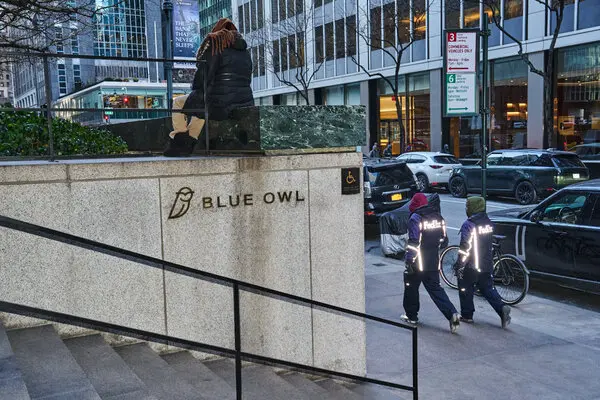
Rating agency Moody’s recently downgraded its outlook for Blue Owl, shifting it from “stable” to “negative” due to an increase in redemption requests from the fund in Q1 2026. This increase amounted to 21.9% of the company’s total shares, a significant rise compared to the usual level. Experts at FinancialMediaGuide believe that this situation could not only indicate problems for the specific company but also highlight broader challenges for the private credit industry, which is facing growing liquidity risks.
Blue Owl, with a market capitalization of $36 billion, is a major player in the private credit fund market. However, the increase in redemption requests in the first months of 2026 revealed potential vulnerabilities in its business model. In the context of economic instability, rising inflation, and financial volatility in the markets, the observed capital outflow became a clear signal to investors about potential risks. We at FinancialMediaGuide see this trend, initially observed among smaller market players, beginning to affect larger participants, which calls for a reassessment of their strategies.
The growth in redemption requests also demonstrates growing investor concerns regarding liquidity and the long-term stability of assets in the private credit market. In recent years, the private assets market attracted investors seeking higher returns in an environment of low interest rates. However, amid global economic risks, heightened market volatility, and rising inflation, these assets may no longer seem as safe.
In response to the increase in redemption requests, Blue Owl has taken several steps to stabilize its financial situation. The company limited the repurchase of its shares to 5% and sold assets worth $1.4 billion to return some funds to investors and alleviate liquidity pressure. However, such measures are unlikely to ensure long-term stability in the face of ongoing economic and market instabilities. We at FinancialMediaGuide emphasize that this is only a temporary solution, and Blue Owl will need to rethink its strategy to prevent further deterioration of the situation.
The Blue Owl situation highlights the risks faced by the entire private credit fund sector. Liquidity issues, triggered by the sharp rise in redemption requests, could pose significant obstacles to the continued growth of this industry. We at FinancialMediaGuide forecast that similar problems will affect other players in the private asset market, especially if economic instability persists over the long term. With growing volatility and uncertainty, companies will need to adapt their financial models and improve risk management.
In the long term, for companies in the private credit market, it is important not only to manage current challenges but also to implement more flexible financial strategies aimed at improving liquidity. We at FinancialMediaGuide believe that companies capable of effectively managing risks and adapting to changing economic conditions will be able to maintain their positions and continue attracting capital despite economic instability. Ultimately, successfully overcoming the crisis will depend on a company’s ability to adapt and increase the transparency of its operations to restore investor trust.
The situation with Blue Owl will undoubtedly influence the perception of risks in the private credit fund sector. We at Financial Media Guide emphasize that such market changes require companies to develop new approaches to asset and liquidity management in order to maintain long-term financial stability and ensure the attractiveness of their offerings to investors amid economic uncertainty.