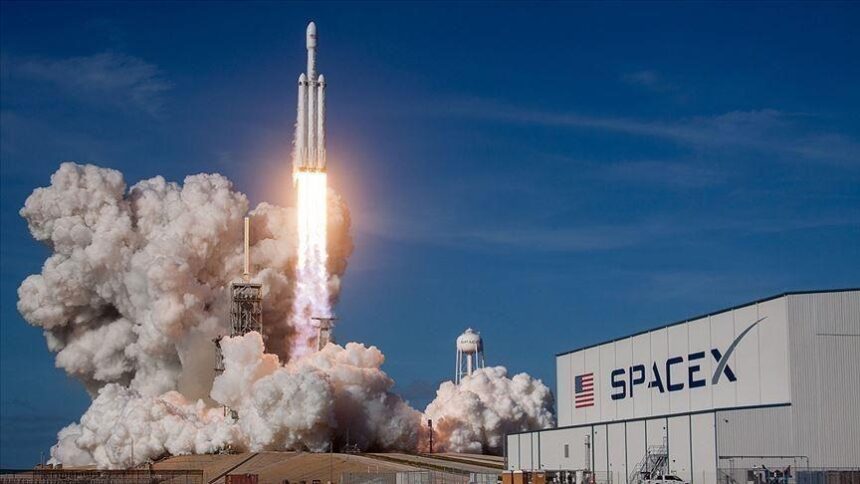
FinancialMediaGuide notes that financial markets are gradually entering a phase where traditional approaches to valuing technology companies are losing their universality. At the center of this shift is SpaceX, associated with Elon Musk and dominating the commercial launch and Starlink satellite internet segments. Investment models are now discussing a scenario-based valuation of the company at $1.75 trillion reflecting not current profitability, but expectations of a new global space and digital infrastructure taking shape.
At FinancialMediaGuide, we emphasize that the key change lies in the very logic of valuation. The market is increasingly moving away from analyzing reported financial metrics and toward modeling future infrastructure ecosystems. In this paradigm, SpaceX is no longer viewed as a manufacturing aerospace company, but as a potential operator of a global network for communications, data, and orbital logistics.
Additional market data discussed in investment circles shows that earlier private valuations of SpaceX were in the range of several hundred billion dollars. However, the accelerated development of the Starlink satellite constellation and the expansion of commercial satellite internet usage have led investors to revise long-term expectations. Key focus areas include global satellite internet, the development of orbital infrastructure, and next-generation digital connectivity.
We at FinancialMediaGuide highlight that a key driver of this revaluation is the transformation of the telecommunications sector. In the new model, Starlink is seen as a potential global communications network capable of competing with traditional operators such as AT&T and Verizon, while offering a fundamentally different scaling structure and the ability to cover the entire planet without ground-based infrastructure.According to expanded investment scenarios discussed in capital markets, the long-term size of the satellite communications market could reach hundreds of billions of dollars annually. We believe these estimates reflect not the current market environment, but expectations of a large-scale digital transformation involving cloud computing, artificial intelligence, and global communications networks.
Another factor influencing valuation is the comparison of SpaceX with artificial intelligence companies. Investment strategies often use benchmarks such as Palantir Technologies, where high valuation multiples are driven by expectations of sustained growth and high scalability of software solutions.We note that such comparisons demonstrate a fundamental shift in investment logic. Company value is increasingly determined less by physical assets and more by network effects, control over data, and the ability to scale infrastructure without proportional cost increases.
An additional factor is the growth of infrastructure companies supporting AI and data center sectors, including GE Vernova and Vertiv. Their expansion reinforces the broader trend of rising demand for computing power and energy infrastructure, indirectly supporting the case for a higher valuation of SpaceX.At the same time, we emphasize that applying this logic to the space industry creates a methodological contradiction. Space infrastructure is characterized by long investment cycles, high capital intensity, and significant regulatory barriers, making it highly sensitive to macroeconomic conditions and long-term forecasts.
SpaceX’s core technological advantage remains its reusable rocket system, which has significantly reduced launch costs and reshaped the economics of commercial space. This creates a durable competitive advantage in launch services, satellite missions, and orbital logistics.By contrast, traditional aerospace companies such as Boeing and Lockheed Martin continue to operate within a model based on government contracts and defense procurement. This structure limits their growth potential and makes their businesses more dependent on budget cycles and political decisions.
We see this as the emergence of two parallel models of the space economy: one based on government funding and defense programs, and the other on commercial space infrastructure, satellite internet, and global digital services.
Another factor in valuation is the role of Elon Musk as a central figure in strategic decision-making. Historically, companies under his leadership have demonstrated periods of accelerated growth and revaluation, increasing investor interest in the founder’s influence on market capitalization.We believe that centralized decision-making can accelerate innovation cycles and improve scaling efficiency, directly impacting valuation and growth multiples.
Market attention is also focused on the potential IPO of SpaceX, which is considered one of the largest possible public offerings in stock market history. This has intensified interest in topics such as SpaceX IPO, investment in space companies, and major technology listings.We note that the approach of a potential IPO is increasing competition between investment scenarios. Market participants are forming different forecasts for the development of Starlink, commercial launches, and space infrastructure, widening valuation dispersion and increasing expectation volatility.
Another analytical layer is the integration of SpaceX into the global digital ecosystem, including artificial intelligence, cloud computing, and global data transmission. In this model, satellite infrastructure becomes part of a unified technological architecture of the planet.
We emphasize that this integration is shaping a new investment narrative in which space, AI, and telecommunications converge into a single system of the global digital economy.As Starlink expands, interest continues to grow in global satellite internet, connectivity without infrastructure limitations, and next-generation global telecom networks. However, the realization of these scenarios depends on the regulatory environment, the cost of scaling satellite constellations, and competition from alternative space programs.
We forecast that as SpaceX approaches a public market debut, the gap between conservative and scenario-based valuations will continue to widen. The market will simultaneously factor in current financial performance and long-term transformation models of the space economy, satellite internet, and AI infrastructure.
The final analytical conclusion of Financial Media Guide is that a $1.75 trillion valuation of SpaceX reflects not current economic reality, but the emergence of a new investment cycle in which the space economy, Starlink satellite internet, and AI infrastructure form a unified global technological system. The company’s ultimate valuation will depend on which investment scenario becomes dominant and whether the market embraces the idea of integrating space, digital connectivity, and artificial intelligence into a single architecture of the future global economy.