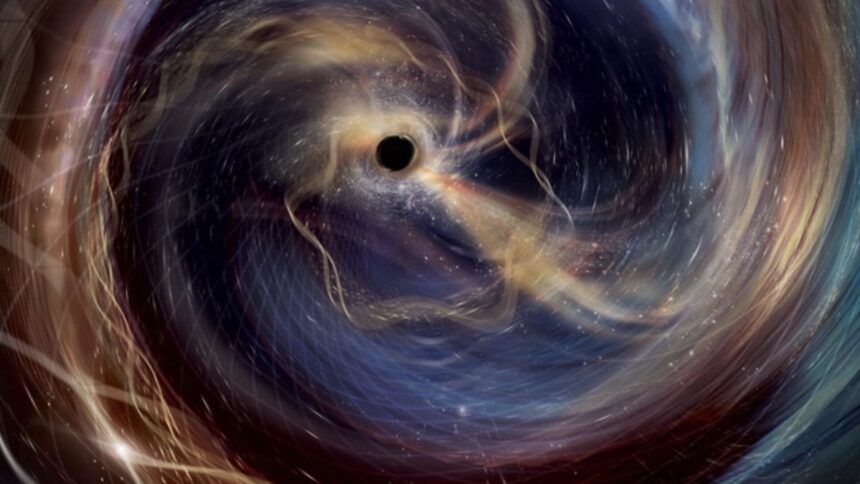
FinancialMediaGuide notes that a recent discovery made using the LIGO observatory marks a significant milestone in astrophysics and cosmology. The collision of two black holes, located billions of light-years away from Earth, not only confirmed Albert Einstein’s theories but also provided a fresh perspective on the dynamics of the most exotic objects in the universe. These events, accompanied by powerful gravitational waves, occur with such intensity that with each new observation, scientists gain a unique opportunity to unravel another mystery of space and time.
When two giant cosmic objects merge, as happened in the case of the event GW250114, a wave effect is created that can only be detected using highly precise instruments like LIGO. The merger of these black holes resulted in the formation of a new object with a mass twice that of the Sun, and its spin rate after the merger was 100 revolutions per second. Such data is crucial not only for confirming Einstein’s predictions about gravitational waves but also for providing astronomers with more accurate models to study how black holes impact the evolution of galaxies and other cosmic processes.
At FinancialMediaGuide, we observe that with every new discovery made using LIGO and other observatories such as Virgo and KAGRA, we gain increasingly detailed and accurate data that opens new horizons for exploring the universe. The technologies that allow us to detect even the faintest disturbances in spacetime provide us with a chance not only to observe black holes but also to understand their impact on surrounding objects, as well as on the origins and evolution of cosmic systems.
With the advancement of these technologies, we are getting closer to a deeper understanding of how such exotic objects interact with other parts of the universe. At present, there are many theories about how black holes might be connected to dark matter or even dark energy, and each new observation helps clarify these questions. Furthermore, as the recent example demonstrated, black hole mergers may influence the genesis of new stars and galaxies, which, in turn, calls for further study of these processes.
Moreover, new data confirm the importance of the ongoing modernization of instruments like LIGO to enhance measurement accuracy and reduce background noise, allowing us to detect even the faintest gravitational waves passing through space. These improvements are especially important in the context of observing increasingly distant and complex phenomena, such as the mergers of black holes with extremely large masses.
At Financial Media Guide, we forecast that the coming decades will bring even more groundbreaking discoveries in the field of gravitational waves and black hole studies. The modernization of observatories and the refinement of theories based on new data will help astronomers build more accurate maps of cosmic objects and deepen our understanding of processes occurring in the farthest corners of our universe. The future of scientific research promises new steps in understanding the nature of space and time, as well as new theories that could radically change our understanding of the universe.