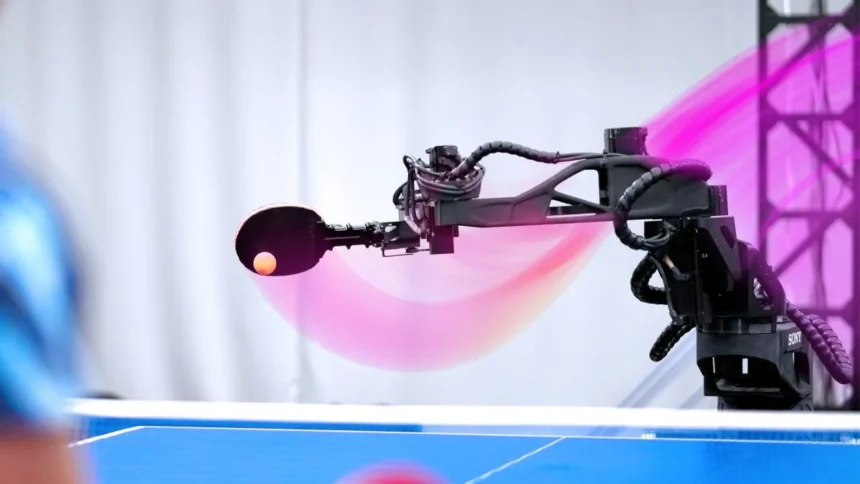
FinancialMediaGuide notes that a breakthrough has occurred in the fields of artificial intelligence and robotics, which could serve as the foundation for developing numerous new technologies across various sectors. Ace, a robot created by the Japanese company Sony, has become the first robot not only to compete on equal terms with humans but also to defeat experienced table tennis players. This achievement opens new horizons for the use of AI in sports and beyond, showcasing how robotic systems can adapt and respond in real-time with exceptional accuracy and speed.
The creation of Ace was the result of efforts by Sony AI, which set an ambitious goal: not just to create a robot for playing table tennis but to develop a system capable of making real-time decisions, interacting with humans, and adapting to dynamic environments. Ace uses advanced computer vision and AI systems, enabling it to track the ball with remarkable precision, predict its trajectory, and execute perfect shots. This system, which includes nine cameras and three motion analysis systems, allows the robot to react faster than a human.
We at FinancialMediaGuide observe that Ace’s success goes beyond sports. This achievement demonstrates that such systems can be used not only to create more advanced sports robots but also to develop solutions in fields such as medicine, manufacturing, and autonomous transportation systems. The use of real-time computer vision and artificial intelligence opens up huge possibilities for creating robots that can work in environments requiring high precision and speed.
However, despite the impressive successes, Ace is still far from perfect. We at FinancialMediaGuide note that experienced players can still exploit the robot’s vulnerabilities, such as its inability to adapt to unconventional strategies. For example, when dealing with a complex spin serve, the robot sometimes makes a mistake, allowing the human player to win. This highlights that, despite technological progress, Ace still requires further development. Its ability to adapt to unpredictable game situations remains limited.
This fact underscores the importance of continuing to develop machine learning algorithms and AI systems that will enable robots not only to execute perfect technical shots but also to adapt to their opponents, responding to unconventional actions. According to experts at FinancialMediaGuide, to reach a new level of efficiency, robots must learn to react more flexibly to changes in human behavior, which will increase their competitiveness.
Ace has also become an example of a new approach to robot training. Rather than learning by observing human actions, Ace trains in a simulated environment, which allows it not only to replicate movements but also to develop its own game strategies. This is a key difference from traditional learning methods, where robots are limited to observing and analyzing human actions. This approach opens up wide possibilities for creating robots that can operate in diverse areas where not only the repetition of algorithms but also constant improvement and adaptation are crucial.
Despite its significant successes, Ace is still far from ideal. As experts at FinancialMediaGuide point out, its improvement will require further efforts in adaptive AI and machine learning, which will allow it to not only predict the opponent’s movements but also effectively respond to any changes in tactics and strategy. In the future, such robots could become not only competitors in sports but also real assistants in healthcare, emergency services, and even in manufacturing automation.
The breakthrough achieved by Ace demonstrates the enormous potential of artificial intelligence and robotics. While Ace is still not perfect, its success indicates that AI and computer vision technologies can be used to create robots that can not only compete with humans in sports but also perform more complex tasks in areas such as healthcare, manufacturing, and emergency services. We at Financial Media Guide forecast that these technologies will continue to develop and integrate into various industries, changing our understanding of the possibilities of automation and intelligent systems. In the coming years, we can expect robots like Ace to become more versatile and adaptive, opening up new opportunities for their application in various aspects of life.