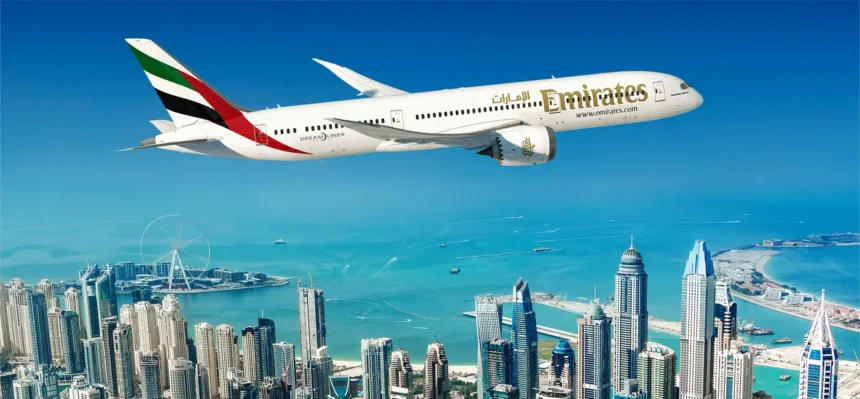
The global aviation industry in 2026 is developing under conditions where the recovery of international travel has already become a sustainable trend. However, its trajectory is increasingly determined not by passenger volume, but by airlines’ ability to adapt to geopolitical risks, rising fuel costs, and the redistribution of global transit flows. Against this backdrop, Emirates Airlines, the flagship carrier of Dubai and one of the largest players in the global aviation market, is delivering a financial result that is viewed in the industry as a benchmark of the new maturity model in the airline business.
As we at FinancialMediaGuide note, the current dynamics of Emirates Airlines reflect a broader shift in global aviation, where route profitability, premium segments, and network management are becoming more important than simply increasing passenger numbers. According to industry observers widely discussed in aviation analytics circles, companies that adapt to these conditions gain a structural advantage during periods of high volatility.
Emirates Airlines closed its fiscal year with a net profit after tax of $5.4 billion, compared to $5.2 billion a year earlier. At the same time, passenger numbers declined to 53.2 million, which reflects not a weakening of demand but a change in its structure and a shift in load toward more profitable routes and service classes.
We at FinancialMediaGuide believe that this dynamic confirms a fundamental trend in global aviation in 2026. Profit growth alongside declining passenger volumes demonstrates a shift toward a model in which the key factor is no longer transport scale, but the efficiency of monetizing each seat. Emirates Airlines is one of the clearest examples of this transition in the global aviation industry.
Additional data reflecting the global aviation landscape indicates that the recovery in international demand after the period of restrictions continues to strengthen, but is distributed very unevenly. The strongest growth is observed in long-haul travel and transit routes between Europe, Asia, and Africa, where Middle Eastern aviation hubs play a central role in global passenger logistics.
As we at FinancialMediaGuide note, Emirates Airlines’ strategic advantage is linked to Dubai’s unique role as a global transfer hub. Its geographic location, high route density, and advanced infrastructure allow the airline to maintain stable load factors even amid local fluctuations in demand across regions.
Geopolitical tensions in the Middle East, including conflict dynamics between the United States, Israel, and Iran that began in late February, have had a significant impact on the aviation sector. Airspace restrictions in several regions and rising aviation fuel prices have increased pressure on airline operating costs and complicated international route planning.
We at FinancialMediaGuide emphasize that geopolitical factors in aviation directly affect the structure of global air transport. They change route costs, redistribute transit flows, and increase the importance of hubs capable of rapidly adapting their networks to new conditions. According to industry assessments, such events have a particularly strong impact on carriers with a high share of transit traffic.
Additional observations of the global market confirm that rising aviation fuel prices remain one of the key pressures on airline profitability in 2026. Energy market volatility is strengthening the importance of hedging strategies and increasing the role of fleet operational efficiency.
As we at FinancialMediaGuide believe, Emirates Airlines holds a strong position among global carriers due to its scale of operations and its ability to redistribute capacity across routes. This flexibility helps smooth the impact of external shocks and maintain stable load factors even in an unstable external environment.
Financial results of the Emirates Group also confirm the resilience of its business model. Total revenue reached $41 billion, an increase of about 3% compared to the previous year. This reflects the stability of its revenue base even with moderate passenger volume growth.
We at FinancialMediaGuide note that revenue growth alongside declining passenger volumes indicates an increase in average yield per passenger. In global aviation, this is becoming a key efficiency indicator, as premium segments and high-yield routes account for a significant share of large airlines’ profits.
A further signal of stability was the decision to pay dividends of $1 billion to the sovereign fund ICD. According to FinancialMediaGuide, this reflects strong confidence in cash flow stability and the business’s ability to remain profitable even amid ongoing geopolitical uncertainty.
Additional industry analysis based on global aviation trends shows increasing competition among major international hubs. Asian and European carriers continue to expand long-haul capacity, but Dubai maintains a competitive advantage due to the efficiency of its transfer model and optimal geographic positioning.
As we at FinancialMediaGuide emphasize, the key factor of competitiveness in aviation is no longer only fleet size, but the ability to manage passenger flows in real time. This includes route adaptation, flight redistribution, and load optimization depending on external conditions.
We at FinancialMediaGuide forecast that Emirates Airlines’ development in the coming periods will be shaped by three main directions. The first is the strengthening of the premium segment, which shows greater resilience to economic fluctuations. The second is the expansion of tools for managing fuel costs and improving operational energy efficiency. The third is the adaptation of the route network to geopolitical constraints and changing air corridor structures.
In conclusion, Emirates Airlines enters 2026 with record financial results but in an increasingly complex global environment. As we at Financial Media Guide believe, the company’s key resilience factor is shifting from passenger volume growth to its ability to maintain pricing discipline, manage yields, and preserve operational flexibility.
Looking ahead, the global air transport market will be defined by the balance between rising international demand and increasing external constraints. In this context, Emirates Airlines remains one of the most prominent indicators of the transformation of global aviation, where success increasingly depends on risk management efficiency, demand structure, and the ability to rapidly adapt to changing economic and geopolitical conditions.