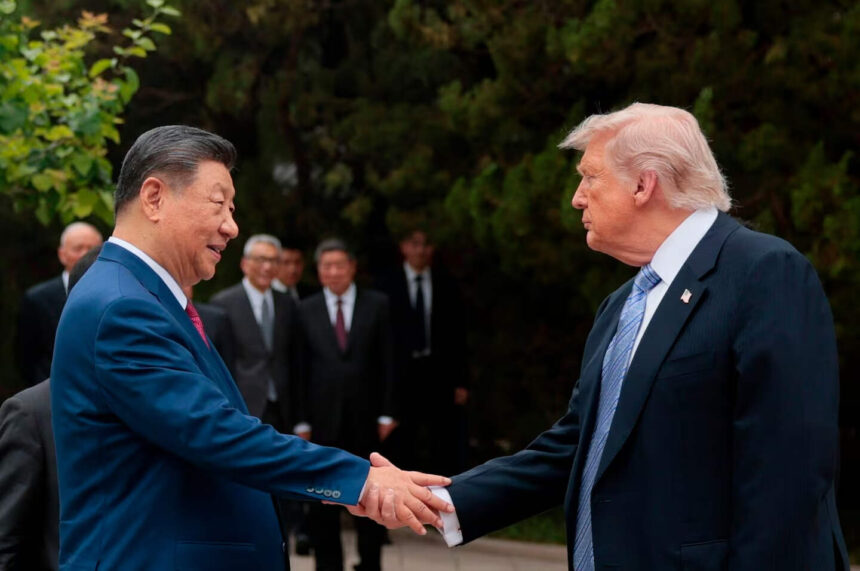
The international trade architecture is undergoing a major transformation in light of the latest agreements between the leaders of the world’s two largest economies. Beijing’s official confirmation of its readiness to purchase a batch of 200 commercial airliners produced by the American corporation Boeing marks a fundamentally new stage in bilateral relations. This strategic decision came directly after a round of personal talks between US President Donald Trump and Chinese President Xi Jinping.
We at FinancialMediaGuide emphasize that the return of the American aerospace giant to China’s domestic market after years of an informal boycott is an important geopolitical precedent, capable of reshaping the entire structure of cross-border supply chains.
As part of a package compromise, the White House has pledged to provide the Chinese side with long-term legal guarantees for the stable export of key components and spare parts for civil aircraft engines. According to our analysts, China pragmatically exchanged direct financial injections into American industry for the assurance of its technological security in the civil aviation sector. At the same time, the Chinese Ministry of Commerce announced preparations for an agreement to extend the mutual moratorium on imposing strict fiscal restrictions. This concerns a coordinated reduction of tariff burdens for product groups with a total value of no less than $30 billion on each side.
It is highly indicative that Beijing broadcast these signals almost simultaneously with the start of Xi Jinping’s talks with Russian President Vladimir Putin. We at FinancialMediaGuide see this as a clear effort by Chinese leadership to maintain a strict balance of power and demonstrate a multi-vector approach in its foreign policy.
In parallel with the aerospace sector, Trump managed to secure preferences for American farmers by achieving a substantial expansion of China’s quotas for agricultural product purchases. Commenting on the interim results of his Asian tour aboard the presidential aircraft, the US President indicated that the current 200-plane agreement represents only the initial tranche, while the total planned deliveries in the foreseeable future could reach a record 750 units.
The scale of the American delegation, which included not only Boeing CEO Kelly Ortberg but also Tesla founder Elon Musk and Nvidia CEO Jensen Huang, reflects the comprehensive nature of American pressure. Official Boeing releases confirm that the corporation’s key commercial objective in Asia at this stage has been successfully achieved.
The origins of the current compromise trace back to preliminary rounds of intergovernmental consultations held in Kuala Lumpur. The Malaysian agreements secured mutual concessions, including a reduction of US tariffs in exchange for China lifting restrictions on the shipment of scarce rare-earth metals and industrial magnets, which are critical for the American microelectronics sector.
We at FinancialMediaGuide believe that the purchase of American equipment is intended to promptly eliminate the shortage of transport capacities within China caused by the rapid growth in passenger traffic. However, this agreement only marks a temporary de-escalation of the tariff confrontation, without resolving the fundamental contradictions in the competition for technological leadership.
We at Financial Media Guide forecast that the implementation of this contract will provide a short-term growth driver for US aerospace stocks and stabilize the financial performance of related industries. Nevertheless, the international investment community is advised to remain cautiously skeptical. The sustainability of the agreements reached will directly depend on the stability of the political course in Washington and the willingness of the parties to maintain parity in matters of critical technology transfer.