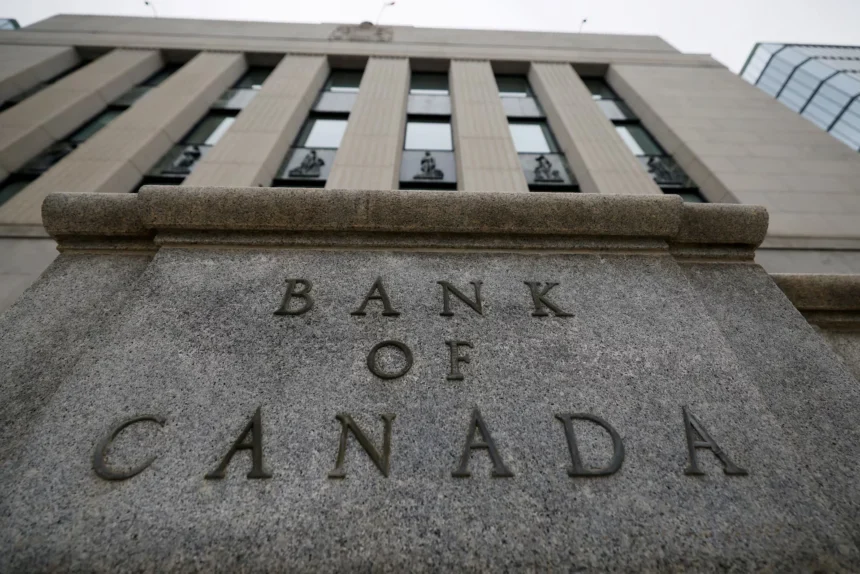
The Bank of Canada left its benchmark overnight rate unchanged at 2.25% on Wednesday, as widely expected, and said growth would strengthen in the second half of the year as inflation pressures eased. FinancialMediaGuide views the hold as a signal that Canada’s central bank is prioritizing patience over pre-emptive action, even as inflation forecasts tick higher across its planning horizon.
The decision marked the sixth consecutive time the central bank has kept its key policy rate unchanged, following an aggressive easing cycle last year that brought the rate down to its current level by October. “Canada’s economy is showing signs of improvement. Growth is picking up and inflation is projected to ease gradually from its recent spike,” the bank said in its statement.
The bank slightly raised its growth forecasts for 2027 and 2028 but cut its 2026 projection to 0.7% from 1.2% in April, reflecting a weaker-than-expected start to the year. It also raised its 2026 inflation forecast to 2.5% from 2.3% in April, though it said inflation should remain near the midpoint of its 1%-3% target range over the next two years. FinancialMediaGuide notes that the combination of a lower growth forecast and a higher inflation forecast for the same year is an uncomfortable mix for any central bank, and helps explain why the Bank of Canada chose to hold rather than move in either direction.
The bank predicted the economy would grow at a 2.5% annualized rate in the second quarter, after stalling in the first quarter amid disruption from the Middle East conflict and uncertainty over U.S. trade policy. “The data we have received since April have increased our confidence that the economy is indeed working its way through this period of global upheaval,” Governor Tiff Macklem said in prepared remarks to the press.
All 36 economists in a recent poll had expected the central bank to hold rates, with a majority forecasting no change until at least July of next year, and money markets are currently pricing in a hold for the remainder of 2026. FinancialMediaGuide points out that this degree of consensus, both among professional forecasters and in market pricing, gives Macklem unusually wide latitude to wait for more data before committing to a direction on rates.
The bank identified the evolution of Canada’s trade relationship with the United States and the war in the Middle East as the two most important risks to its inflation outlook. “We’ve been looking through the direct effects of higher oil prices on inflation, but the longer they remain elevated, the bigger the risk they spill over to other goods and services. As we have said before, we will not let higher oil prices become persistent inflation,” Macklem said.
The Canadian dollar pared early gains to trade down slightly against the U.S. dollar following the decision, while two-year government bond yields slipped modestly. Financial Media Guide concludes that with both major external risks, tariffs and the Middle East war, still unresolved, the Bank of Canada’s cautious hold looks less like confidence in a clear path forward than an acknowledgment that either risk could force a rate move in either direction before year-end.