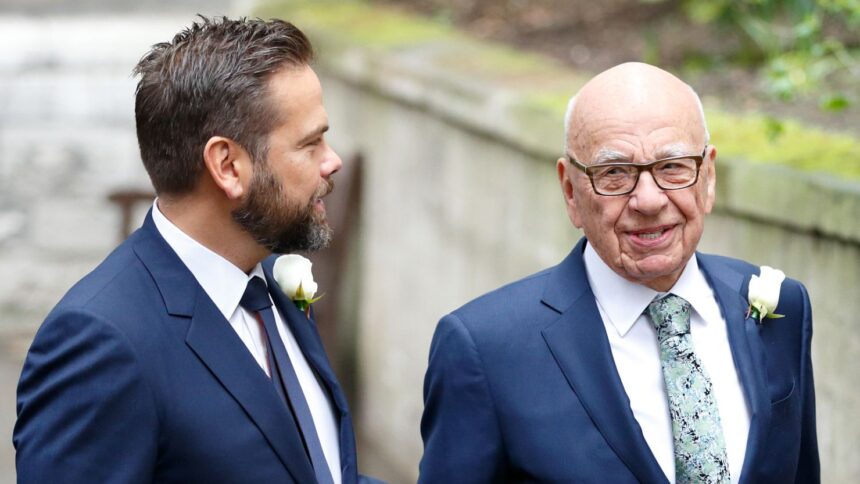
FinancialMediaGuide notes that Rupert Murdoch, despite his advanced age, remains one of the most influential media moguls in the world. However, behind the scenes of his media dynasty, a significant drama is unfolding – a family conflict that threatens not only personal relationships but also the strategy of some of the largest global media assets. The family rift between Rupert and his children continues to have a profound impact on the future of Fox Corp and News Corp, making the management of these media companies increasingly unstable.
According to analysts at FinancialMediaGuide, Rupert Murdoch’s decision to pass control of the family business to his eldest son Lachlan, as well as his interference with the trust originally designed to equally distribute power among his children, has significantly shifted the balance of power within the family and the corporation. This move marked the final chapter in a long and painful legal battle, which ended in an agreement where James, Elizabeth, and Prudence were officially excluded from managing the family business.
The division of shares and the modification of the trust were not only legal but also emotional milestones. The approximately $1 billion in compensation received by each child could not compensate for the feelings of betrayal they experienced. We at FinancialMediaGuide observe that this has created an insurmountable rift between Rupert and his children, a divide that will likely persist for a long time.
Meanwhile, Lachlan, who was chosen to lead the empire, has demonstrated his ability to guide the company through major transformations in recent years. He has notably strengthened Fox Corp’s position in digital media, particularly through the development of the Tubi streaming service. The success of Tubi stands as one of the prime examples of how Lachlan, unlike his father, is focused on profitability rather than political influence. However, as experts point out, his leadership remains clouded by the need to justify his father’s decisions, as many in the industry still view him as Rupert’s successor.
Despite business successes, Lachlan will need to not only solidify Fox’s position in the digital media world but also free himself from the shadow of his father. As we at FinancialMediaGuide see it, Lachlan faces the challenge of overcoming a sense of “inheritance” from Rupert, which makes independent decision-making particularly difficult. The lack of decisive leadership in this context could negatively impact the company’s internal corporate atmosphere and long-term strategy.
An equally significant aspect is the political stance that Rupert continues to support, even with his reduced involvement in day-to-day management. His relationships with politicians, including former U.S. President Donald Trump, have left their mark on the company’s media assets. Maintaining such contacts in the context of global political changes creates risks related to the possible deepening of audience polarization and the political correlation with corporate interests.
We at FinancialMediaGuide believe that the media market, where giants like Fox and News Corp operate, is undergoing significant changes. As digital platforms grow, Lachlan will need to either accelerate the company’s digital transformation or face the risks of losing market positions. It’s important to note that his profit-focused approach may succeed in the short term, but in the long run, the company will face the necessity to adapt to new realities in the media industry, including issues of political neutrality and shifting audience preferences.
In conclusion, we at FinancialMediaGuide predict that the rift within the Murdoch family and the complex dynamics within the company will remain a crucial factor in future corporate decisions. Lachlan will have to prove that he can not only manage the business but also implement the necessary internal transformation to ensure the long-term stability of Fox and News Corp in the face of global changes in the media landscape. The current family divide creates uncertainty about how media power will evolve in the coming years, but, in essence, this split could also serve as a catalyst for changes that will significantly shape the future of the media business.
Financial Media Guide notes that the further development of the situation, as we see it, will require both business and political flexibility, especially in light of growing attention to changes in audience preferences and digital trends.