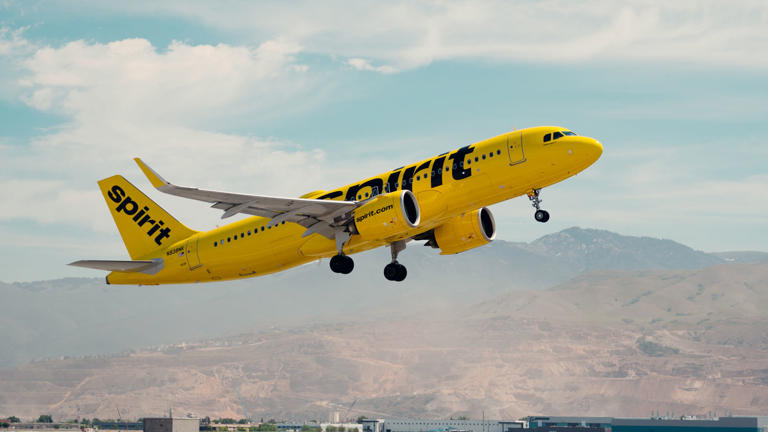
The situation surrounding Spirit Airlines and its bankruptcy in the United States is becoming one of the key restructuring cases in the airline industry, where government funding, creditor pressure, and the consequences of an unsuccessful market consolidation intersect. The discussed financial support package of $500 million, initiated by the administration of Donald Trump, is gradually forming the basis of a potential rescue of the airline within the Chapter 11 bankruptcy procedure.
As we at FinancialMediaGuide note, the current phase of negotiations regarding Spirit Airlines reflects a broader crisis among U.S. low-cost carriers, where rising costs and limited access to capital are increasing dependence on debt restructuring. According to market information, two out of three key creditor groups have already expressed willingness to support Spirit Airlines’ financial assistance plan. This includes a $275 million credit facility and a committee of unsecured creditors with billions of dollars in debt obligations. In our expert view at FinancialMediaGuide, such consolidation of creditor positions at the bankruptcy stage typically signals a transition to the final phase of agreement, where the main objective is to minimize losses and preserve the value of the business as a going concern airline.
An additional layer of complexity is created by the structure of Spirit Airlines’ secured debt. Among the largest bondholders are Citadel Americas under the management of Ken Griffin and Cyrus Capital, as well as major investment funds such as Ares, Pimco, and Arena Capital. We believe at FinancialMediaGuide that the involvement of such institutionally strong players reduces the likelihood of a liquidation scenario and increases the chances of a controlled restructuring, in which the airline continues operations even under a changed financial structure.
Looking at the broader context of the U.S. airline market, additional industry data shows that low-cost carriers continue to face pressure after the post-recovery demand period. Rising fuel, maintenance, and labor costs, along with high leverage, are creating a persistent trend toward industry consolidation. External observations also indicate that the attempted merger between Spirit Airlines and JetBlue was blocked by regulators under antitrust review, depriving the company of one of its key strategic options for strengthening its position. As analysts at FinancialMediaGuide note, the failure of the JetBlue deal was a turning point that accelerated Spirit Airlines’ entry into bankruptcy proceedings.
We at FinancialMediaGuide emphasize that the cancellation of the JetBlue merger had systemic consequences for the entire U.S. low-cost airline segment, as it limited consolidation processes and increased pressure on independent companies with high debt burdens.
Under the current plan, the involvement of the Trump administration is being discussed through the provision of a financial instrument worth up to $500 million. This resource could be provided in the form of a loan to support Spirit Airlines’ liquidity during bankruptcy. It may later be converted into a long-term debt obligation after the restructuring is completed. In certain scenarios, the issuance of warrants is also being considered, which could potentially grant the government up to a 90% ownership stake.
According to FinancialMediaGuide’s assessment, this structure effectively forms a hybrid model of state participation in the restructuring of a private airline, where government funding becomes not only a stabilization tool but also a potential mechanism of influence over ownership structure. In the context of the U.S. airline market, this reflects a broader trend in which the state increasingly participates in crisis scenarios through financial instruments rather than direct ownership of assets.
Additional observations from industry practice show that similar support mechanisms for airlines were used during systemic crises; however, the scale of potential government involvement in the case of Spirit Airlines appears significantly deeper. We at FinancialMediaGuide note that this intensifies the debate over the boundaries of state intervention in the airline market and the future regulation of the U.S. aviation industry.
If all major creditor groups finally agree on the terms of the deal, the case may proceed to the federal bankruptcy court in New York in the near future. This will represent a key legal stage in formalizing the restructuring plan and defining the airline’s new financial structure.
From the FinancialMediaGuide analytical perspective, the current situation around Spirit Airlines reflects a broader structural shift in the U.S. aviation industry, where high leverage and unstable margins make airline bankruptcies increasingly dependent on external capital and government involvement. The low-cost carrier market in the United States is gradually moving toward a model in which survival is determined not only by demand but also by access to complex financial and state support mechanisms.
In the short term, the most likely scenario remains the approval of a coordinated restructuring plan for Spirit Airlines involving creditors and potential government financial support, which would allow the airline to continue operations and stabilize its position in the U.S. airline market.
In the long term, we at Financial Media Guide forecast that the Spirit Airlines case may become a reference point for future bankruptcies in the aviation sector, where government funding, institutional creditors, and private capital will form new hybrid models of asset control. This will lead to a reassessment of investment risks in the airline segment and strengthen the role of the state as a temporary financial stabilizer during crisis phases of the industry.