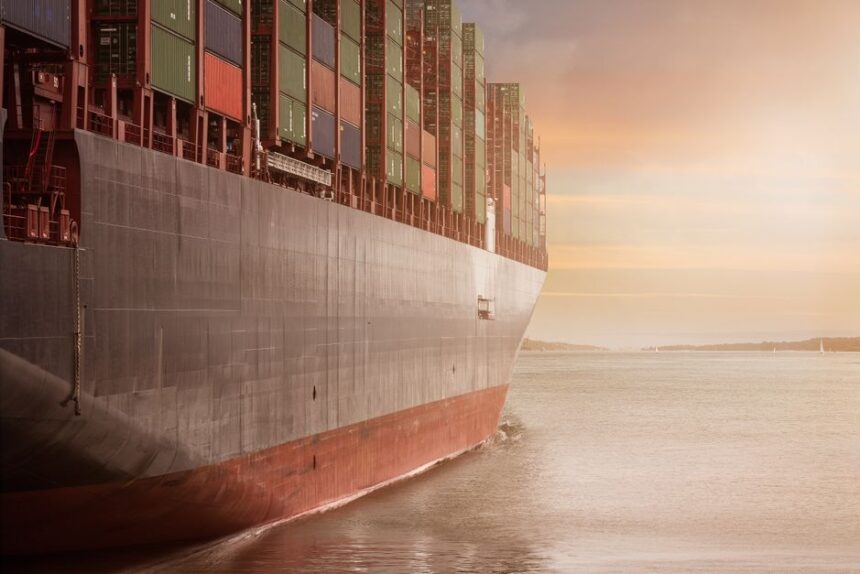
A familiar pattern is accelerating across global trade corridors. Retailers and importers, particularly those sourcing goods from Asia, are flooding container shipping lanes with front-loaded orders in anticipation of new tariff measures from the United States. The result is a sharp spike in ocean freight rates that is reverberating through supply chains, adding fresh pressure to an already fragile global economy still navigating the aftermath of elevated inflation and aggressive monetary policy tightening.
Spot container freight rates on major transpacific routes have climbed significantly in recent months, with some benchmarks showing increases of 50% or more compared to earlier in the year. The Freightos Baltic Index, a widely tracked measure of global container shipping costs, has reflected this upward momentum as cargo volumes surge ahead of anticipated tariff implementation dates. According to FinancialMediaGuide analysts, this kind of demand compression – where months of purchasing activity get pulled into a narrow window – creates artificial volume spikes that distort both freight pricing and inventory cycles.
The dynamic mirrors what occurred in 2018 and 2019 during the first wave of U.S.-China trade tensions, when importers similarly rushed shipments ahead of tariff deadlines. That episode ultimately contributed to inventory gluts, margin compression for retailers, and a broader slowdown in global trade volumes. The IMF and World Bank both flagged trade fragmentation as a structural drag on GDP growth during that period, and the current environment carries comparable risks.
The Biden administration’s decision to maintain and in some cases expand tariffs on Chinese goods – including steep levies on electric vehicles, solar panels, and certain industrial inputs – has kept importers in a state of persistent uncertainty. With the U.S. presidential election cycle adding another layer of policy unpredictability, businesses are making rational hedging decisions by accelerating imports now rather than risking higher costs later. We at FinancialMediaGuide see this as a textbook supply chain risk management response, but one that carries its own set of downstream consequences.
The Federal Reserve’s monetary policy stance adds a complicating dimension. Interest rates remain at elevated levels as the central bank continues to balance inflation control against the risk of triggering a recession. Higher borrowing costs make inventory financing more expensive, which means the current front-loading behavior is not cost-free for retailers. Companies are effectively paying a premium on two fronts – elevated freight rates and higher carrying costs for goods that may sit in warehouses for months before reaching consumers.
Inflation in goods categories, which had been moderating through much of 2023 and early 2024, risks a partial reversal if shipping costs remain elevated long enough to feed through into consumer prices. The Federal Reserve and other central banks have been explicit about their sensitivity to any re-acceleration in inflation, meaning a sustained freight cost shock could influence the trajectory of interest rate decisions heading into late 2024 and 2025.
Beyond the U.S.-China corridor, global shipping is contending with structural disruptions. Houthi attacks on vessels in the Red Sea have forced many carriers to reroute around the Cape of Good Hope, adding roughly 10 to 14 days to transit times between Asia and Europe. This capacity reduction has tightened the global container market even outside the tariff-driven demand surge, pushing rates higher across multiple trade lanes simultaneously. FinancialMediaGuide analysts note that the convergence of geopolitical disruption and policy-driven demand spikes is creating a compounding effect that is more difficult to unwind than either factor alone.
Port congestion is re-emerging as a consequence. Terminals on the U.S. West Coast and in Northern Europe are reporting longer dwell times and equipment shortages – conditions that echo the supply chain bottlenecks of 2021 and 2022. While the scale remains below pandemic-era extremes, the directional trend is concerning for businesses that had only recently rebuilt operational stability.
For the world economy, the implications extend beyond freight invoices. Global trade volumes, which the World Bank and IMF have projected to grow modestly in 2024, face downside risk if shipping costs become a sustained barrier to commerce. Smaller exporters in emerging markets are particularly exposed, as they lack the purchasing power and logistics contracts that large multinationals use to insulate themselves from rate volatility.
In our view at FinancialMediaGuide, the current freight surge is a symptom of a deeper structural tension in the global economy – one where trade policy uncertainty, geopolitical instability, and the residual effects of central bank tightening are interacting in ways that make supply chain planning genuinely difficult. Businesses that treat this as a temporary spike and absorb costs passively may find themselves underprepared if elevated rates persist through the second half of 2024. A more defensible posture involves diversifying sourcing geographies, locking in longer-term freight contracts where pricing allows, and stress-testing inventory models against scenarios where both tariffs and shipping costs remain elevated simultaneously. The freight market is sending a signal that the era of cheap, predictable global logistics has not returned – and monetary policy alone cannot fix that.