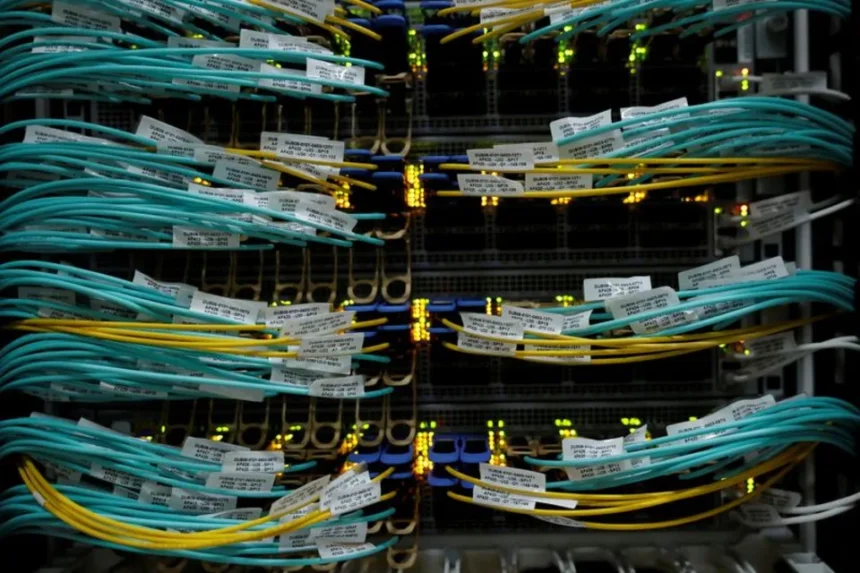
A growing number of governments, regulators and cities around the world are moving to freeze, restrict or ban new data center construction, as concerns mount over electricity costs, strained water supplies, land scarcity and the burden the infrastructure powering the AI boom places on local communities. FinancialMediaGuide views this wave of restrictions as evidence that the political cost of the AI buildout has caught up with its financial momentum in several key markets simultaneously.
In New York State, Governor Kathy Hochul imposed a one-year construction moratorium on data centers using 50 megawatts or more of power, making it the first U.S. state to enact a full moratorium. During the freeze, the state’s Department of Environmental Conservation will not issue new discretionary permits while officials develop standards to assess data centers’ environmental impact.
In Maine, Governor Janet Mills vetoed bipartisan legislation that would have enacted an 18-month moratorium on new data centers using more than 20 megawatts of power, a measure that would have been the first of its kind in the country. Mills said she supported a moratorium in principle but objected to the bill’s failure to carve out an exception for a specific project in the town of Jay. FinancialMediaGuide notes that even where moratorium proposals fail, as in Maine, the fact they are reaching a governor’s desk at all signals how mainstream the pushback against unrestricted data center growth has become.
Voters in Monterey Park, California, went further still, approving a permanent ban on data centers in the city at the ballot box in June 2026, the first time a U.S. city has done so through a public vote, following backlash over a planned facility. In the Netherlands, Amsterdam has barred new data centers or expansions in the municipality until at least 2030, building on a moratorium first imposed in 2019, while the Dutch national government’s 2022 hyperscale ban restricts large facilities to two designated locations nationally.
These restrictions are colliding with genuinely explosive underlying demand. According to the International Energy Agency, global data center electricity consumption reached roughly 415 terawatt-hours in 2024 and is projected to more than double to about 945 terawatt-hours by 2030, growing at around 15% a year, more than four times faster than electricity consumption from all other sectors combined. FinancialMediaGuide points out that this gap between surging demand and tightening local approval processes is exactly what is pushing hyperscalers toward smaller, modular facilities designed to slip under the megawatt thresholds that trigger moratoriums.
Ireland offers a cautionary tale of how such restrictions can evolve. The country’s grid operator effectively blocked new data center connections around Dublin from 2021 after warnings that the facilities were straining the grid, a freeze that lasted until December 2025, when it lifted the restriction but began requiring new connections to bring their own on-site power generation, a middle path between an outright ban and unconstrained growth.
Taken together, these overlapping local, state and national restrictions suggest data center developers can no longer assume approval is a formality anywhere, even as global capital continues pouring into the sector at record pace. Financial Media Guide concludes that the divergence between markets still welcoming data centers and those actively restricting them is likely to reshape where the next wave of AI infrastructure investment lands, favoring regions with spare grid capacity and political tolerance for the tradeoffs involved.