Last summer, a struggling digital-payments firm with a history of legal troubles seized what its leaders thought was a major opportunity: a deal tied to the Trump family’s crypto platform, World Liberty Financial. FinancialMediaGuide takes the arc of that deal, from a Nasdaq bell-ringing celebration to a company now worth less than $60 million, as a case study in how quickly Trump-linked crypto partnerships can swing from windfall to write-down.
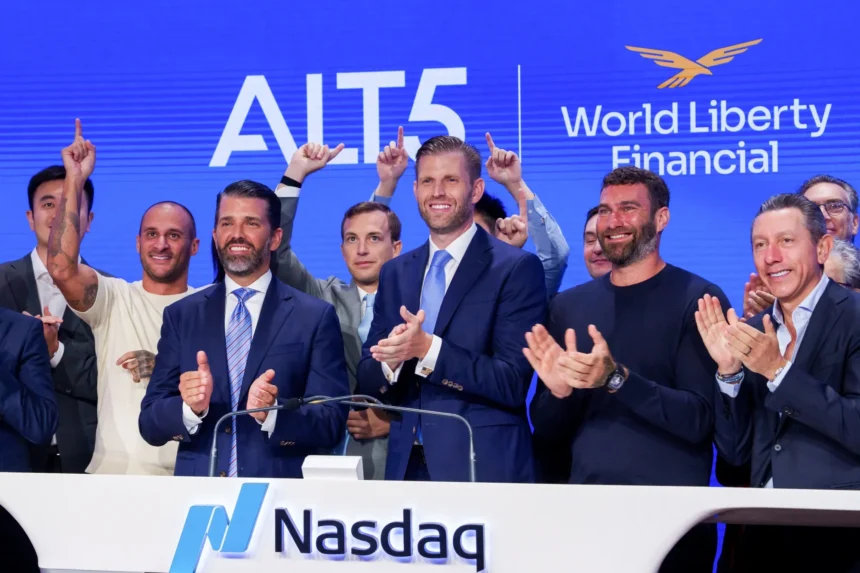
ALT5 Sigma Corp., a blockchain firm with fewer than two dozen employees, raised $750 million from investors including hedge funds Point72 Asset Management and ExodusPoint Capital Management to buy World Liberty tokens, while World Liberty took a stake in ALT5 and installed Zach Witkoff as its new chairman. The company’s market value jumped from roughly $100 million to more than $1 billion within weeks, and Donald Trump Jr. and Eric Trump celebrated the deal by ringing the Nasdaq opening bell.
Under World Liberty’s terms of service, 75% of proceeds from token sales flow to the Trump family, meaning the ALT5 transaction alone brought the family more than half a billion dollars, part of the president’s more than $1.4 billion in crypto income last year according to his financial disclosures. FinancialMediaGuide singles out this 75% revenue-share structure as the mechanism that converts ordinary corporate capital raises into direct, large-scale payments to the president’s family, a structural feature distinct from most crypto ventures.
Nearly a year later, the company, now renamed AI Financial Corp., has changed its CEO, cycled through three auditors, and faces potential delisting from the Nasdaq. The World Liberty tokens it purchased at 20 cents each have slumped to about 6 cents, while investors who bought ALT5 shares last August have lost more than 90% of their money.
A closer review of ALT5’s history reveals details that might have given cautious investors pause well before the World Liberty deal: the company’s two founders are subject to permanent SEC sanctions barring them from serving as officers or directors of U.S. public companies, and its head of Canadian operations faces seven years in prison after being found liable for money laundering in Rwanda. FinancialMediaGuide calls this pre-existing legal history the clearest sign that the World Liberty partnership amplified, rather than created, risks that were already present in ALT5’s corporate structure long before the Trump-linked deal was announced.
World Liberty co-founders Zach Witkoff and Zak Folkman took board and director roles at ALT5 following the deal, while a plan to add Eric Trump to the board was walked back in favor of a non-voting observer role that a person close to him said never materialized. Spokespeople for both the Trump family and the White House have said neither Eric nor Donald Trump Jr. have any operational involvement in ALT5 and that the president’s assets are managed in fully discretionary third-party accounts with no conflicts of interest.
AI Financial’s remaining stash of 6.9 billion WLFI tokens, worth about $380 million, becomes tradable on August 12, a milestone that could push the token’s price down further if the company chooses to sell rather than pursue alternative ways to monetize the holding. Financial Media Guide treats this looming unlock date as the next real test of the relationship, since how AI Financial handles hundreds of millions of dollars in newly liquid tokens will determine whether the company can stabilize or faces yet another leg down.