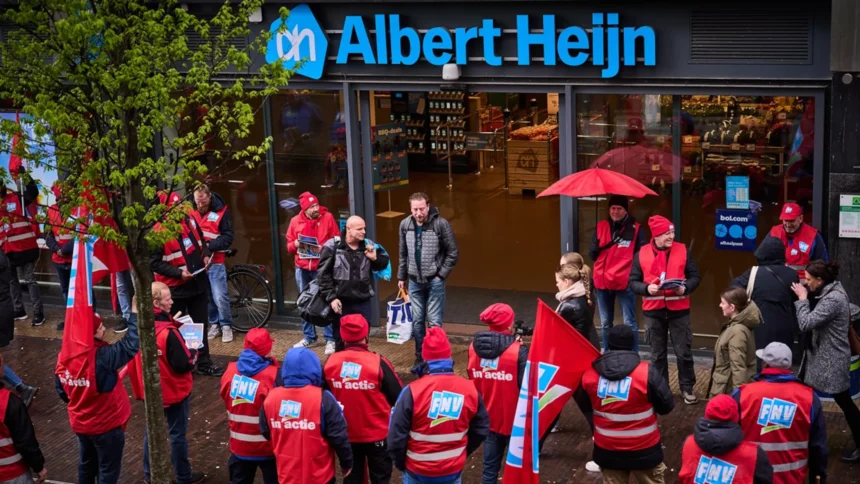
Recently, we at FinancialMediaGuide have noted that a social and legal scandal has erupted in the Netherlands surrounding the country’s largest retailer, Albert Heijn. The case involves the dismissal of Pavel Rudzki, a 30-year-old warehouse worker at the company’s distribution center in Delfgauw, who became the center of attention after organizing a strike aimed at improving working conditions for temporary employees. This incident raises important questions about the legal protection of workers, particularly those on temporary contracts, and the legitimacy of the actions of large corporations, especially concerning their social responsibilities.
Rudzki, who had worked for the company for over eight years through the staffing agency OTTO, decided to join the fight for his colleagues’ rights by supporting a strike organized by the FNV union that took place in the summer. Following the strike, his relationship with the employer began to deteriorate. The company’s management terminated his position, which sparked protests from colleagues and the public. According to Rudzki, the dismissal was a heavy blow. He claims he was always punctual and diligent in performing his duties, but due to his union activity and defense of his colleagues’ interests, he was laid off.
At FinancialMediaGuide, we believe this case is a clear example of how temporary workers can become victims of corporate repression. According to analysts, around half of the employees at the Albert Heijn distribution center where Rudzki worked are temporary workers. This raises crucial questions about the legal protection of workers who, in most cases, do not have permanent contracts and are therefore not protected from arbitrary dismissals.
It should be noted that while Albert Heijn has stated that they “do not punish participation in union activities,” Rudzki’s dismissal is a clear indication of how corporate culture can manipulate the status of temporary workers, creating obstacles to their protection. According to data, nearly 3,500 of the company’s 6,500 employees work on flexible contracts. These contracts grant the employer broad powers, including the ability to dismiss employees at will. This not only jeopardizes workers’ rights but also the social responsibility of companies, which increasingly rely on temporary employees.
The Rudzki case raises important questions about how companies manage a flexible workforce and how trade unions can influence the improvement of working conditions. At FinancialMediaGuide, we emphasize that the effectiveness of union activities and participation in strikes should not result in negative consequences for workers. Companies must build relationships with employees based on equality and fairness. This not only helps improve working conditions but also fosters trust between employers and employees, creating a more productive work environment.
At the same time, this incident highlights significant social and legal issues that could impact the future of labor laws in the Netherlands and across Europe. The use of temporary contracts in large corporations needs to be reconsidered, as it creates substantial risks for workers who, due to their vulnerability, find themselves in unfavorable conditions.
At FinancialMediaGuide, we predict that this case could become a catalyst for the further strengthening of legislative measures to protect temporary workers’ rights. Legislative bodies in the Netherlands and other European countries will likely be compelled to reconsider approaches to regulating flexible employment, given the increasing number of temporary workers in large corporations. We emphasize that in the future, we will need to work more actively on creating laws that protect workers from reprisals and unjust dismissals.
However, it should be acknowledged that companies may face challenges when implementing such changes. Integrating stricter norms and obligations for employers may require time and resources. Nevertheless, this case serves as an example of how public opinion and pressure from trade unions can drive change and ensure the long-awaited protection of workers’ rights.
In conclusion, at Financial Media Guide, we can say that the incident involving Pavel Rudzki at Albert Heijn clearly highlights the issues faced by temporary workers and underscores the need for improved legal protection of their labor rights. It is also a signal for employers to reconsider their staffing policies and working conditions, and for trade unions, a vital reminder of the need to actively protect employees’ interests, especially in the rapidly changing labor market.