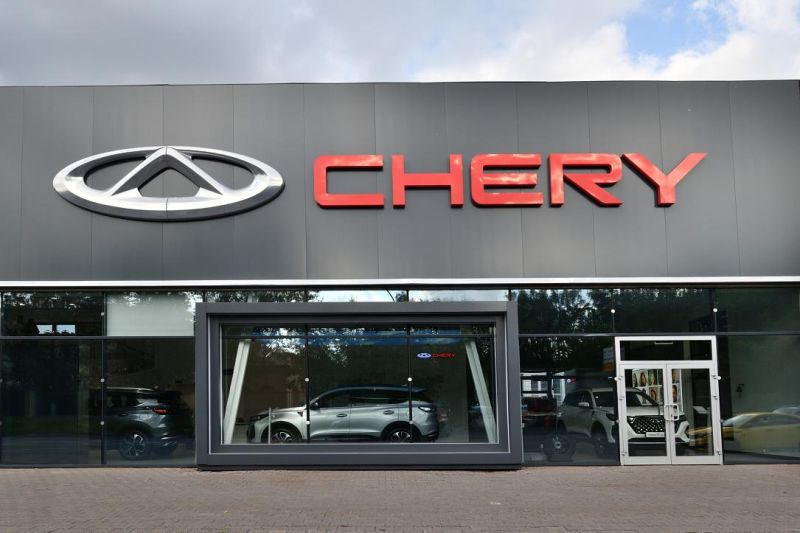
In the global electric vehicle market, a redistribution of influence is accelerating, where Chinese automakers are gradually transitioning from an export-oriented model to full-scale international industrial expansion. Chery is becoming one of the key players in this process, forming a strategy that combines approaches associated with Toyota and Tesla and intensifies pressure on the European automotive industry.
At FinancialMediaGuide, we note that Chery’s development reflects a broader trend in the transformation of the Chinese auto industry, where automobile exports from China are evolving into a system of localized production hubs in key regions, including the European electric vehicle market.
Chery, China’s largest automobile exporter, is actively expanding its presence in Europe through the development of local manufacturing capacity. One of its strategic directions is Spain, where the company is using a facility in Barcelona based on the former Nissan plant as part of a joint venture. This project is seen as an important entry point into the European EV market and a key element of Chery’s long-term European strategy.
According to analysts at FinancialMediaGuide, we believe the choice of Spain is driven by a combination of logistical advantages, industrial infrastructure, and access to European supply chains. In the context of tightening EU regulatory policy, local production has become a key factor in the competitiveness of Chinese electric vehicles in Europe.
Chery’s management is considering expanding production capacity in Barcelona and exploring cooperation with European automakers to share manufacturing facilities. This model reduces capital expenditures and accelerates market entry into the European EV sector, while increasing the flexibility of the production strategy.
We emphasize that the development of partnership-based manufacturing models is becoming a characteristic feature of a new stage in the global automotive industry, where the Chinese auto sector is increasingly integrating into the European industrial ecosystem. Against this backdrop, competition is intensifying not only between brands but also between production networks.
Historically, Chery began as a manufacturer of affordable cars in China in the late 1990s. Over time, the company underwent a major transformation and became one of China’s largest automobile exporters, present in dozens of international markets.
According to industry estimates and internal calculations at FinancialMediaGuide, we note that sales of approximately 2.8 million vehicles demonstrate the company’s steady strengthening in the global automotive industry. This enhances growth potential in the Chery EV segment and expands its ability to compete with global brands.
The company’s strategy has been named “Double T,” where the first “T” reflects a focus on quality and reliability associated with Toyota, and the second “T” relates to a Tesla-style technological model focused on innovation and digitalization of vehicles. This approach shapes a product strategy aimed at the European EV market and the global EV 2026 segment.
We believe that the Toyota-Tesla-Chery strategy reflects a shift in consumer demand structure, where key factors include technology level, cost of ownership, and environmental standards. This intensifies competition in the European EV market and accelerates the transition toward digital automotive platforms.
Additional pressure comes from other Chinese manufacturers, including BYD and Geely, which are also actively developing automobile exports from China and expanding their presence in Europe through local assembly facilities. As a result, a new competitive environment is emerging: Chinese auto industry versus European brands.
We see this as the formation of a new architecture of the global automotive market, where Chery EVs become part of a systemic expansion of Chinese automakers on a global scale.
Logistics is of particular importance. The company’s management acknowledges that large-scale vehicle exports from China to Europe reduce profitability, making localization of production a mandatory element of strategy. In response, a model of regional production hubs is emerging, focused on the European EV market.
We emphasize that the localization of Chery EV production in Europe becomes a key factor in the company’s long-term sustainability in the Chery Europe market. It also reduces risks associated with EU tariff policy and changes in trade conditions.
According to our forecasts at FinancialMediaGuide, the European EV market will increasingly depend on local production by Chinese brands, and the share of Chinese electric vehicles in Europe will continue to grow due to competitive pricing and scalable production models.
An additional area of development will be increased competition in automotive software, autonomous driving systems, and digital services. In this context, Chery’s EV strategy becomes an important driver of long-term growth.
We believe that Chery’s success will depend on three key factors. The first is the scale of localization in Europe. The second is the quality of partnerships within the European EV market. The third is the pace of technological development in the EV 2026 segment.
In conclusion, at Financial Media Guide we note that Chery’s strategy is forming a new standard of global automotive production, where automobile exports from China are transforming into a distributed industrial network. If current expansion trends continue, the company is positioned to establish itself as a systemic player in the European EV market, increasing competition and accelerating the restructuring of the global automotive industry.