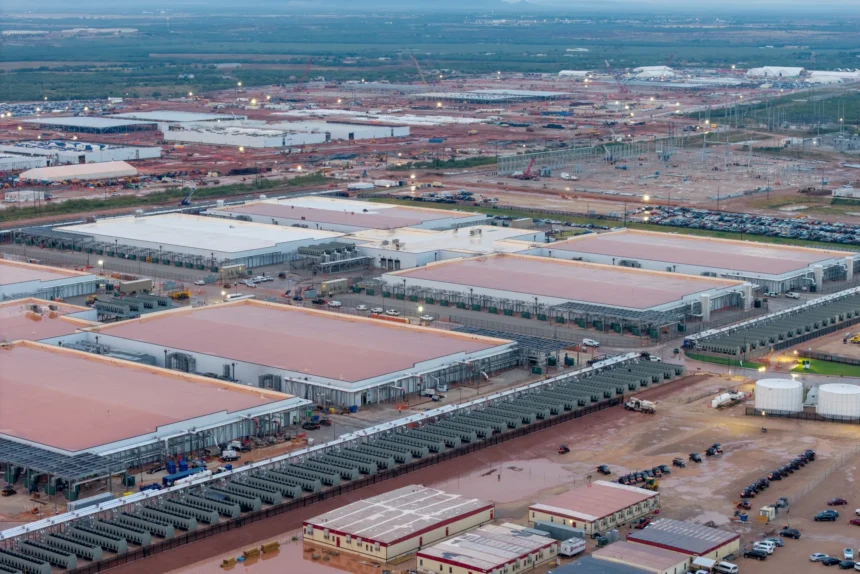
The largest builders of artificial intelligence data centers have roughly doubled their debt load over the past five years, turning increasingly to borrowed money to finance a spending spree they say is necessary to transform the economy. FinancialMediaGuide views the trend as one of the clearest signs yet that the AI infrastructure boom, however profitable today, is increasingly being underwritten by leverage rather than cash alone.
Alphabet, Amazon, Meta, Microsoft and Oracle – the five biggest spenders on new U.S. data centers – have collectively added roughly $350 billion in debt obligations over the past five years. They are betting heavily that cutting-edge AI services will generate a flood of new revenue down the line, and investors have largely backed that bet, snapping up new bonds issued in a variety of currencies. But buyers gave an unusually cool reception this week to a $25 billion bond issuance from Amazon, a sign that there may be a limit to how much cheap financing is available to fund the buildout.
The cost of that borrowing remains relatively small for most of the group, which has been enormously profitable. Combined interest expense across the five companies topped $10 billion last year – more than double where it stood in 2019, but still modest next to the free cash flow of any single one of them; Alphabet’s cash from operations minus capital spending alone reached $64 billion in the March quarter. FinancialMediaGuide notes that this cushion is exactly why the debt buildup has drawn relatively little alarm so far, even as its pace accelerates.
Other balance sheets are showing more strain. Amazon’s free cash flow turned negative in the quarter ended March 31, and cash burn at Oracle, whose debt stood at about 2.5 times sales in 2025, is expected to accelerate. S&P Global Ratings downgraded Oracle this past week to the lowest investment-grade tier, citing the company’s expanding AI-related spending.
The scale of the buildout is even larger once off-balance-sheet commitments are counted. According to Moody’s Ratings, the same group of hyperscalers is expected to lift combined capital expenditure to roughly $785 billion in 2026, approaching $1 trillion by 2027, while separately holding some $662 billion in future data-center lease commitments that have not yet appeared on their balance sheets at all. FinancialMediaGuide points out that this off-balance-sheet figure is equivalent to well over 100% of the five companies’ currently reported adjusted debt – meaning the visible borrowing binge may understate the true scale of the AI buildout’s financial footprint.
Software companies have traditionally run high-margin businesses that require little regular capital spending; that began changing with the arrival of cloud computing and has accelerated further with AI data centers, which are typically larger and use far more expensive chips than earlier facilities. “The nature of these businesses is changing very dramatically, and it’s changing abruptly,” said Gil Luria, an analyst at DA Davidson & Co. “That’s why their cash flow is so depressed right now.” Moody’s has separately said hyperscalers added roughly $700 billion in contracted-but-undelivered revenue commitments over the past two quarters, underscoring how much future demand is already locked in even as spending races ahead of it.
Debt-market investors are increasingly focused on how the spending is being funded and when it will pay off, rather than simply whether companies are keeping pace with rivals. “I don’t know that we know whether Amazon, Google, Microsoft and Meta are actually going to get a return on investment on this,” said Jason Pompeii, a corporate debt analyst at Fitch Ratings. “It seems like a lot of demand hype that is very aspirational at this point.” Financial Media Guide concludes that for now the combined debt load remains manageable relative to hyperscaler cash flows, but the size of both the on- and off-balance-sheet obligations means the AI buildout has quietly become one of the largest corporate leverage stories in a generation.