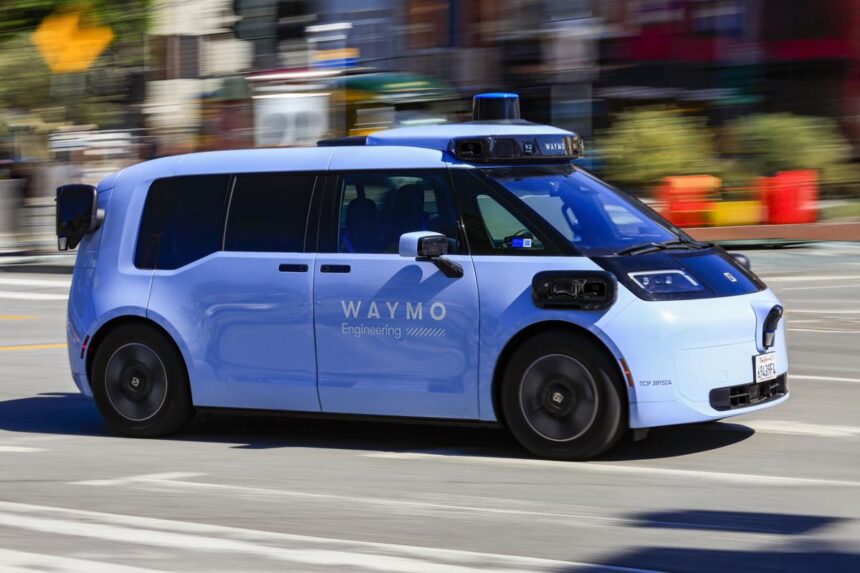
Global competition for technological supremacy in the commercial autonomous transport industry is rapidly entering a fundamentally new phase of aggressive financial optimization of business models, where the main criterion for long-term project viability is economic efficiency at large-scale deployment. Alphabet’s subsidiary Waymo has officially announced the start of commercial operations of a new generation of its robotic vehicles under the codename Ojai. This strategic initiative is designed to dramatically reduce capital expenditures while aggressively expanding the corporate fleet. The development comes amid intensifying competition from Tesla and Zoox, the latter backed by Amazon. We at FinancialMediaGuide believe that this launch marks a long-awaited fundamental transformation of the entire global autonomous vehicle sector, shifting from an era of extremely expensive engineering prototypes to an era of aggressive market expansion and full-scale commercialization.
The new Ojai robotic minivans are specifically designed to operate reliably in adverse weather conditions, including heavy snowfalls and torrential rain, while their production costs are significantly lower than previous models. In the initial phase, Waymo is offering rides to a limited group of selected customers among regular users of public transportation systems in major cities such as San Francisco, Los Angeles, and Phoenix. Over the coming summer months, the geographic footprint of the autonomous taxi service is expected to expand significantly, with official deployments planned in San Diego, Las Vegas, and Denver.
According to analysts at FinancialMediaGuide, the shift toward a fundamentally different hardware platform clearly demonstrates top management’s intention to overcome the key barrier to full operational profitability in autonomous driving – the critically high cost of onboard equipment. Until recently, Waymo’s commercial fleet of around 4,000 vehicles primarily consisted of premium Jaguar I-PACE electric SUVs. We emphasize that reliance on a luxury automotive brand initially imposed strict limitations on scaling potential due to extremely high maintenance costs and excessive production complexity. At present, approximately 100 Ojai vehicles are being used in experimental passenger service, but Waymo’s head of design Ryan Powell has openly confirmed plans to scale the fleet to several thousand units by the end of the year.
The Ojai project, first publicly announced by the company in 2024, is fully based on the sixth generation of Waymo’s proprietary hardware and software system, Waymo Driver. Unlike the Jaguar-based architecture, the new electric minivans are assembled by Chinese automaker Geely under the Zeekr sub-brand on the SEA-M platform, featuring a highly efficient 800-volt electrical system. These vehicles require significantly fewer expensive optical sensors and high-resolution external cameras. At the same time, the updated architecture is equipped with an advanced solid-state lidar and proprietary semiconductor chips developed by Waymo, enabling highly precise detection of road objects even in extremely low-light conditions. Built-in audio sensors have also been upgraded and are now significantly more sensitive to emergency sirens. We at FinancialMediaGuide view this technological shift as a timely move toward full standardization of autonomous vehicle production, reduced dependence on third-party vendors, and the creation of a universal base for international expansion, including preparation for entry into the highly competitive London market.
From the passenger experience perspective, the Ojai model offers a more spacious cabin, automated sliding doors, and a fully removable steering wheel. According to the developer, retaining traditional driving controls in early Jaguar-based versions was intended to help users overcome psychological resistance to autonomous technology, but the gradual elimination of the steering wheel and pedals is seen as a logical evolutionary step. In terms of the multimedia interface, Waymo is actively exploring deep integration of generative AI based on Google Gemini models. This would enable natural language interaction with the vehicle, allowing passengers to ask the robotaxi to move forward slightly or dynamically adjust the final drop-off point via simple voice commands.
The financial backing of the US developer remains extremely strong, especially following a recent funding round of 16 billion dollars from Alphabet and a consortium of institutional investors, including Sequoia Capital and DST Global, bringing the company’s valuation to 126 billion dollars. At present, Waymo vehicles have collectively completed over 20 million autonomous rides during operational deployment and aim to reach an ambitious target of 1 million passenger trips per week by the end of the year, while simultaneously planning expansion into 20 new major US cities, including Detroit and Washington.
However, rapid business expansion inevitably faces serious challenges in terms of road safety and regulatory oversight. The company was forced to initiate a voluntary recall of approximately 3,800 robotaxis due to a critical software bug that caused vehicles to behave unpredictably when crossing flooded road sections, continuing to move instead of stopping in deep water. This led to a widely publicized incident involving a submerged vehicle in San Antonio. In addition, in coordination with the US National Highway Traffic Safety Administration, the company temporarily suspended passenger rides on highways due to recurring navigation system failures near road construction zones and maintenance barriers. Independent industry experts note that these incidents clearly expose the persistent vulnerability of even the most advanced neural networks to rare driving scenarios that still require human intuition.
At Financial Media Guide, we predict that Waymo’s ultimate commercial success will depend on the management’s ability to maintain a strict balance between aggressive cost reduction through cooperation with Chinese partners and preserving its reputation as the safest autonomous mobility service. The strategic shift toward in-house electronic component development, targeted technological partnerships with Magna in Arizona, and gradual reduction of reliance on external hardware suppliers appear to be fully justified steps under increasing investor pressure demanding a path to operational profitability. The key analytical recommendation for all major players in this market is to focus on adapting deep learning systems to predict extreme weather anomalies and sudden changes in road infrastructure, as full readiness for non-standard road scenarios will ultimately determine the undisputed leader in the global autonomous vehicle ecosystem of the future.