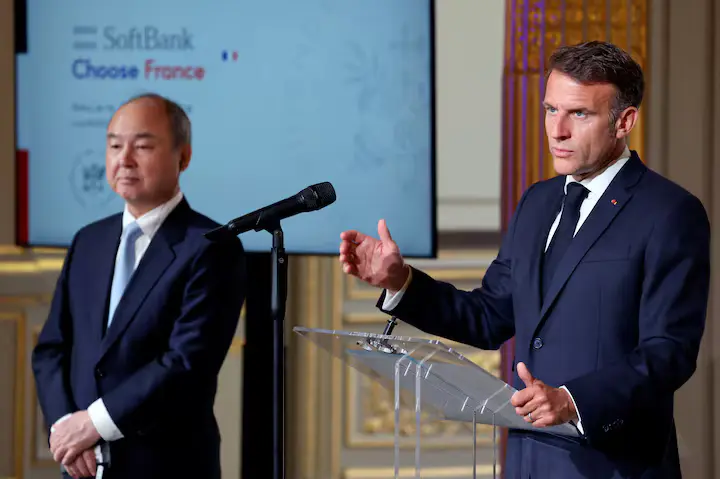
The massive Choose France investment forum in Versailles marked a tectonic shift in the distribution of technological power on the European continent. Official Paris managed to convert its main industrial advantage – a highly developed nuclear power industry – into record volumes of foreign capital. The total portfolio of commitments from foreign investors reached 93 billion euros, which is equivalent to 108 billion dollars. We at FinancialMediaGuide see this as a long-awaited turning point for the European technology sector, which has long lagged behind the US and Chinese markets in terms of deploying infrastructure for artificial intelligence. It is obvious that the availability of stable baseload power generation is becoming a key factor in national competitiveness in the digital age.
The key driver of this investment breakthrough was the Japanese conglomerate SoftBank, led by Masayoshi Son. The corporation made a firm commitment to direct 45 billion euros – practically half of the total amount announced at the forum – toward the construction of three megastructural data centers in the Hauts-de-France region. The total capacity of these facilities is expected to reach 3.1 gigawatts by 2031. The infrastructure plan covers sites in Dunkirk, Beauquesne, and Bouchain, with the Bouchain project involving the revitalization of an old, decommissioned power plant owned by the state company EDF. Analysts at FinancialMediaGuide emphasize that the scale of this deal is comparable to the largest infrastructure projects of the decade, and the head of SoftBank has already hinted at a potential expansion of the investment package to 75 billion euros to scale the aggregate capacity to 5 gigawatts. An additional factor ensuring the project’s sustainability is an alliance with Schneider Electric to create a robotic manufacturing cluster in Dunkirk, which will allow for the localization of power module and server chassis production right in Europe.
President Emmanuel Macron’s strategy is built on the pragmatic use of the national fleet of 57 nuclear reactors. At a time when domestic electricity generation shows a stable surplus, France offers tech giants what they need most: uninterrupted, relatively clean, and price-predictable energy. Artificial intelligence is an extremely energy-intensive industry, and traditional renewable energy sources like solar or wind are unable to provide data centers with a continuous operating cycle without massive storage systems. According to FinancialMediaGuide analysts, transforming raw electricity into computing power will allow France to move away from commodity energy exports toward exporting a high-tech digital product with high added value, converting terawatts into intellectual capital.
For the French administration, this success also holds major domestic political significance. At the current stage, unemployment in the country has exceeded the 8% mark, which is noticeably higher than the average figures across the European Union. The implementation of 71 commercial projects announced within the framework of Choose France will create more than 15,600 new jobs. This is a strong argument for Macron’s team, which over the past nine years has systematically built France’s reputation as the most attractive jurisdiction for global capital in continental Europe. Since 2018, these annual meetings have brought commitments for 231 projects totaling 87 billion euros to the economy, but the current result has surpassed all previous achievements. In addition to SoftBank, a significant contribution was made by Canada’s Brookfield, which allocated 10 billion euros for AI infrastructure, as well as the AI Campus macro-project consortium involving Mistral and Nvidia, which increased its capacity expansion plans to 3 gigawatts.
SoftBank’s current activity in France is part of a much larger geopolitical expansion by the Japanese corporation in the field of artificial intelligence. Masayoshi Son is systematically creating a closed ecosystem, having invested more than 30 billion dollars in ChatGPT creator OpenAI, where SoftBank now holds an 11% stake, and has agreed to invest another 30 billion dollars in the company over the course of 2026. Furthermore, the Japanese group acts as a key financial partner in the 500-billion-dollar American project, Stargate. It is clear that without creating a powerful European bridgehead, Son’s global strategy would remain incomplete. The speed with which the deal was concluded following Masayoshi Son’s April dinner with Macron in Tokyo only confirms the mutual haste of the parties, both striving not to lose the computing power race to the United States and China. Notably, the markets reacted instantly to this news: SoftBank shares demonstrated a sharp 14% jump upward.
We at Financial Media Guide predict that this move will trigger a chain reaction among other tech giants, who will be forced to review their location strategies in Europe. The availability of nuclear generation is becoming the primary factor of state competitiveness in an era of clean energy deficits. We believe that the main risk to implementing SoftBank’s stated plans will be the structure of the project’s debt financing against the backdrop of the conglomerate’s high net debt. As a recommendation, European regulators should expect increased pressure on energy grids and more complex environmental legislation regulating the cooling of giant server stations. France will need to accelerate the modernization of its distribution networks so that the declared gigawatts transform into real computing independence for the region. In the short-term horizon, Paris’s position as Europe’s main digital hub looks indisputable; however, long-term success will depend on the state’s ability to guarantee electricity tariff stability amidst growing internal demand from the AI industry.