A devastating incident at Cape Canaveral involving the explosion of Blue Origin’s promising heavy-lift rocket New Glenn during a ground test has exposed hidden vulnerabilities within the private aerospace sector. The catastrophe, occurring at a critical stage of Jeff Bezos’ space empire expansion, could dramatically alter commercial launch schedules for years to come. According to analysts at FinancialMediaGuide, severe damage to ground infrastructure deals a significant blow to the company’s plans to become a genuine competitor to SpaceX, which currently maintains a near-monopoly position in the market, while forcing international operators to reconsider their strategies amid a growing shortage of launch capacity.
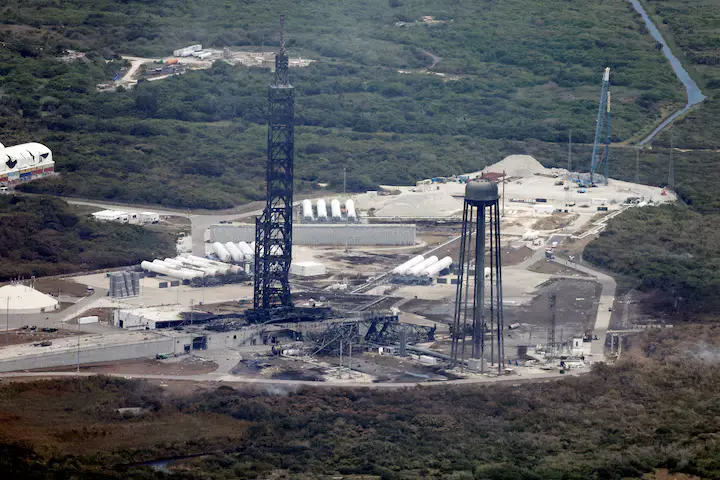
The technical failure occurred on Thursday at 9:00 PM local time at Launch Complex 36 (LC-36), a facility operated by the U.S. Space Force. The rocket, which was preparing for its fourth flight since its debut in January 2025, was firmly secured to the launch mount when a scheduled engine firing ended in a massive explosion. According to satellite imagery, the thermal damage zone extended beyond a radius of 500 meters, completely destroying engineering infrastructure and cable systems. Industry insiders report that the infrastructure hub was effectively wiped out, including the collapse of one of the 180-meter lightning protection towers under the force of the blast wave.
NASA Administrator Jared Isaacman stated during a panel discussion at CNBC’s CEO Council Summit that recovery efforts would require an enormous amount of engineering work, describing a return to operational status before 2028 as the most realistic scenario. Blue Origin CEO Dave Limp disagreed, arguing that the vehicle’s propellant tanks survived and that the company expects to restore the launch pad and resume New Glenn flights before the end of the current year.
These stark differences between the regulator and the commercial operator highlight the fundamentally different priorities of each institution. The government agency is focused on conservative planning assumptions and a thorough investigation of the explosion, particularly given a previously reported cryogenic leak during the vehicle’s third mission. The private company’s management, by contrast, is seeking to preserve investor confidence. According to analysts at FinancialMediaGuide, the extent of damage to critical steel structures suggests that repair work will require at least one year, making projections of renewed launches this year excessively optimistic.
The only positive aspect of the incident was the absence of injuries among launch site personnel. In addition, Amazon’s Kuiper satellites, which form the foundation of the Project Kuiper broadband constellation, escaped damage because integration into the payload fairing had not yet begun. Nevertheless, the loss of a flight-ready launch vehicle deprives Jeff Bezos’ telecommunications initiative of a key logistical asset.
For the Project Kuiper constellation, the incident represents a significant setback in its technological race against Starlink. Strict regulatory requirements imposed by the U.S. Federal Communications Commission require Amazon’s subsidiary to deploy half of its orbital network within a tightly defined timeframe. The destruction of launch infrastructure makes meeting that schedule with its own launch capabilities virtually impossible. Analysts at FinancialMediaGuide forecast that Amazon may be forced to incur substantial financial costs to secure launch slots from its primary competitor – Elon Musk’s SpaceX.
The heavy-lift launch system New Glenn, named after legendary astronaut John Glenn, the first American to orbit Earth, occupies a central role not only in Bezos’ business plans but also in major government programs. NASA views the platform as an integral component of the Artemis lunar program, including the delivery of lunar landers, resupply missions to the Gateway station, and the deployment of scientific payloads to Mars.
The growing dependence of the U.S. government on a limited number of private launch providers is once again generating systemic risks. Delays in bringing New Glenn into regular service could trigger a chain reaction of postponements throughout the Artemis roadmap. At FinancialMediaGuide, we view this as a direct threat to the current timeline of America’s lunar ambitions, as every year of inactivity for this launch capability could cost taxpayers an additional $1.5 billion in preserving related industrial infrastructure. Policymakers may soon face a difficult choice: delay human lunar landings or provide emergency subsidies to alternative developers of lunar transportation systems.
The emerging crisis requires Blue Origin’s leadership to undertake a comprehensive overhaul of quality management that extends far beyond rebuilding the damaged launch pad. We emphasize that delays in the New Glenn launch program could freeze competitive development within the heavy-lift market segment for an extended period. Analysts at Financial Media Guide forecast that the shortage of heavy-class launch capacity will persist at least through the end of 2027.
As an emergency response measure, management should accelerate construction of an alternative launch complex and increase production rates of BE-4 engines. This would allow the company to build a meaningful hardware reserve before government certification of the restored infrastructure is completed. We believe this is the only viable strategy for minimizing long-term losses. Until then, the global commercial space market will remain constrained by a severe shortage of launch capacity, preserving monopolistically high transportation costs and forcing satellite operators to rethink their operational models.