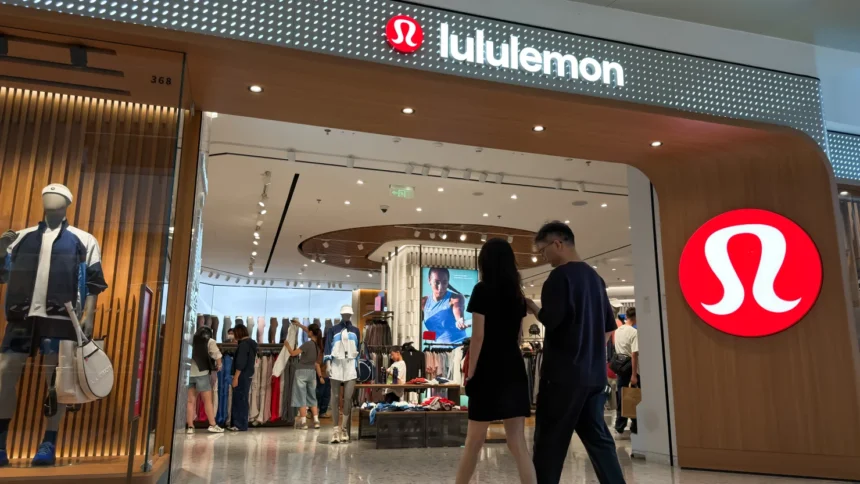
The global premium retail market has faced a major reassessment of values, and the previously flawless trajectory of Lululemon Athletica is now under serious threat. A period of rapid growth has given way to a harsh corporate reality, where mistakes in product strategy and public scandals instantly translate into billion-dollar losses in market capitalization. At FinancialMediaGuide, we believe the current situation around the athleisure pioneer demonstrates a classic brand identity dilution crisis, where the operational model cannot keep up with the scale of the business, and internal conflicts paralyze crisis management. The reduction of annual guidance revealed deep systemic problems that have been accumulating within the company over several seasons.
The sudden and significant deterioration of annual financial guidance triggered a massive wave of sell-offs in financial markets. During after-hours trading, the company’s stock fell 11%, increasing the total market value loss since the beginning of the year to a staggering 40%. Such investor reaction signals deep skepticism about management’s ability to quickly fix the situation. We see this as a natural outcome: the market long tolerated a high valuation premium for the company, but faced with systemic slowdown, investors demanded strict discipline that the retailer is currently unable to demonstrate.
Explaining the operational failures, interim CEO Megan Frank pointed to unprecedented pressure from media and social networks, as well as weak consumer response to recent product launches. FinancialMediaGuide analysts emphasize that attempting to shift responsibility onto a negative information environment appears to be a tactical excuse for managerial missteps. The real problem lies in the quality of the product matrix: consumers are tired of monotony, and new collections, intended to refresh the brand’s perception, failed to offer the market the expected level of innovation and aesthetics.
At the center of the media storm was a prolonged conflict with the company’s founder, Chip Wilson, who has consistently and publicly criticized the brand’s development direction, accusing management of straying from the original philosophy of quality. Questions from customers about the composition and durability of certain flagship lines added fuel to the fire. The situation was further exacerbated by independent market data showing increasing competition from younger brands such as Alo Yoga and Vuori, which are actively taking market share from the aging leader. Although management claims the peak of criticism has passed, a return to previous store traffic levels has yet to be observed.
Adjustments to 2026 financial year guidance have been painful. Management lowered expected revenue to a range of $11-11.15 billion, whereas it had previously guided investors to $11.35-11.50 billion. Independent market analysts, whose consensus forecast according to LSEG data was $11.48 billion, must revise their models. Earnings per share guidance was also cut by more than a dollar: the new target range is $10.95-11.15 compared to the prior optimistic $12.10-12.30. The professional community sees such guidance downgrades as a sign of losing control over operational costs.
Forecasts for the current three-month period confirm that the operational decline is prolonged. Quarterly sales are expected to range from $2.45 to $2.48 billion, significantly below market expectations of $2.60 billion. Expected EPS is set at $1.76-1.81, showing a massive shortfall compared to initial Wall Street forecasts of $2.68.
Against this backdrop, formally exceeding expectations in the first fiscal quarter ended May 3 looks like weak consolation, as investor forecasts had already been lowered in advance. EPS was $1.69 versus an expected $1.68, and net revenue reached $2.47 billion, slightly above the forecast of $2.43 billion. At the same time, net profit for this quarter fell to $195 million compared to $314.6 million the previous year. Minimal comparable sales growth of 1% only confirms stagnant consumer activity.
Geographical sales analysis reveals the company’s main vulnerability. North America, which forms the main revenue stream, shows a 5% decline in comparable sales, marking the fifth consecutive quarter of decline. FinancialMediaGuide notes that domestic market saturation occurred much faster than optimistic scenarios assumed, and the loss of local consumer loyalty is the most dangerous symptom for long-term stability. Independent consumer spending panels confirm that American shoppers increasingly choose more affordable alternatives or shift attention to other product categories.
The real salvation for reporting remains the international division, where sales rose 22%, and comparable metrics increased 13%. Double-digit growth in China and other regions keeps the company afloat for now, but international expansion requires massive capital expenditures and cannot immediately offset the decline in the American region. Management forecasts the negative trend in the domestic market will continue, expecting double-digit sales decline in the current quarter, while the Chinese market is projected to grow 10-20% in the current quarter and about 20% for the full year.
However, the greatest concern for investors is the rapid decline in profitability. Gross margin dropped 4.1 percentage points to 54.2%, worse than the market expectation of 54.6%. A strong blow was dealt by the cancellation of the de minimis customs rule, which previously allowed products to be imported from Canadian warehouses to the US duty-free. Facing rising tariffs and declining foot traffic, Lululemon made a strategic error: the company began to heavily rely on discounts. In our view, indulging in promotional campaigns to stimulate short-term sales causes long-term damage to the premium brand reputation, turning it in consumers’ eyes into a mass-market category.
The situation is further aggravated by external shocks: escalating Middle East conflicts have disrupted usual logistics chains, and rising gasoline prices have driven up operating costs. In the current quarter, margin will fall another 4.1 percentage points due to tariffs and investments in updating the retail network, while discount pressure will increase by 0.5 percentage points. Management hopes to offset part of the costs in the second half of the year, aiming to limit the annual margin decline to 0.9 percentage points, while discounts will remain at the same level or slightly increase.
On the corporate front, positive shifts have emerged: the prolonged conflict with the founder over voting rights has finally been resolved. The major development was the appointment of Heidi O’Neill, a Nike industry veteran who built a multi-billion-dollar women’s business there, as CEO. O’Neill has unique experience in optimizing supply chains: under interim leadership of Frank and Andre Maestrini, the company has already reduced product-to-market timelines from 18-24 months to 15-16 months, and the new leader is expected to cut them further to 12-14 months. However, O’Neill will assume the role only in September, creating a dangerous vacuum of strategic decisions during the summer season.
Assessing the combination of factors, Financial Media Guide forecasts that Lululemon is at the early stage of a prolonged structural restructuring, and rapid improvements should not be expected. Our recommendation to investors is to maintain a conservative approach to the retailer’s shares until the new team presents an updated product matrix and proves the ability to stabilize North American margins without compromising the brand’s premium status. A full business turnaround and financial stabilization will not be possible before mid-next year, when adaptation to the new tariff reality is completed and the destructive practice of aggressive discounting ends.