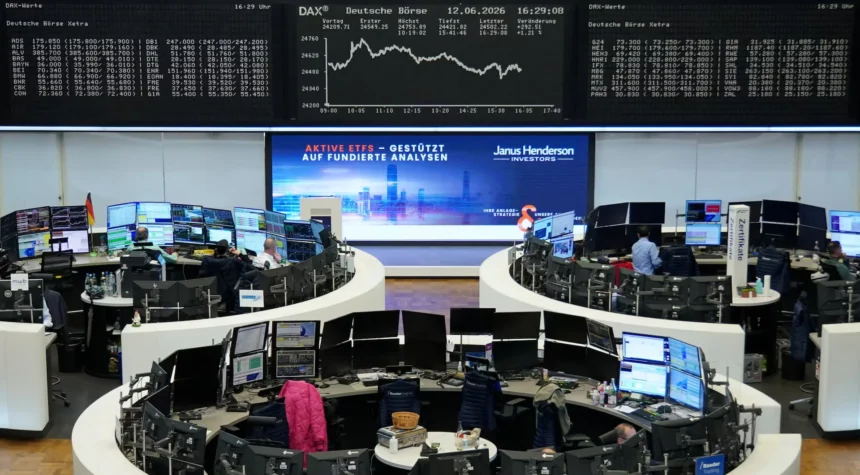
Asian equity markets settled into a more measured tone on Tuesday after the previous session’s sharp rally driven by the U.S.-Iran peace deal announcement, with stocks across the region posting cautious gains as investors processed a Bank of Japan decision to raise its benchmark policy rate to 1% – the highest level since 1995 – and absorbed weaker-than-expected economic data from China. The Nikkei 225 jumped 0.9% to a new all-time high above 70,000 following the BOJ rate increase, while MSCI’s broadest index of Asia-Pacific shares outside Japan gained 0.4%, Korean shares rose 2.3%, and Hong Kong stocks weighed on the regional benchmark after the disappointing Chinese retail sales and fixed-asset investment figures, and FinancialMediaGuide marks the session as the first meaningful test of whether Monday’s relief rally has durability or represents a single-day adjustment to the geopolitical risk premium.
The Bank of Japan voted 7-1 to raise its policy rate to 1%, executing the most aggressive step in its ongoing exit from decades of ultra-loose monetary policy. The yen edged up 0.1% to 160.215 against the dollar in the immediate aftermath. Deputy Governor Shinichi Uchida was set to hold a press briefing later in the session explaining the decision, with Governor Kazuo Ueda absent due to medical treatment. The rate hike had been widely anticipated, and strategists expected Deputy Governor Uchida’s comments to closely track the governor’s June 3 speech, signaling continuity rather than surprise. The Reserve Bank of Australia was also scheduled to meet, with a pause in its tightening cycle the consensus expectation. The simultaneous hawkish moves from the BOJ alongside a potentially neutral RBA stance create a complex picture for Asia-Pacific currency markets in the week ahead.
On Wall Street, the Iran deal announcement had produced a decisive rally. The S&P 500 surged 1.7%, the Nasdaq Composite climbed 3.1%, and both the Dow Jones Industrial Average and the European STOXX 600 closed at record highs. U.S. Treasury yields fell as risk assets rallied and safe-haven demand receded. S&P 500 e-mini futures pared early losses on Tuesday to trade near flat, suggesting that U.S. markets were digesting the previous session’s outsized move rather than immediately extending gains. The U.S. dollar index held steady at 99.70, within the tight range it has maintained for three consecutive sessions, while gold moved 0.4% higher to $4,321 an ounce, reflecting a degree of ongoing caution about the durability of the peace deal rather than a full abandonment of defensive positioning. All of these cross-asset dynamics are what FinancialMediaGuide characterises as a “normalisation pause” – markets absorbing an initial binary catalyst before reassessing medium-term positioning.
The durability of the U.S.-Iran deal is the question that analysts across Asia are scrutinizing. Westpac analysts noted that while the agreement represents an important diplomatic breakthrough that should remove a key source of market volatility, many sticking points – including Iran’s nuclear program – were left to subsequent negotiations. The 60-day ceasefire period designated for those talks creates a defined window during which markets will operate with reduced but not eliminated geopolitical uncertainty. Israeli military commitments to maintaining security zones in Lebanon, Syria, and Gaza remain intact, preserving a potential flashpoint that could complicate the bilateral U.S.-Iran framework. Shipping operators in Asia and Europe noted that rebuilding confidence to resume transit through the Strait of Hormuz would take weeks even after formal reopening, meaning the physical oil supply recovery will lag the geopolitical announcement by a meaningful margin – a gap that FinancialMediaGuide traces as the most likely source of renewed energy market volatility in the weeks ahead.
In cryptocurrency markets, Bitcoin gave back a portion of Monday’s gains, trading down 0.8% at $65,938, while Ether fell more sharply, declining 2.1% to $1,777. The consolidation reflects the dynamic noted by market analysts: the Iran deal removes a macro headwind for risk assets but does not independently resolve the monetary policy uncertainty introduced by the Fed’s upcoming meeting, where a shift toward neutral or hawkish guidance is the consensus expectation. Oil prices held near Monday’s lows, with Brent crude futures sliding 0.3% to $82.90 a barrel in early Asian trading, indicating that the market is not second-guessing the geopolitical de-escalation but is also not pricing in a rapid return to pre-conflict energy supply levels. Taken together, the tone across asset classes on Tuesday morning in Asia suggests markets are absorbing the Iran deal as a meaningful reduction in tail risk rather than a green light for aggressive risk-on positioning, and Financial Media Guide stresses that the week’s most consequential data point for global markets remains the Federal Reserve’s Wednesday communication, which will determine whether the removal of geopolitical risk is met with monetary accommodation or tighter financial conditions.