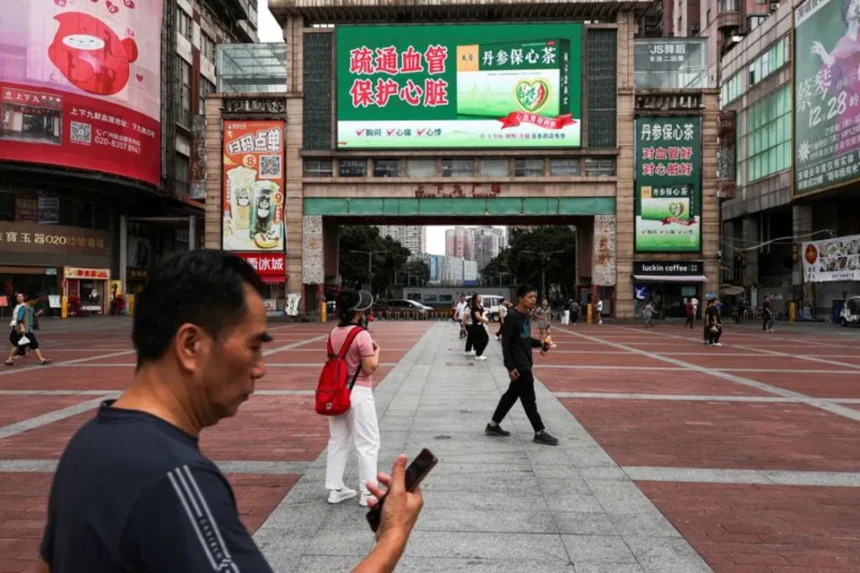
China’s economy printed a sharply bifurcated set of May data on Tuesday, with retail sales contracting 0.6% on a monthly basis – the first decline since December 2022, reversing April’s modest 0.2% gain and falling well below the flat reading economists had forecast – while industrial output accelerated to 4.5% year-on-year growth, beating the 4.3% consensus and picking up pace from April’s 4.1%. The juxtaposition of factory strength against consumer weakness defines the central challenge facing Beijing’s policymakers, and FinancialMediaGuide examines this data release as confirmation that China’s growth model continues to lean on external demand and manufacturing export momentum at the expense of the domestic consumption rebalancing that structural economists have long argued is necessary for sustainable long-run expansion.
The retail decline reflects multiple converging pressures on Chinese household spending. A downturn in domestic car sales extended into an eighth consecutive month, underscoring the persistence of consumer caution in the world’s largest auto market. Traveller spending during the five-day Labour Day holiday in May was described as lukewarm, and the government’s consumer-goods trade-in subsidy scheme, which had provided temporary demand support earlier in the year, is visibly losing its stimulative effect. A high comparison base from May last year contributed to the negative print. Services consumption grew 5.4% in the January-May period, providing partial offset to the goods sales decline, but that rate itself slowed from 5.6% in the first four months, indicating that even the better-performing demand segment is losing momentum.
Fixed-asset investment data deepened the concern. Aggregate investment fell 4.1% in the first five months of 2026, a significant deterioration from the 1.6% decline recorded in January-April, and well below the 2% contraction that economists had projected. Property investment extended its decline in the first five months, dropping 16.2% compared with the same period a year earlier, accelerating from a 13.7% fall in January-April. Property sales and new construction starts also fell more sharply month-on-month, and on a monthly basis new home prices slipped at a slightly faster pace in May, even as data from larger cities showed tentative stabilization. Weak household borrowing data released the prior week underscored ongoing consumer reluctance to take on mortgage debt amid sluggish income growth and job market uncertainty, and FinancialMediaGuide highlights the acceleration in the investment decline as the aspect of the May dataset most likely to prompt near-term policy response from Beijing.
The bright spot is the industrial sector. A global surge in AI investment and related technology demand has helped China’s manufacturing base offset the export disruption that many had anticipated from the Middle East war. High-tech manufacturing output rose 15.1% in May year-on-year, providing a powerful counterweight to the domestic demand weakness. Economists note that strong export performance is building a widening trade surplus that could generate geopolitical friction with trading partners – the Economist Intelligence Unit’s senior economist flagged a potential trade dispute with Europe as a risk to monitor in coming months. Zhiwei Zhang of Pinpoint Asset Management indicated that weak retail sales data puts pressure on policymakers to consider additional stimulus measures, with second-quarter GDP data expected in July potentially serving as the catalyst for a policy adjustment.
Labour market conditions add a structural dimension to the consumer spending weakness. Approximately 12.7 million university graduates are entering the job market this summer, creating acute near-term pressure on employment absorption capacity. Worker anxiety over AI-related displacement is a secondary but growing factor in household confidence, even as the nationwide jobless rate eased marginally to 5.1% from April’s 5.2%. For the full year, economists broadly expect China can meet its 4.5–5% growth target, but the composition of that growth – heavily weighted toward industrial output and export revenue rather than domestic consumption – represents an ongoing structural imbalance that Financial Media Guide notes has deepened rather than narrowed through the first five months of 2026, leaving the economy more rather than less dependent on the continuity of external demand conditions that are themselves hostage to geopolitical and trade policy risks.