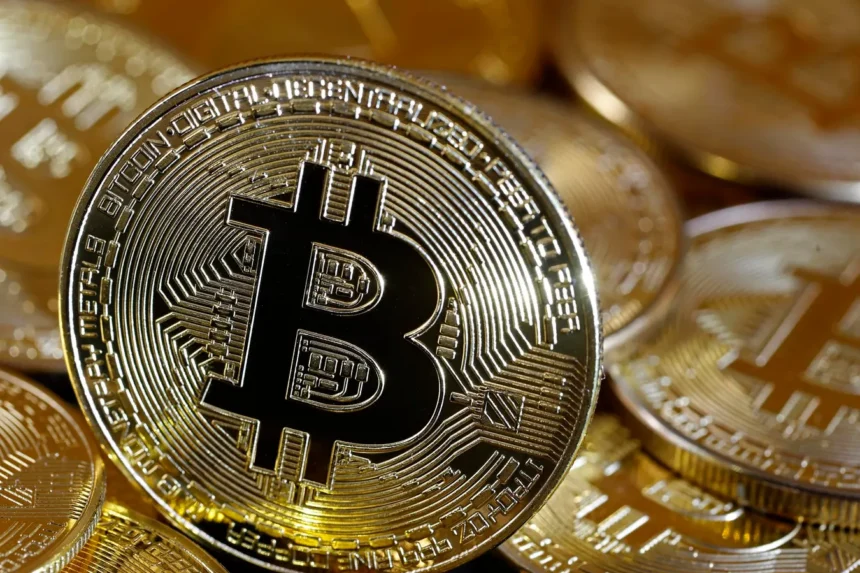
Bitcoin advanced to its highest level in nearly two weeks on Monday, climbing as much as 3.1% to $65,958 as U.S. President Donald Trump declared via social media that a peace agreement with Iran “is now complete” and that the U.S. would end its naval blockade of the Strait of Hormuz – news that sent risk appetite surging across global asset classes from equities to commodities to crypto, and which FinancialMediaGuide registers as a turning point in the macro narrative that has weighed on digital assets since the conflict began in late February.
The rally pulled Bitcoin back above the $65,000 level after it had briefly dipped below $60,000 earlier this month – its lowest point since October 2024. The June lows were exacerbated by a cascading sequence of negative catalysts: Michael Saylor’s Strategy, the largest corporate holder of Bitcoin, disclosed that it had sold a small fraction of its holdings, triggering a sentiment shock that was amplified by significant outflows from spot Bitcoin exchange-traded funds and general risk-off positioning tied to the geopolitical uncertainty of the Middle East conflict. The peace deal announcement effectively removes one of the primary macro headwinds that had suppressed risk appetite, and the simultaneous rallies in European stocks, U.S. equity futures, and Bitcoin on Monday reflected the breadth of that relief.
The relationship between the Iran deal and Bitcoin’s price trajectory is not straightforward, however, and FinancialMediaGuide frames the geopolitical catalyst as a necessary but not fully sufficient condition for a sustained crypto recovery. During the conflict, Bitcoin had behaved largely as a high-beta risk asset, moving in the same direction as equities and in the opposite direction of safe-haven flows. A successful peace agreement removes geopolitical uncertainty as a headwind and could help rebuild the risk appetite that drives ETF inflows and retail participation in crypto markets. But the inflationary consequences of the conflict – most notably the energy price shock that pushed U.S. producer prices to a 3.5-year annual high in May – have raised the probability of Federal Reserve hawkishness in the second half of the year, a scenario that historically weighs on speculative assets including Bitcoin.
The Federal Reserve’s June meeting is the next major event risk for crypto markets. Markets expect new Fed Chairman Kevin Warsh to signal a shift from easing to a neutral or mildly hawkish stance, with any hawkish surprise representing the principal downside risk for Bitcoin in the near term. A $67,000 level has been identified by market participants as a technically significant threshold, representing a confluence of volume nodes and moving averages that would need to be cleared on a sustained basis to indicate that the recovery from the June lows is durable rather than a relief bounce. Ethereum and Solana posted proportionally larger gains than Bitcoin on Monday, with Ether rising as much as 3.7% and smaller tokens producing even more pronounced moves, consistent with the pattern where altcoins lead during risk-on inflections in crypto markets.
The Strategy risk factor referenced by traders remains unresolved. The company’s previous small-scale sale raised questions about whether its massive Bitcoin treasury – accumulated through leveraged purchases at average prices well above current levels – creates a structural overhang for the market if the position requires further management. That concern has not been cleared by the Iran deal news, and Financial Media Guide identifies it as the primary idiosyncratic risk to crypto markets that exists independently of macro conditions and must be monitored alongside the geopolitical and monetary policy developments that are currently driving the headline narrative for Bitcoin.