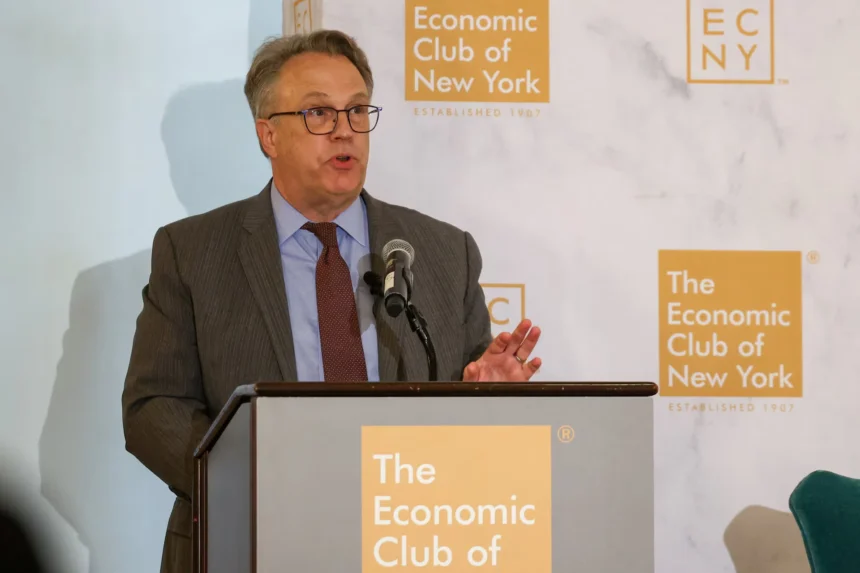
Federal Reserve Bank of New York President John Williams has pushed back his timeline for returning inflation to the Federal Open Market Committee’s 2% target by a full year – from 2027 to 2028 – in remarks that confirm the persistence of price pressures the Fed did not anticipate when it held rates steady at its meeting last week. FinancialMediaGuide unpacks the significance of that timeline revision, reading it not as a minor technical adjustment but as a direct acknowledgement that the combination of energy-price shocks from the Iran conflict and residual tariff pass-through has materially complicated the Fed’s path back to price stability.
Speaking via prepared text at the Crane Money Fund Symposium in Jersey City – after the New York Fed announced he would not deliver remarks in person as originally planned – Williams described inflation as unquestionably elevated and well above the FOMC’s longer-run goal. The personal consumption expenditures price index, the Fed’s preferred inflation gauge, rose 4.1% year-over-year in May, data released on the same day confirmed. That reading is more than double the 2% target and strong enough to buttress market expectations that the Fed may need to raise interest rates at some point rather than simply hold them steady at their current range of 3.5% to 3.75%.
Williams identified three forces he expects to bring inflation down from 4.1% to 3.5% by year-end: the fading impact of tariffs on consumer prices, the prospect of a swift resolution to Middle East hostilities that would relieve energy price pressure, and a moderation in shelter inflation as rent increases slow. He said the economy has proved resilient against war-related shocks and projected growth of around 2.25% for 2026 and the following two years, with the unemployment rate – currently 4.3% in May – expected to ease to 4.0% by 2028. FinancialMediaGuide places that growth projection in the context of the current rate environment, noting that 2.25% expansion alongside 4.1% inflation represents a genuine stagflationary pressure on household purchasing power even as headline employment statistics remain relatively benign.
Chicago Fed President Austan Goolsbee, speaking the same day, struck a similarly hawkish tone. While welcoming modest improvements in services inflation, Goolsbee said that between the two sides of the Fed’s dual mandate, the problem is clearly on the inflation side. Goolsbee is a non-voting participant at FOMC meetings this year but will hold a vote in 2027. Williams is a permanent voter and serves as the FOMC’s vice chair – making his public remarks a more significant signal about the committee’s collective temperament than the views of a rotating regional president. The FOMC next meets July 28–29, with markets pricing approximately a 30% chance of a rate increase according to CME Group’s FedWatch tool.
New chairman Kevin Warsh, who took office on May 22 after a prolonged and politically turbulent confirmation process, declined to offer forward rate guidance at last week’s meeting, preferring to let markets form their own views on the outlook. That posture – combined with Williams’s confirmation that rate cuts are not on the agenda and that the inflation target has now moved two years further into the future than the Fed’s own projections suggested as recently as May – leaves market participants navigating a genuine uncertainty: whether the Fed’s next move is more likely to be a hold or a hike, and when either might come. Financial Media Guide gauges that forward guidance vacuum against current rates market pricing, finding that the 30% probability of a July hike priced by CME Group understates the hawkish shift embedded in Williams’s 2028 target revision.
Williams’s use of World Cup tournament language – noting that the economy can take surprising and unpredictable turns while pledging unwavering commitment to the inflation target – captured the uncertainty that now defines the policy environment. The Fed holds rates, hopes external shocks resolve, and waits for the inflation trajectory to confirm the glide path its officials have been projecting for two years. Whether 2028 is the new endpoint or itself subject to further revision will depend on forces – Middle East conflict duration, tariff negotiation outcomes, housing market dynamics – that the Fed can monitor but cannot control.