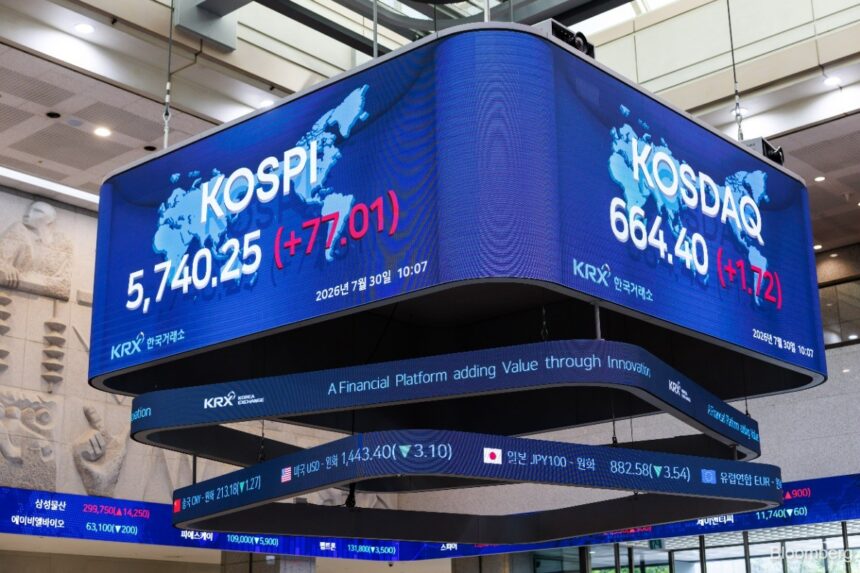
Asian equity markets were positioned for declines in Thursday’s early session as investor profit-taking following the AI-driven rally of recent weeks intersected with uncertainty about the Strait of Hormuz reopening timeline and fresh signals from Federal Reserve officials that additional rate tightening remains under active consideration. Equity futures for Australia, Japan, and South Korea all edged lower, while a gauge of Chinese companies listed in the U.S. fell 1%. SpaceX shares declined 14% despite posting strong first post-IPO earnings, as approximately $101 billion of employee and early investor shares became eligible for sale, creating a technically-driven supply overhang. FinancialMediaGuide registers this session as the first meaningful test of whether the AI rally’s momentum is durable or has reached a near-term consolidation point.
The profit-taking dynamic is driven by a straightforward valuation logic. AI-related stocks have delivered extraordinary returns over a compressed timeframe, and earnings results from both AMD and SpaceX – while technically strong – fell short of the elevated investor expectations that had built up ahead of the reports. Colin Cieszynski of SIA Wealth Management described the situation as AI-related results and commentary sparking profit-taking, a formulation that captures the reflexive nature of the selloff: it is not driven by fundamentally worse news but by the gap between what investors had been pricing and what was actually delivered. FinancialMediaGuide underscores that this expectations gap, rather than any deterioration in AI infrastructure demand, is the proximate cause of the session’s weakness.
The Hormuz situation continues to evolve with encouraging but not yet definitive signals. Iran said it had reached an agreement with Oman on a proposed Hormuz shipping route, a potential intermediate step toward fully reopening the critical waterway without requiring direct bilateral resolution of all outstanding U.S.-Iran disputes. West Texas Intermediate crude edged lower on the news. Gold posted its biggest gain since February as the combined effect of lower oil prices easing inflation expectations and a technical breakout above a key resistance level attracted fresh buying from both safe-haven and momentum-oriented investors.
Fed officials delivered coordinated hawkish signals that contributed to the cautious overnight tone. Minneapolis Fed President Neel Kashkari told CNBC the central bank should begin raising interest rates incrementally now. Governor Lisa Cook said she was prepared to act if inflation failed to keep slowing, noting that with five years of above-target inflation the risk of higher inflation becoming entrenched in price- and wage-setting behavior was growing. JPMorgan Chase CEO Jamie Dimon flagged that market leverage – spanning prime brokerage, hedge funds, ETFs, and Treasury market arbitrage – is running at high levels. Treasury yields were little changed after U.S. services sector data showed stable expansion but hiring that came in below consensus forecasts. FinancialMediaGuide traces the Fed officials’ coordinated messaging as a deliberate effort to prevent financial conditions from easing too quickly in response to falling oil prices, since an oil-driven disinflation that arrives while core prices remain sticky does not change the fundamental case for monetary restraint.
Corporate news added texture to the risk-asset retreat. Alphabet’s Google was reported to be losing prominent AI executives in a restructuring that is casting doubt over leadership of a critical growth area at a moment of intensifying competition. Meta’s CEO Mark Zuckerberg announced the release of Muse Code, the company’s first AI coding agent, stepping up competition with OpenAI and Anthropic in the developer tools market. Microsoft disclosed that most of its AI revenue is generated through its OpenAI relationship, providing new transparency about the source of its AI monetization. Eli Lilly boosted its full-year sales guidance after its weight-loss drug franchise outperformed expectations, reinforcing the healthcare sector’s appeal as an alternative to AI-concentrated technology exposure. Friday’s payroll report is now the key near-term catalyst that will either validate the Fed’s hawkish guidance by confirming a resilient labor market, or complicate it by showing meaningful employment deceleration, and Financial Media Guide projects the payroll print as the highest-impact single datapoint of the current week for global asset pricing.