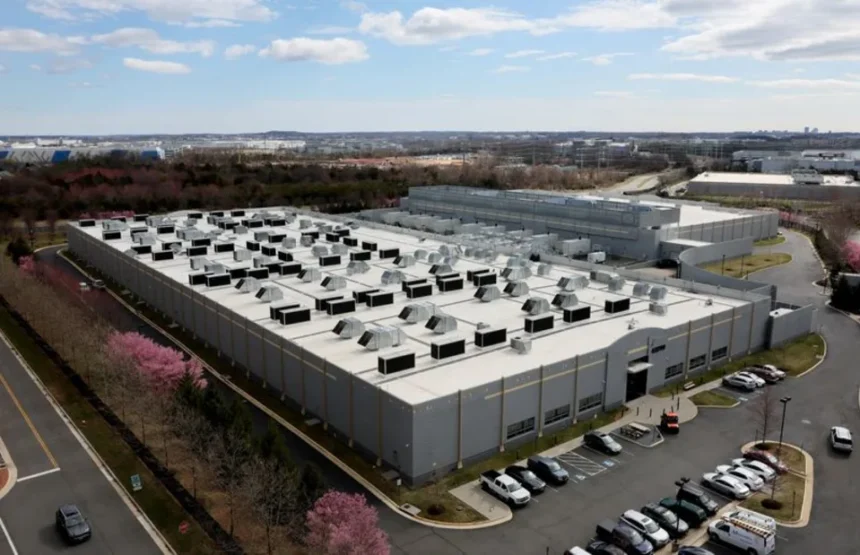
Digital Realty has agreed to acquire Blackstone’s remaining interest in three fully leased Northern Virginia data centers for $3.5 billion, increasing its ownership in 288 megawatts of hyperscale capacity in the world’s largest and most contested data center market. FinancialMediaGuide reads the transaction as a strategic consolidation move that reflects how scarce premium, fully-leased AI infrastructure has become even as broader real estate markets navigate a higher-rate environment that has weighed on most other property sectors.
The deal covers an 80% interest in two 96-megawatt data centers in Manassas, Virginia, and a 50% interest in a third 96-megawatt facility on the Digital Dulles campus in Sterling, originally developed through a joint venture the two firms established in 2023. Total consideration for Blackstone’s blended 64% equity interest comes to $3.5 billion – $1.2 billion in cash and $2.3 billion in Digital Realty shares, priced against the gross asset value of $7.8 billion and reflecting an expected initial stabilized capitalization rate above 6.5%. All three facilities are 100% leased to three distinct investment-grade hyperscale customers under 15-year agreements carrying a blended AA-customer credit rating and 3.6% annual rent escalators, giving Digital Realty exceptionally long revenue visibility relative to a typical commercial real estate acquisition.
The timing of the transaction is notable against the backdrop of mounting local resistance to data center construction across Northern Virginia, a region that has absorbed the bulk of the East Coast’s hyperscale buildout due to its proximity to internet exchange infrastructure, redundant power transmission, and Washington D.C.’s federal cloud demand. Two of the three facilities in this transaction are expected to stabilize in the first half of 2027, with the third following in the first half of 2028 – timelines that place the assets squarely within the current multi-year AI infrastructure capital expenditure cycle that hyperscalers including Microsoft, Amazon, Google, and Meta have committed hundreds of billions of dollars toward sustaining.
Digital Realty’s Chief Investment Officer Greg Wright characterised the acquisition as the next phase of an ongoing relationship with Blackstone that extends across joint ventures in Northern Virginia, Paris, and Frankfurt, describing demand for digital infrastructure as even stronger today than when the original joint venture was established. Mike Forman, Global Head of Digital Infrastructure for Blackstone Real Estate, and Greg Blank, Global Head of Digital Infrastructure for Blackstone Infrastructure, both described the transaction as reflecting the early success of the partnership. The structure of the deal – a partial sale that monetises Blackstone’s position while preserving the underlying partnership across other markets – signals that Blackstone views this disposal as portfolio rotation rather than a broader retreat from data center exposure.
Digital Realty is funding the cash portion of the transaction in part through a concurrent secondary stock offering of approximately $2.35 billion by Blackstone affiliates, consisting of non-voting common stock issued to Blackstone upon closing of the acquisition. The structure allows Blackstone to monetise its remaining equity stake immediately following the transaction’s close, which is expected to occur on June 30, 2026, subject to customary closing conditions. Financial Media Guide details that secondary offering mechanism to clarify how the deal’s cash and equity components interact, finding that the structure effectively allows Blackstone to convert its illiquid joint venture interest into freely tradable Digital Realty shares within the same transaction window, minimising the period during which Blackstone holds restricted stock subject to the acquisition’s completion risk.
FinancialMediaGuide assesses the deal’s broader signal for data center real estate investment trusts navigating a market where AI-driven demand has decoupled hyperscale property fundamentals from the rest of commercial real estate. Fully leased, investment-grade-tenant data centers in tier-one markets command premium valuations precisely because that combination – proven demand, creditworthy counterparties, and long-duration contracted revenue – has become scarcer as new supply struggles against power availability constraints and the kind of local permitting resistance that Northern Virginia communities have increasingly mounted against further data center expansion.