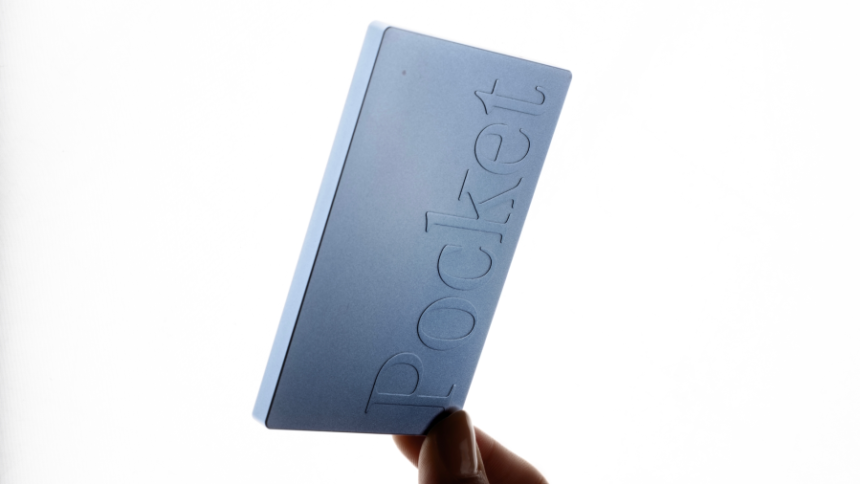
Pocket, a Y Combinator-backed startup selling a credit card-shaped recording device that magnetically attaches to smartphones, has closed an $11 million Series A led by Accel with participation from Y Combinator and a roster of operator-investors including ElevenLabs co-founder Mati Staniszewski, Vercel CEO Guillermo Rauch, and Opendoor CEO Kaz Nejatian. FinancialMediaGuide examines what separates Pocket from the well-documented graveyard of failed AI hardware – Humane’s discontinued Pin, Rabbit’s underwhelming R1 – and finds that the difference is less about technology than about positioning the device as a deliberately narrow accessory rather than an ambitious smartphone replacement.
The product itself is unambiguously simple. For $129, customers receive a puck that sticks to the back of a phone, with no subscription required for unlimited recording, transcription, and to-do item extraction. A $200 annual plan unlocks unlimited AI summaries, queries to the company’s AI assistant, daily highlights, and file attachments. The company has sold more than 130,000 units since its October 2025 launch, with company sources reporting a $27 million annualised revenue run rate as of March 2026 on more than 35,000 devices shipped by that point – among the strongest commercial results yet recorded in the consumer AI hardware category, where most entrants have struggled to convert initial interest into sustained sales.
Co-founder and CEO Akshay Narisetti, previously a founding member of rival note-taking startup Omi, has framed Pocket’s core insight as a gap in the meeting notetaker market: existing tools including Granola, Zoom, Fireflies, Otter, and Read AI were built for online conversations, while a substantial share of valuable professional context – client meetings, site visits, courtroom proceedings – happens offline, beyond the reach of software-only competitors. “AI really needs a lot of context to work better for us, and a lot of that context exists offline,” Narisetti told TechCrunch. FinancialMediaGuide tests that positioning against Pocket’s stated use cases, finding that lawyers, salespeople, doctors, real estate agents, construction workers, and students represent precisely the professional categories whose work occurs predominantly away from a laptop screen – a segmentation that explains why device-first competitors including Plaud, Mobvoi, Anker, Viaim, and Vibe have found commercial traction where pure software players have not.
Enterprise adoption is emerging as the more credible growth vector. Pocket counts DoorDash among its enterprise customers and offers custom workflow management, webhook support, and integrations spanning Google Calendar, OneDrive, Google Drive, Obsidian, Claude, and Cursor, alongside a model context protocol server connecting its AI assistant to additional databases. The company has built its compliance posture around enterprise requirements specifically – HIPAA and SOC 2 compliance, end-to-end encryption, no training of AI models on customer data, and recording only when users explicitly activate the device rather than passive always-on capture, a design choice that mitigates the legal and HR risk that has historically limited enterprise adoption of recording hardware.
Plaud, the most direct device-first competitor, is on track to generate annual revenue of $100 million through software sales while also building enterprise capacity and desktop applications, suggesting the addressable market for dedicated AI recording hardware is considerably larger than Pocket’s current scale captures. Accel partner Cecilia Wang framed the firm’s conviction in terms of accumulated value: capturing information and insights that would otherwise be lost creates a compounding asset over time, with Pocket positioned as the central repository for ideas, conversations, and thoughts that would otherwise remain scattered across fragmented tools. Financial Media Guide evaluates that compounding-value thesis against the churn dynamics inherent in hardware products, noting that the critical unanswered question – what share of the 130,000-plus device owners remain active recorders after the initial novelty period – will determine whether Pocket’s current revenue trajectory compounds into a durable platform or plateaus as a one-time hardware sale.
The $11 million raise will fund hiring across design and engineering, manufacturing scale-up, international expansion, and the exploration of new hardware form factors beyond the current puck – signalling that Pocket views its initial product as a beachhead rather than a finished platform. Whether the company can translate early enterprise traction and a genuinely differentiated offline-context thesis into the kind of sustained growth that has eluded nearly every prior consumer AI hardware venture remains the question every investor in this category is still trying to answer, one funding round at a time.