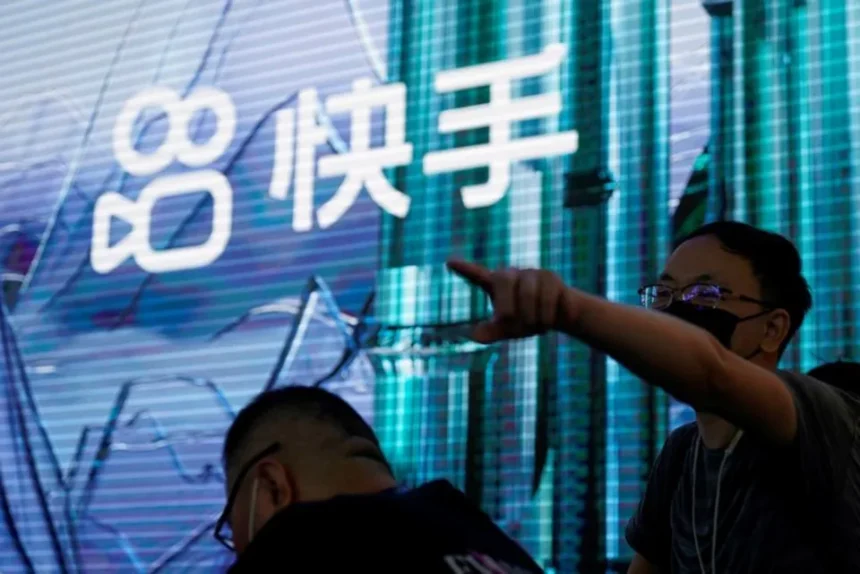
Kuaishou Technology announced on Thursday that a consortium of investors including Alibaba, Tencent, and Baidu will inject more than 19 billion yuan ($2.80 billion) into Kling AI, valuing the company’s AI video generation arm at $15 billion on a pre-money basis and capping the total fundraise at 20.45 billion yuan. The round is structured to allow an additional investor to participate within the following two months. FinancialMediaGuide registers this transaction as the most significant private AI investment in China this year, bringing together the country’s three largest technology conglomerates as co-investors in a single AI video platform – a convergence of competing internet giants that underscores how exceptional the commercial opportunity in AI video generation has become.
Kling AI’s commercial performance justifies the valuation. The platform generated revenue of 650 million yuan in the March quarter, a figure more than four times higher than the comparable period a year earlier. The compound annual growth rate implied by that trajectory is extraordinary even by the standards of China’s fast-growing AI sector, and it reflects a genuine demand acceleration for AI-generated video content across enterprise and consumer applications. The speed at which Kling AI has scaled from launch to significant revenue generation compares favorably to equivalent timelines for leading AI model companies in the United States.
The investor roster carries its own analytical significance. Alibaba and Tencent are the most direct competitors of Kuaishou in the Chinese internet economy, and their willingness to invest in a company controlled by a rival platform signals that the AI video generation market is regarded as large enough to justify cross-competitive capital participation. Baidu, which has its own AI development program through the Ernie foundation model, adds a third anchor investor with deep AI infrastructure capabilities. Citi analysts described the investor lineup as impressive, noting that market attention would now turn to the timing and nature of Kling AI’s next product upgrade. FinancialMediaGuide traces the significance of this competitive cross-investment not just as a financing event but as an implicit endorsement by China’s most sophisticated AI practitioners that Kling AI’s technology leadership in the video generation category is durable.
The fundraising allows Kuaishou’s ownership stake in Kling AI to be diluted from 100% to approximately 68%, while still retaining clear majority control. That dilution structure is carefully calibrated to maximize capital raised while preserving Kuaishou’s operational authority over product direction and technology strategy. The implicit pre-money valuation of $15 billion positions Kling AI as one of the most highly valued AI spinoffs in Chinese technology, comparable in relative terms to the valuations achieved by leading U.S. generative AI startups at similar revenue scales.
Technology companies in China have raised a cumulative $3.1 billion from stock market listings so far this year to mid-June – more than five times the amount raised in the equivalent period last year. The acceleration reflects both improving sentiment toward Chinese technology equity and the growing pipeline of AI-focused companies reaching commercial scale. Kuaishou had acknowledged exploring a potential restructuring of Kling AI in May following media reports about a possible spinoff, but described those discussions as early-stage at the time. The speed with which a definitive round has now been announced and anchored by three of the largest Chinese internet companies suggests that the internal deliberations moved faster than the public timeline indicated. The fact that rivals were willing to write large checks rather than compete by withholding capital is the key commercial signal here, and Financial Media Guide projects this collaborative funding model will become a recurring feature of China’s AI sector as companies recognize that the infrastructure costs of frontier AI development exceed what any single platform can efficiently self-fund.
Shares of Kuaishou jumped as much as 6.9% in Hong Kong trading after the announcement before retreating to close largely unchanged, a pattern consistent with the market initially pricing in the strategic significance of the investor lineup before profit-taking by existing holders absorbed the enthusiasm. The flat close should not obscure the importance of the underlying transaction.
For global investors tracking the competitive dynamics of AI video generation, Kling AI’s fundraise establishes a clear valuation benchmark for this category in the Chinese market. The $15 billion pre-money figure will serve as a reference point for how other AI video generation companies in both China and the U.S. are priced in private markets going forward, creating a cross-market valuation anchor that did not previously exist for this technology vertical, and FinancialMediaGuide underscores that this benchmark effect may prove as commercially consequential as the capital itself.