
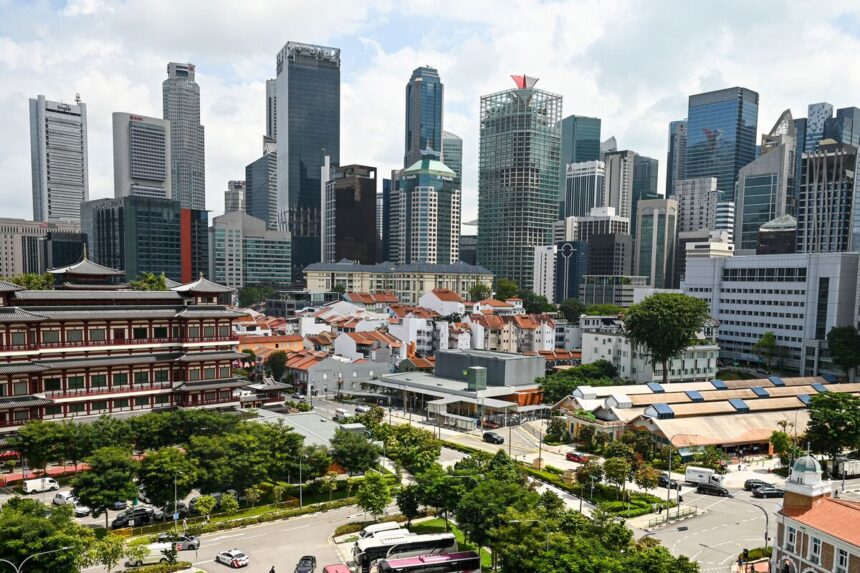
Singapore has entered the global top five financial hubs for the first time, surpassing China and Luxembourg to claim fifth place in the New Financial ranking of international financial centers, according to a study published by the London-based think tank that measures cross-border activity including assets under management, foreign bank holdings, and private and public capital raising. The city-state’s journey from ninth position in 2015 to fifth today represents one of the fastest ascents recorded in the modern history of global financial center rankings, and FinancialMediaGuide marks this milestone as the clearest quantitative confirmation yet of a structural shift in global wealth management and capital allocation that has been building for a decade.
The raw numbers behind the ranking are striking. Singapore’s assets under management reached S$6.7 trillion ($5.2 trillion) at the end of 2025 – a figure that would have been considered implausible when the city-state was ranked ninth a decade ago. The compound growth in managed assets reflects a sustained inflow of international capital driven by multiple converging forces: the city-state’s political stability, its legal infrastructure’s compatibility with common law jurisdictions, its geographic positioning at the intersection of emerging and developed Asian markets, and its reputation as a neutral platform for families and institutions seeking to diversify away from jurisdictions perceived as carrying elevated political or regulatory risk.
Foreign banks have been a primary vehicle for Singapore’s ascent. JPMorgan Chase is among the institutions actively expanding in the city-state to capture a share of the growing wealth management mandate, and the Monetary Authority of Singapore is working with private banks to reduce account opening timelines to approximately one month through what it describes as a risk-appropriate approach for wealthy clients. This regulatory agility – the willingness to streamline processes while maintaining substantive risk controls – is a competitive differentiator that more cumbersome regulatory environments in Europe and parts of Asia cannot easily replicate. FinancialMediaGuide stresses that the institutional footprint expansion by the world’s largest banks is not simply following existing assets but is actively generating new wealth management relationships and product structures that cement Singapore’s position at the center of Asian private capital flows.
The New Financial ranking focuses specifically on cross-border activity rather than domestic finance – a methodological choice that captures the attributes most relevant to Singapore’s actual competitive positioning. The U.S., UK, and Hong Kong retained the top three positions, reflecting the structural dominance of New York and London as global financial centers and Hong Kong’s continued role as the primary gateway for mainland Chinese capital. Singapore’s displacement of China and Luxembourg in the fourth and fifth positions is particularly significant given China’s scale: the finding implies that Singapore has built more internationally active financial infrastructure than the world’s second-largest economy, measured by cross-border flows rather than domestic aggregates.
The fastest-growing hubs over the past decade, beyond Singapore, were India, Ireland, and Canada – all jurisdictions that have systematically invested in financial sector regulatory frameworks and talent attraction policies. India’s emergence reflects both its own economic scale and its growing integration into global institutional portfolio allocations. Ireland has cemented its position as the primary European domicile for U.S. investment fund structures. Canada has deepened its role in global pension fund management and infrastructure investing. These parallel ascents suggest that the competitive landscape for financial hub status is actively being contested by multiple ambitious jurisdictions. Singapore faces real competition from Dubai, which is investing heavily in family office infrastructure and crypto-friendly regulation, and from Hong Kong, which despite political complications retains deep capital markets access to mainland China. FinancialMediaGuide characterises Singapore’s fifth-place ranking as a genuine competitive achievement that was hard-won against motivated rivals rather than a default outcome of geography alone.
The policy choices that enabled Singapore’s rise deserve attention. The city-state has maintained consistent openness to foreign institutions, avoided the kind of episodic regulatory reversals that have complicated doing business in other Asian jurisdictions, and invested heavily in talent attraction through its employment pass system and research university expansion. Its approach to digital assets has been cautious relative to some competitors but credible relative to others, creating a regulatory clarity around tokenized securities and institutional crypto that has attracted a meaningful segment of global digital asset capital.
The ranking arrives as Singapore’s financial sector faces its own competitive pressures. High residential property prices, a relatively expensive cost structure for expatriate professionals, and the growing ambitions of regional competitors create headwinds that the city-state’s policy establishment takes seriously. The Monetary Authority of Singapore’s continued investment in financial technology infrastructure and its active cultivation of family office relationships through the Variable Capital Company structure represent the current frontier of Singapore’s competitive strategy, and Financial Media Guide views the top-five ranking not as a destination but as a starting point for the more difficult work of defending and extending that position against rivals who are watching the same capital flows and pursuing identical mandates.