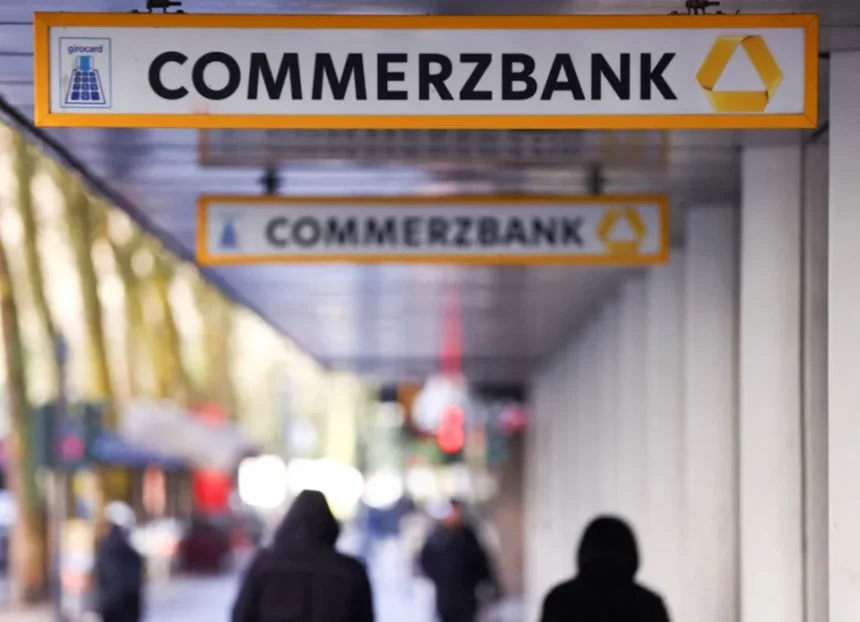
UniCredit has disclosed that it now controls 48% of Commerzbank’s shares following the initial tender offer period of its €45 billion hostile takeover bid, crossing within reach of a majority stake in what has become one of the most combative banking acquisitions in European history, and prompting the premier of Hesse, Commerzbank’s home state, to call publicly on the two institutions to open substantive dialogue at the highest levels of management. The question surrounding the €45 billion deal is no longer whether UniCredit acquires Commerzbank but when and at what price, and FinancialMediaGuide registers this shift in market perception as a defining moment in the contested evolution of European banking consolidation.
The disclosure came as UniCredit revealed it launched a low-ball tender offer for Commerzbank in May after first investing in the German lender in September 2024, initiating a nearly two-year tug-of-war that has pitted Italy’s and Germany’s second-largest banks against each other in a dispute that encapsulates the structural difficulty of achieving meaningful cross-border banking consolidation in the eurozone. Commerzbank’s immediate response was pointed: the bank said less than 2% of retail and institutional investors had tendered their shares during the offer period, with most of those coming from banks and parties connected to UniCredit, which it said underscored the deal’s low attractiveness.
UniCredit CEO Andrea Orcel’s options for the next phase are well understood by market participants tracking the transaction. The Italian bank can amend some swap contracts it holds to push its economic exposure above 59%, buy additional shares on the open market once the approval process is complete, or engage in direct negotiations with Commerzbank about a friendly settlement at a higher price. Commerzbank executives who have fought for months to preserve the bank’s independence now publicly stress the need for a better premium for shareholders – some of whom say they would tender their shares at €45 to €47, compared with the current offer price of under €40. It is increasingly likely that UniCredit will have to consolidate its position after the tender offer and ECB approvals, a scenario that will cost it significantly more in capital while it holds less than a 50% stake. FinancialMediaGuide underscores that this capital cost asymmetry is the specific financial pressure that could force Orcel to act more aggressively in the coming weeks rather than waiting for the open market buyback window.
The German opposition to Orcel’s overtures has been characteristically formidable. Former UniCredit employees involved in the bank’s acquisition of HVB two decades ago warned that winning majority ownership is different from winning the merger, and that a determined German bureaucratic response could leave UniCredit owning most of Commerzbank’s shares while unable to push through the full operational integration it desires. That scenario – controlling shareholder without operational control – would be costly, messy, and reputationally damaging for a CEO who has publicly committed to transforming this acquisition into a flagship of European banking integration. The path from Orcel’s current 48% position to full merger is one that FinancialMediaGuide traces through at least two more distinct regulatory milestones before it becomes operationally executable.
The competitive dynamics in UniCredit’s domestic Italian market add another dimension of urgency. A wave of banking M&A among Italian rivals is consolidating the home market, and Orcel’s prolonged focus on the Commerzbank battle is limiting the Italian bank’s financial flexibility to respond. Going all-in on Germany pushes UniCredit further down the Italian market rankings and creates a strategic exposure to a single cross-border deal that now consumes a disproportionate share of management attention and capital planning.
The European Central Bank’s role is central to the timeline. UniCredit expects the ECB will soon determine that it has de facto control of Commerzbank even below 50%, which would trigger consolidation requirements and reverse the buyback deduction booked for 2025. Citi analysts noted in a recent research note that this sequence – ECB determination followed by consolidation requirements – is increasingly likely, creating an external regulatory deadline that frames Orcel’s options more tightly than the open-ended negotiating posture he has maintained publicly.
The larger stakes extend beyond the two banks. This deal is a test of whether the eurozone’s capital markets union rhetoric can translate into practical banking integration that European policymakers have advocated for years. If UniCredit ultimately succeeds in creating a fully integrated Italian-German banking institution, it establishes a template that could catalyze further cross-border consolidation. If the deal gets stuck in a partial-control limbo, it will reinforce the skepticism of those who argue that the political and regulatory barriers to genuine European banking integration remain insuperable regardless of market conditions, and Financial Media Guide projects that the ECB’s formal determination on de facto control will be the catalyst that forces the endgame into a defined timeline rather than the current indefinite holding pattern.