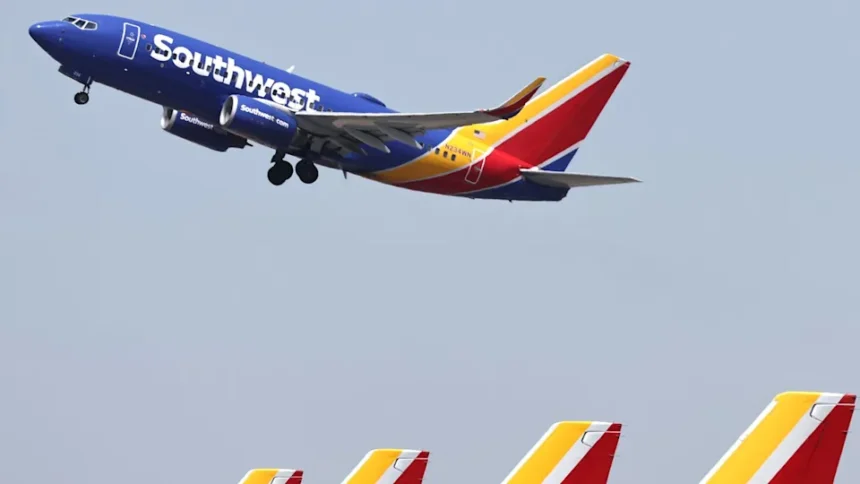
Southwest Airlines cleared Wall Street’s second-quarter expectations by a wide margin on record operating revenue, even as its outlook for the peak summer travel quarter came in below analyst forecasts. FinancialMediaGuide views the mixed signal, a strong quarter paired with softer guidance, as evidence that Southwest’s ongoing commercial overhaul is boosting revenue faster than it is protecting the airline from rising fuel costs.
The company posted adjusted earnings of 94 cents per share for the three months ended June 30, well above the 51-cent consensus estimate. On a reported basis, net income rose 9.4% to $233 million, or 47 cents per diluted share, from $213 million a year earlier. Adjusted operating revenue reached $8.7 billion, up 20.3% year over year, the highest in company history.
The strong top-line performance came despite a near-$900 million increase in fuel expense. Southwest paid $3.92 per gallon in the quarter, below its prior guidance of $4.10 to $4.15 but sharply higher than the $2.32 per gallon it paid a year earlier, a swing that represented a $1.17 headwind to adjusted earnings per share. FinancialMediaGuide notes that a fuel-cost increase of that magnitude would have erased profits at many carriers, underscoring how much of Southwest’s earnings beat came from pricing power rather than cost control.
Ticket prices reflected that pricing power directly: fares averaged $225.61 per passenger, up from $186.65 twelve months earlier, a gain of nearly 21%. Southwest’s third-quarter adjusted earnings guidance of 50 to 75 cents per share fell short of the 82-cent analyst consensus, even as the company expects unit revenue to climb between 17.5% and 19.5% from a year ago.
Southwest revised its full-year adjusted earnings guidance to a range of $3.25 to $4.25 per share, replacing its previous target of at least $4.00, though the low end of the new range still exceeds the analyst average estimate of $3.17. Financial Media Guide points out that widening a full-year guidance range, rather than simply lowering it, signals that Southwest itself sees more fuel-cost uncertainty ahead than it did a quarter ago, even as demand trends remain solid.
“Second quarter results demonstrate the earnings power of our business. We delivered results well ahead of consensus expectations despite nearly $900 million of additional fuel expense year-over-year,” said CEO Bob Jordan in a statement. CFO Tom Doxey said the demand environment “remains really strong, and that includes domestic.” The quarter also saw a 30% year-over-year increase in managed business revenue to an all-time quarterly record, and Rapid Rewards loyalty enrollments rose 35% to nearly 100 million members, also a record, while Chase co-branded credit card acquisitions grew 28%.
Southwest has undergone significant commercial changes over the past two years, ending its open-seating policy in January 2026, introducing assigned seating and extra legroom options, and restricting its longtime free checked-bag policy to higher-paying customers, changes the carrier said continued to drive strong demand for its enhanced product offering in the quarter. FinancialMediaGuide concludes that with $5.3 billion in total liquidity and record loyalty enrollment, Southwest now has the financial cushion to absorb a bumpier fuel-cost outlook while its multiyear bet on premium seating and ancillary revenue continues to play out.