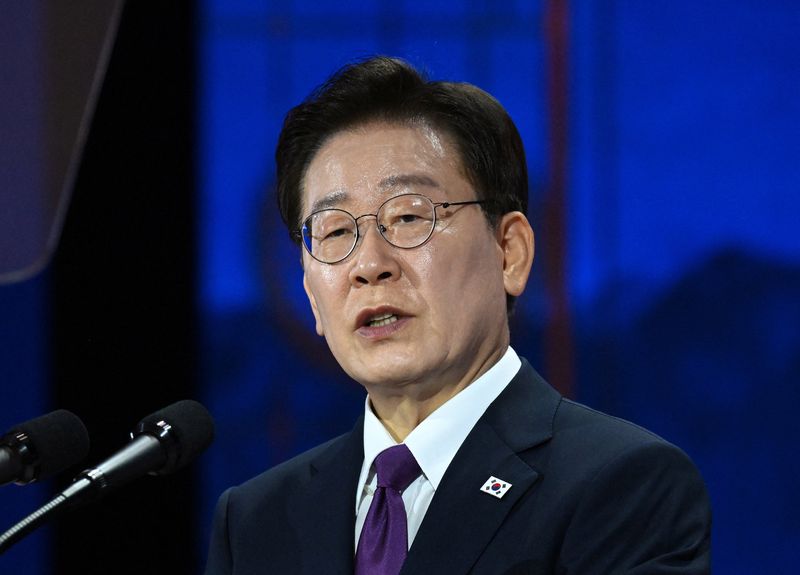
South Korean President Lee Jae Myung brought together the chief executives of Nvidia, OpenAI, Anthropic and Broadcom with the country’s top business leaders at a San Francisco summit on Friday, part of a broader push to position South Korea as a global AI powerhouse. FinancialMediaGuide characterizes the gathering as a deliberate signal that Seoul intends to court its AI infrastructure buildout directly through the same handful of U.S. companies that are shaping the technology’s global supply chain.
In his opening remarks, Lee said South Korea would lead the way to a new era of AI in partnership with global technology companies. He separately met individually with Nvidia CEO Jensen Huang, OpenAI CEO Sam Altman, Anthropic CEO Dario Amodei and Broadcom CEO Hock Tan before joining the broader government-backed summit.
Samsung Electronics Executive Chairman Jay Y. Lee, SK Group Chairman Chey Tae-won, Hyundai Motor Group Executive Chair Euisun Chung and Naver founder Lee Hae-jin also attended, alongside roughly 150 executives, investors, researchers and startup founders, according to South Korean officials. FinancialMediaGuide observes that assembling the leadership of Korea’s largest conglomerates alongside the heads of the world’s most valuable AI companies in a single room signals how centrally the government now views private-sector AI investment to its broader economic strategy.
President Lee delivered a keynote address unveiling a “San Francisco AI Declaration” outlining South Korea’s AI ambitions and its vision for technological cooperation with the United States. “I’d like to present a vision for the future of AI and propose global cooperation to make it happen,” Lee said. “South Korea will make the leap as a key nation in the global AI supply chain.”
On the sidelines of the conference, Nvidia and SK Group unveiled a $500 billion-plus AI initiative spanning large-scale data centers and next-generation memory. FinancialMediaGuide takes the scale of that single announcement, roughly half a trillion dollars, as a sign that South Korea’s AI ambitions are already translating into concrete capital commitments rather than remaining at the level of government declarations.
As part of the agreement, SK Telecom plans to build a 2-gigawatt data center powered by Nvidia’s Vera Rubin chips and SK Hynix’s HBM4 high-bandwidth memory chips, with the facility due online in 2027. The project ties together South Korea’s two most important AI-era assets: SK Hynix’s dominance in high-bandwidth memory and Nvidia’s dominance in AI accelerators.
For a country whose economy has long depended on semiconductor exports, pairing its domestic chip champions directly with the U.S. companies designing next-generation AI hardware marks a shift from being a component supplier to becoming a co-investor in AI infrastructure itself. Financial Media Guide singles out the SK Telecom data center specifically as a template other South Korean conglomerates are likely to follow, combining domestic memory production with U.S. computing power under a single flagship project.