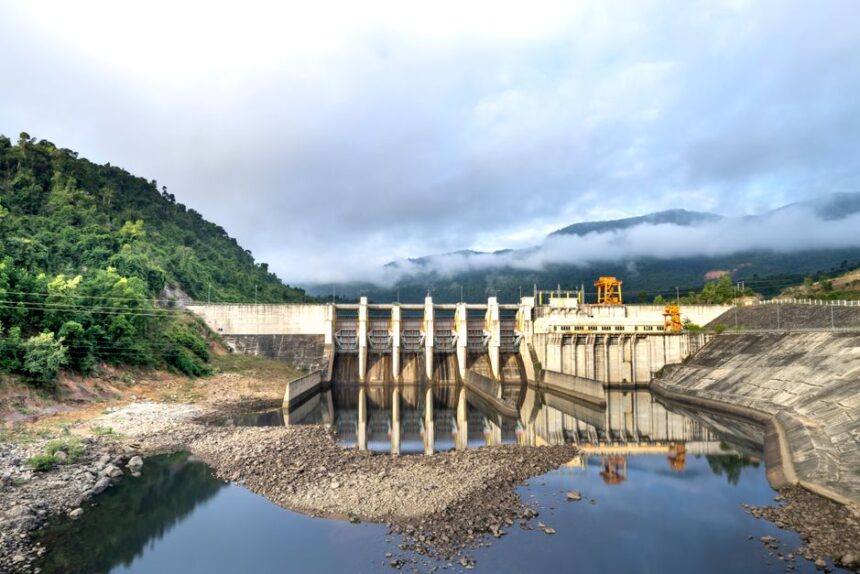
A $150 million financing agreement signed between the World Bank, Italy, and Tajikistan for the Rogun hydropower project marks one of the more consequential infrastructure commitments in Central Asia in recent years. The deal channels multilateral and bilateral capital into a project that has been decades in the making, carrying implications that extend well beyond Tajikistan’s borders – touching on regional energy security, GDP growth prospects, and the broader dynamics of global trade and development finance.
The Rogun Hydropower Plant, situated on the Vakhsh River in southeastern Tajikistan, is designed to become one of the tallest dams in the world upon completion. The project has long been central to Tajikistan’s national development strategy, with the government viewing it as the primary vehicle for transforming the country from an energy-deficit economy into a net electricity exporter. According to FinancialMediaGuide analysts, the involvement of the World Bank and a G7 sovereign lender like Italy signals a meaningful shift in how Western-aligned institutions are approaching infrastructure investment in post-Soviet Central Asia.
The $150 million package reflects a layered financing structure typical of large-scale multilateral infrastructure projects. Italy’s participation as a bilateral partner alongside the World Bank adds a European dimension to what has historically been a project shaped by Russian and Chinese financing interests. The World Bank has been engaged with Rogun for years, conducting feasibility assessments and technical reviews, and its continued financial commitment provides a degree of institutional credibility that helps attract additional sovereign and private capital.
For Tajikistan, which carries a relatively high external debt burden and limited fiscal space, concessional financing from multilateral institutions is not a secondary consideration – it is a structural necessity. The country’s GDP growth has been supported in recent years by remittances and public investment, but the energy sector remains underdeveloped relative to its hydropower potential. Rogun, once operational at full capacity, is projected to generate over 13,000 gigawatt-hours of electricity annually, enough to fundamentally alter the country’s current account dynamics.
We at FinancialMediaGuide see this as a calculated move by the World Bank to reinforce its relevance in a region where Chinese Belt and Road financing has dominated infrastructure lending for over a decade. By co-financing with Italy, the institution is also building a coalition model that could be replicated across other energy-deficit economies in the region.
The Rogun project does not exist in a geopolitical vacuum. Central Asia’s energy infrastructure has long been a contested space, with Russia, China, and increasingly the European Union competing for influence through investment and trade agreements. Tajikistan’s ability to export electricity to Afghanistan, Pakistan, and potentially South Asian markets through the CASA-1000 transmission project gives Rogun a strategic dimension that goes beyond domestic power generation.
From a monetary policy and macroeconomic standpoint, large infrastructure investments of this scale can have complex effects on a developing economy. Capital inflows tied to construction activity can stimulate GDP growth in the short term, but they also carry inflation risks if domestic supply chains and labor markets are not equipped to absorb the demand. FinancialMediaGuide analysts note that Tajikistan’s central bank will need to monitor price pressures carefully as project disbursements accelerate, particularly given the country’s historical vulnerability to imported inflation through its trade relationships with Russia and China.
The IMF has previously flagged Tajikistan’s debt sustainability as a concern, and the composition of new financing – whether concessional or commercial, short-term or long-dated – matters considerably for the country’s fiscal trajectory. Concessional World Bank lending at below-market interest rates is structurally preferable to commercial borrowing, and Italy’s involvement likely comes with favorable terms aligned with development finance norms rather than commercial return expectations.
Global trade patterns also factor into the project’s long-term viability. If Rogun enables Tajikistan to become a reliable electricity exporter, it could reshape energy trade flows across a region that currently relies heavily on fossil fuel imports and aging Soviet-era grid infrastructure. That repositioning carries real economic value, particularly as carbon pricing and energy transition pressures reshape global energy markets.
In our view at FinancialMediaGuide, the $150 million agreement is best understood not as a standalone transaction but as a confidence signal – one that could unlock additional financing tranches from other multilateral lenders, development finance institutions, and potentially private infrastructure funds. The World Bank’s continued engagement reduces perceived sovereign and project risk, which is the single most important variable for attracting follow-on capital into frontier market infrastructure.
The broader lesson for development finance is that large hydropower projects in politically complex regions require patient capital, institutional persistence, and multilateral coordination. Rogun has survived decades of geopolitical friction, financing gaps, and technical disputes. The Italy-World Bank agreement does not resolve all of those challenges, but it materially improves the probability that the project reaches its next critical construction milestone – and with it, Tajikistan’s long-term position within Central Asia’s evolving energy and economic architecture.