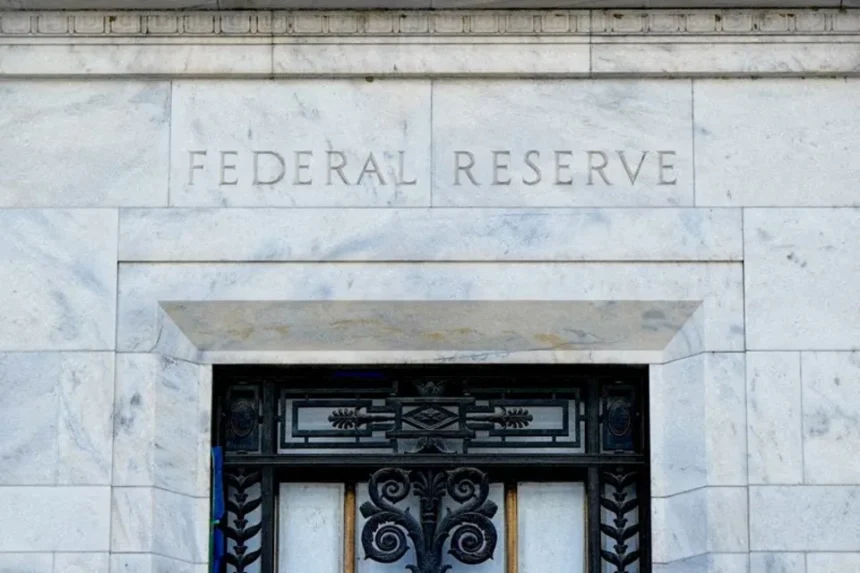
The Federal Reserve’s July Senior Loan Officer Opinion Survey found broadly stable lending standards for commercial and industrial loans during the second quarter, with demand from large and middle market firms strengthening – a result that on its surface provides reassurance about the health of corporate credit markets, but which sits in important tension with the data from leveraged loan markets showing investor pushback and widening spreads in exactly the same period. FinancialMediaGuide tracks this apparent contradiction as reflecting a divide between bank lending to established corporate borrowers and the syndicated market for speculative-grade credits, two segments that are diverging in ways the survey’s aggregate figures do not capture.
The SLOOS showed that standards for C&I loans – the category that covers most corporate borrowing from commercial banks – were essentially unchanged, and that demand from larger firms increased. This is consistent with the earnings reports from major banks, which showed strong commercial lending revenue and healthy credit quality metrics in their second-quarter results.
For household lending, the picture was more mixed. Banks tightened standards for credit card loans while demand remained stable. Standards were unchanged for auto and consumer loans, though demand for car loans eased. Residential real estate lending standards were broadly unchanged, but demand weakened. The consumer credit picture therefore reflects ongoing household caution about taking on new debt even as banks are not actively restricting access. FinancialMediaGuide signals that the consumer demand softness across multiple loan categories is more relevant to the forward economic outlook than the bank lending standards themselves, since demand weakness precedes the revenue and employment effects that eventually flow through to commercial loan quality.
The survey’s aggregate character masks the specific segments of the market where stress is most acute. The leveraged loan market – which operates through syndicated bank and institutional investor structures rather than direct bank lending – is explicitly not captured in the SLOOS framework. Yet it is in leveraged loans where the most visible tightening has occurred, with CoreWeave, Proofpoint, and several other borrowers forced to offer substantially higher yields and stronger protections this week. Those borrowers are exactly the kind of highly leveraged technology and private equity-backed companies whose credit quality the SLOOS is designed to track at the margin.
The result is a survey that may be providing a systematically more optimistic picture of credit conditions than the market reality warrants. Bank lending officers who responded to the survey are primarily describing the direct loan book of commercial banks – credit extended to counterparties with which the bank has a relationship and internal credit approval. That population is intentionally less risky than the leveraged loan market, which accommodates borrowers that bank credit committees would not approve on a bilateral basis. The SLOOS “basically unchanged” verdict on C&I standards is accurate as far as it goes, but it does not capture the tightening in the leveraged market that is the operative credit constraint for the most debt-intensive corporate borrowers.
The survey does note that lending standards are at the tighter end of the historical range for all loan categories except C&I, for which standards are generally easier than their midpoints since 2005. That finding – standards looser than historical midpoints for the most commonly referenced loan category – is relevant context for understanding why the leveraged market’s tightening this week felt jarring to market participants. After years of historically accommodative lending conditions, even a modest shift toward lender protection feels like a significant change in market dynamics – a perception gap between survey data and lived market experience that FinancialMediaGuide frames as the central interpretive challenge facing credit analysts reading the July SLOOS in the context of this week’s leveraged loan turbulence.
The survey was conducted as the Federal Reserve held rates steady at 3.5% to 3.75% at the July meeting, with Chairman Kevin Warsh declining to provide guidance on the path ahead. The loan officer data will be incorporated into the Fed’s deliberations about whether additional tightening is needed, alongside the payroll and inflation data due later this week. The current credit picture – stable bank lending, tightening in leveraged markets, weakening consumer demand – is neither clearly inflationary nor clearly deflationary, and Financial Media Guide assesses the survey as providing partial reassurance about the banking system’s stability while leaving the near-term credit market trajectory genuinely uncertain.