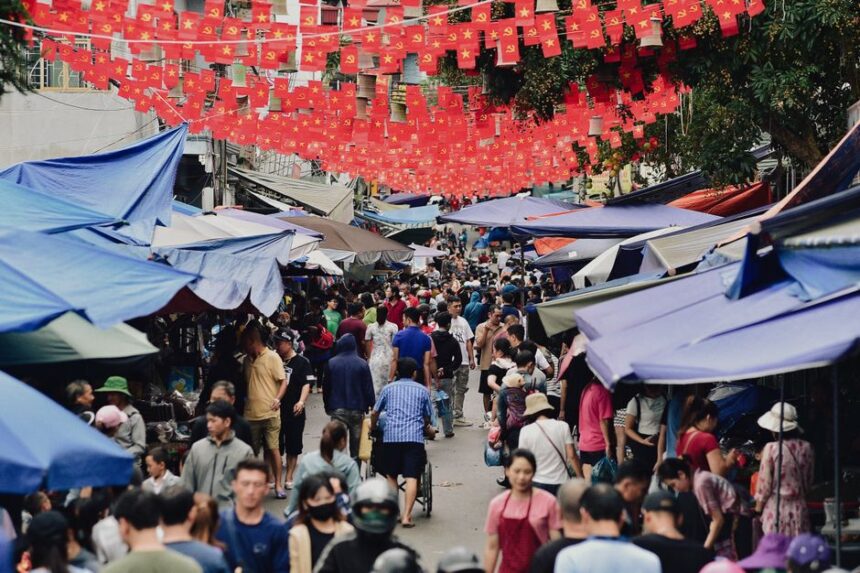
Vietnam’s export machine has been running at a pace that stands out sharply against a backdrop of sluggish demand across much of the global economy. In the first seven months of 2024, the country’s total trade turnover reached approximately $439 billion, with exports climbing to around $226 billion – a year-on-year increase of roughly 15%, according to data from Vietnam’s General Statistics Office. For an economy whose trade-to-GDP ratio consistently exceeds 200%, these figures are not incidental – they are the primary engine of national output and a direct signal of where Vietnam sits in the shifting architecture of global trade.
The performance carries weight beyond domestic headlines. At a moment when the world economy is navigating the lagged effects of aggressive monetary tightening, elevated interest rates in major markets, and persistent uncertainty around tariffs and supply chain realignment, Vietnam’s trajectory offers a case study in how smaller, export-oriented economies can capture momentum by positioning themselves at the intersection of manufacturing diversification and trade corridor expansion.
The composition of Vietnam’s export growth matters as much as the headline figure. Electronics, machinery, and textiles remain the dominant categories, with the United States, China, and the European Union collectively absorbing the bulk of outbound shipments. Foreign direct investment – particularly from South Korean, Japanese, and Taiwanese manufacturers – has continued to flow into Vietnamese industrial zones, reinforcing the country’s role as a preferred alternative to higher-cost or higher-risk production bases. Samsung alone accounts for a significant share of Vietnam’s electronics exports, a concentration that represents both a structural advantage and a vulnerability if demand from major consumer markets softens.
GDP growth in Vietnam reached approximately 6.9% in the first half of 2024, according to official government data – a rate that places it among the faster-growing economies in Southeast Asia and well above the IMF’s projected global average of around 3.2% for the full year. The World Bank has maintained a broadly constructive outlook for Vietnam’s medium-term growth, citing infrastructure investment and trade integration as key supports, though it has also flagged risks tied to external demand weakness and fiscal space constraints.
The global trade environment in which Vietnam is operating remains complicated. The Federal Reserve held its benchmark interest rate at a 23-year high through much of 2024, keeping borrowing costs elevated for U.S. consumers and businesses. That monetary policy stance has compressed discretionary spending in one of Vietnam’s largest export destinations. Meanwhile, tariff friction between the United States and China – including the continuation and selective expansion of Section 301 tariffs – has paradoxically benefited Vietnamese exporters by redirecting procurement decisions toward non-Chinese suppliers. In our view at FinancialMediaGuide, this tariff-driven trade diversion effect has been a structural tailwind for Vietnam, but it is one that depends on the continuation of a specific geopolitical configuration rather than on domestic productivity gains alone.
Inflation dynamics add another layer of complexity. Vietnam’s consumer price inflation has remained relatively contained compared to peers, running at around 4% in mid-2024 – within the government’s target band. The State Bank of Vietnam has maintained an accommodative monetary policy stance, cutting rates in 2023 to support growth, a contrast to the tightening cycles pursued by the Federal Reserve and other major central banks. This divergence has supported domestic credit conditions but has also put modest pressure on the Vietnamese dong, which affects import costs and the real purchasing power of export revenues when converted back to local currency.
Strong trade data can obscure structural vulnerabilities that matter for investors and policymakers alike. Vietnam’s export base, while diversifying, remains heavily concentrated in a relatively small number of multinational-anchored sectors. A demand recession in the United States or the eurozone – both of which remain plausible tail risks given the lagged transmission of high interest rates into consumer and corporate balance sheets – would reduce order volumes with limited domestic offset available in the short term.
The IMF has repeatedly emphasized that global trade growth is expected to remain below its pre-pandemic average through the medium term, constrained by geopolitical fragmentation, rising tariffs, and the reshoring impulses of major economies. For Vietnam, this means the current window of opportunity – created partly by trade diversion and partly by competitive manufacturing costs – may narrow as other low-cost producers in South and Southeast Asia compete for the same investment and procurement flows.
According to FinancialMediaGuide analysts, the more durable growth path for Vietnam runs through upgrading the value chain rather than simply expanding volume. Attracting higher-value manufacturing, deepening domestic supplier networks, and reducing dependence on imported inputs would improve the quality of GDP growth and reduce exposure to external shocks. The country’s participation in trade agreements including the CPTPP and the EU-Vietnam Free Trade Agreement provides a framework for that transition, but translating preferential market access into sustained productivity gains requires institutional and infrastructure investment that takes years to materialize.
For investors monitoring emerging market exposure, Vietnam’s seven-month trade performance reinforces the case for selective engagement with economies that have clear positioning within global supply chain realignment. The risks are real and the external environment remains fragile – but the underlying trade momentum, grounded in verifiable data and structural investment flows, reflects a growth story that the broader world economy has struggled to replicate in 2024. FinancialMediaGuide sees the trend as meaningful, provided policymakers sustain the conditions – macroeconomic stability, trade openness, and investment-friendly regulation – that have made it possible.