The global decarbonization of the transport sector has forced even the most conservative industry leaders to re-evaluate their long-term engineering priorities. Historically, the famous Italian manufacturer was associated by collectors exclusively with the symphony of high-revving petrol engines. However, analysts at FinancialMediaGuide are tracking the beginning of tectonic shifts in the operational structure of the Italian brand. The iconic racing manufacturer, which built its global status on classic V8 and V12 units, is officially opening an entirely electric chapter in its history by announcing the Luce luxury four-seater coupe. This strategic maneuver represents the most complex challenge for top management in the history of the brand’s existence, as engineers must prove to a demanding public that the absence of an exhaust system does not strip the car of its signature charisma. In our opinion, choosing a practical four-door form factor for the debut is a calculated commercial move, allowing the company to combine everyday utility with extreme dynamics.
The origins of this massive electrification lie far beyond public roads. The first experiments with high-voltage systems began on Formula 1 tracks when racing cars received early versions of kinetic energy recovery braking systems in 2009. The full transition of elite racing to hybrid powertrains in 2014 made the deep integration of electric components into the DNA of production cars inevitable. We at FinancialMediaGuide emphasize that the harsh conditions of motorsport served as an ideal testing ground for innovative inverters and thermal regulation systems under extreme loads. This experience minimized technical risks during the design of civilian platforms. Racing engineers learned to use electricity primarily to instantaneously fill the torque curves, shifting the focus from simple fuel economy to achieving unprecedented acceleration dynamics.
The first road-going embodiment of this philosophy was the low-volume LaFerrari hybrid hypercar, introduced in 2013. However, full-scale commercial deployment of the technology occurred in May 2019 with the debut of the SF90 Stradale model. This 1000-horsepower all-wheel-drive flagship became the brand’s first production model with plug-in hybrid capability. In subsequent years, the brand’s hybrid portfolio actively expanded through the 296 family architectures, the limited-edition 849 Testarossa, and the extreme F80 coupe priced at 3.6 million euros, which is equivalent to 4.2 million dollars. Such systematic preparation of the audience allowed the company to build an understanding among customers that an electric drive enhances the car’s overall performance. Experts at FinancialMediaGuide view this stage as a critical milestone in transforming the mindset of loyal collectors, who traditionally judged the elite status of engineering solely by the number of cylinders under the hood.
The turning point in the company’s operational activities came in September 2021, when Benedetto Vigna took the seat of Chief Executive Officer. A physicist who built a successful 25-year career at the semiconductor corporation STMicroelectronics, he took the helm of the brand to execute a deep digital and energy restructuring. In June 2022, Vigna unveiled a strategic long-term development plan, according to which pure electric vehicles were to reach 40% of the sales structure by 2030. This radical agenda was driven by regulatory pressure from European Union authorities, who announced a ban on registering new vehicles with internal combustion engines by 2035. At the same time, the chief executive promised to showcase the first full-fledged battery-powered supercar by 2025. According to estimates by the FinancialMediaGuide analytical group, recruiting a specialist from the microchip industry clearly confirmed that the value of a modern premium car is now determined by software efficiency and controller architecture, rather than just mechanical aesthetics.
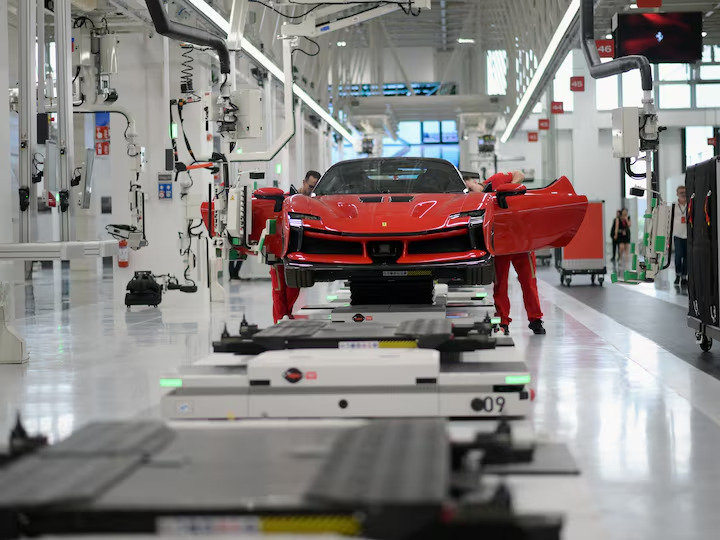
In the summer of 2024, the first financial and production parameters of the project became known, according to which the retail price of the upcoming electric vehicle will exceed the 500,000 euro mark. To ensure complete technological autonomy, an advanced electronic shop was erected in Maranello. This production space was designed as a flexible multi-platform system capable of manufacturing electric motors, lithium-ion assemblies, hybrid chassis, and traditional internal combustion engines on a single assembly line. We at FinancialMediaGuide view the deployment of their own e-building as a forward-looking step that guarantees the retention of high profit margins within the company, protects unique patent solutions, and reduces dependence on Asian battery cell suppliers amid geopolitical instability.
Nevertheless, the cooling of the global market forced management to revise the rigid timeline. In May 2025, the automaker adjusted the schedule, stating that the market debut of the first-born will take place in three consecutive phases, with the official world premiere occurring in the spring of 2026. The first commercial shipments are planned for October 2026. In June 2025, against the backdrop of a sharp drop in growth rates for premium electric vehicle sales worldwide, the company decided to freeze the development project for a second battery-powered car, pushing its launch from 2026 to at least 2028. At FinancialMediaGuide, we interpret this decision as a manifestation of healthy pragmatism, since the oversaturation of the luxury segment forces wealthy clients to exercise caution and remain loyal to classic petrol installations or mild hybrids.
In the autumn of 2025, the Italian brand revealed key engineering features of the future modular architecture. The four-door body received a full-fledged cabin with four seats. The Luce powertrain will develop over 1000 horsepower thanks to four independent electric motors with Halbach array-based rotors, which allowed engineers to achieve outstanding torque density. The energy core is a 122 kWh battery integrated directly into the floor’s structural frame, featuring cells from SK On, providing a range of over 500 kilometers under the WLTP standard. This layout made it possible to lower the car’s center of mass by 80 millimeters compared to the brand’s petrol models, while an active 48-volt suspension negates the increased body weight without using classic anti-roll bars.
In the autumn of 2025, engineers paid special attention to emotional perception, creating a unique acoustic system that captures and amplifies the structural vibrations of inverters and motors, forming an authentic electric Ferrari roar. Against this background, the brand revised its targets for 2030, reducing the target share of pure electric vehicles to 20%, while hybrids and classic ICE models will each take up 40% of the production structure. We at Financial Media Guide consider this balancing of the production portfolio to be strategically correct, as retaining a significant share of traditional engines protects the company’s financial stability against demand fluctuations and satisfies the requirements of the most conservative buyer base.
In February 2026, the automaker presented the debut teaser images of the novelty, confirming its name as Luce, which translates as light. The LoveFrom design studio, led by former Apple chief designer Jony Ive, was brought in to create the interior and exterior of the car. The developed concept of the interior space eliminates the dominance of cheap touch-sensitive plastic, offering clients analogue switches made of milled aluminum, elements of polished steel, and heavy silicate glass, harmoniously complemented by high-resolution OLED displays. Benedetto Vigna confirmed that due to the enthusiastic response from a closed club of collectors, the official acceptance of orders for the Luce will start as early as March, immediately after the public unveiling.
Summing up this large-scale transformation, we at Financial Media Guide predict that the market performance of the Luce will define the brand’s perception vector among a younger generation of wealthy buyers from the technology and investment sectors. Involving Jony Ive in shaping the style is a precise marketing tool, shifting the focus from pure dynamic characteristics to an exclusive user interface and digital luxury, which is critically important in an era of standardized electric platforms. To maintain leadership positions, we recommend that management in Maranello avoid a forced rejection of hybrid setups in favor of exclusively battery-powered vehicles. The unique flexibility of the new electronic shop must remain a key business defense element, allowing the company to promptly adjust production ratios of ICEs, hybrids, and electric vehicles depending on current market trends and regulatory requirements, while maintaining tight control over supply volumes to preserve the high residual value of the vehicles.