The global high end automotive sector is undergoing a fundamental tectonic shift, with the epicenter centered around the legendary Italian manufacturer. The official debut of the brand’s first fully electric grand tourer, Ferrari Luce, marks the end of the era in which traditional combustion powertrains completely dominated the upper price tier. This decisive move appears especially striking against the backdrop of the strategies pursued by the industry’s key players. While the German marque Porsche faces structural challenges in updating its product lineup and declining interest in electric variants across crucial markets, and Lamborghini’s leadership openly announces revisions and reductions to its EV ambitions due to cooling global demand, Ferrari has chosen the path of uncompromising technological investment.
We at FinancialMediaGuide believe this polarity among leading European brands does not reflect a systemic crisis within the premium automotive industry, but rather a deep division between companies attempting to adapt outdated engineering patterns to new environmental regulations and those creating an entirely new commercial reality. The determination of the Italian automaker is grounded in long term financial calculation. The brand is building a unique market proposition before the segment becomes oversaturated with competing offerings. The rapid launch of its own production process within the innovative e-building complex in Maranello will allow the company to secure dominant positioning while direct competitors remain stuck in defensive mode.
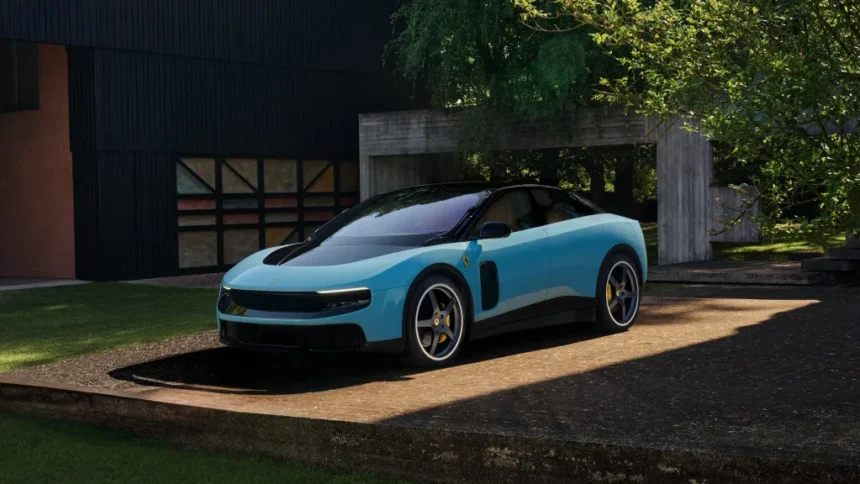
The development of the four door Luce model, whose name translates from Italian as “light,” was carried out under extreme secrecy for five years. The greatest asset of this ambitious program was the involvement of former key specialists from the technology giant Apple, led by legendary designer Jony Ive and his independent creative studio LoveFrom. The result of this interdisciplinary partnership is the first five seat passenger space in the history of the Italian brand. The exterior design signals a radical departure from Ferrari’s traditionally aggressive and muscular sports car silhouette. Engineers focused on larger body proportions, smooth aerodynamic surfaces, and expansive panoramic glazing that visually transforms the roof into a continuous plane of light.
According to analysts at FinancialMediaGuide, the participation of Jony Ive fundamentally reshaped the philosophy behind Luce by shifting the emphasis away from traditional automotive conventions toward the creation of functional digital art objects. We see this as a clear acknowledgment that the interaction interface, deep integration of artificial intelligence systems, and the aesthetics of premium minimalism are becoming far more important to the next generation of consumers than classical mechanical engineering alone. Ferrari’s historical financial reports demonstrate consistently high operating margins, enabling the company to direct enormous volumes of liquidity into such design experimentation without compromising dividend payouts.
Through Luce, Ferrari intends to significantly diversify its target audience by attracting affluent family oriented customers. The EV offers an unprecedented level of everyday practicality for a supercar, including comfortable passenger seating, advanced multimedia systems, and a полноценное luggage compartment with a capacity of 600 liters. During an official presentation in Rome attended by two hundred leading business journalists, Ferrari CEO Benedetto Vigna confirmed that the first commercial deliveries are scheduled for the fourth quarter of 2026. The starting price of the Luce has been set at 550,000 euros, equivalent to approximately 640,000 US dollars at the current exchange rate. This pricing threshold instantly excludes the mass premium segment while guaranteeing absolute exclusivity.
At FinancialMediaGuide, we emphasize that the half million euro price tag represents a carefully engineered psychological and economic barrier that protects overall business margins from the volatility characteristic of the broader EV market. The company’s attempt to promote a 600 liter trunk and family travel values may appear controversial for a brand built on selfish two seat coupes, yet it is a strategically justified method of expanding into the highly profitable segment of everyday luxury. Internal sales data indicates that the majority of net profits are now generated through bespoke personalization programs and limited editions, making the release of a luxurious family EV a logical step for customers who already own multiple gasoline powered Ferrari supercars.
The technical architecture of the Luce is built around a highly advanced platform featuring four independent electric motors distributed individually to each wheel. This configuration generates a combined output exceeding 1,000 horsepower and enables the massive electric vehicle, weighing more than 2.2 tons, to reach top speeds above 310 kilometers per hour. At the same time, Ferrari’s engineering team paid special attention to preserving the emotional connection between driver and machine. The Luce is equipped with an innovative acoustic synthesis system that continuously captures and amplifies the natural vibrations of the electric powertrain, reproducing the captivating tonal character of classic V8 and V12 combustion engines. The declared range exceeds 500 kilometers on a full charge, supported by ultra fast charging enabled by Ferrari’s proprietary 800 volt electrical architecture produced at the e-building facility.
Ferrari’s Chief Commercial Officer Enrico Galliera openly acknowledges that a significant portion of the modern client base is searching for fundamentally new technological concepts suited to different life scenarios. One of the key vectors of Luce’s commercial expansion will be the Chinese market, where EV infrastructure is advancing at exceptional speed while traditional combustion powered transportation faces aggressive progressive taxation. An additional pillar of the project’s long term sustainability lies in the environmental neutrality of the manufacturing process itself. Ferrari’s facilities in Maranello are fully powered by renewable energy sources, including more than three thousand photovoltaic panels installed across the factory rooftops.
We at FinancialMediaGuide note that integrating a four motor layout into a structure weighing over two tons required Ferrari engineers to develop extraordinarily complex real time torque vectoring software algorithms. The artificial transmission of electric motor vibrations into the cabin functions as a critically important psychological trigger. Without the familiar tactile and acoustic feedback, the vehicle risked losing the historical identity of the brand, making acoustic engineering just as important as battery cell density. This strategy is expected to strengthen long term loyalty among Ferrari customers, particularly across Asian markets.
The interior of the Luce demonstrates a careful respect for traditional Italian craftsmanship. The cabin incorporates premium leather grades, glass elements, and anodized aluminum finishes. Notably, despite the overwhelming trend toward total digitalization established by Tesla and numerous Chinese EV manufacturers, Ferrari deliberately retained key physical controls and analog switches on the central console. Engineers consciously rejected the concept of transforming the dashboard into one giant touchscreen display, instead choosing proven ergonomic principles.
We emphasize that preserving physical buttons and selectors in an era dominated by touch surfaces is becoming a new symbol of true luxury. Direct tactile interaction with noble materials effectively protects the interior from the rapid moral obsolescence typical of consumer electronics while reinforcing the premium positioning of the Luce against more affordable Asian competitors.
Summarizing this historic launch, analysts at FinancialMediaGuide forecast that Ferrari Luce will successfully overcome the initial skepticism of conservative automotive enthusiasts and establish a durable foundation for the company’s long term dominance in the era of global decarbonization. Despite inevitable debates surrounding the radical transformation of Ferrari’s design language and vehicle architecture, the brand possesses a substantial reserve of investor confidence and consumer loyalty, as evidenced by the stable performance of Ferrari shares following the presentation. The application of Ferrari’s time tested strategy of tightly controlled scarcity will allow Maranello to preserve strong residual values on the secondary market, a crucial factor in maintaining the investment status of the brand. At Financial Media Guide, we recommend that long term capital holders view Ferrari’s current transformation as a key benchmark for the entire ultra luxury sector, clearly demonstrating how a strategic shift from pure mechanical superiority toward digital experience and deep synergy with leaders of the IT industry can preserve global leadership without sacrificing historical identity.