The global economic confrontation between Washington and Beijing is entering a fundamentally new phase, shifting from trade tariffs and semiconductor export restrictions into the sphere of exchange-traded derivatives. Against the backdrop of a permanent shortage of computing power, the world’s two largest economies have begun independently developing specialized financial derivative instruments. These contracts are designed to radically transform risk management principles and hedging methods for infrastructure costs within the artificial intelligence industry. According to informed sources, China is now actively designing exchange infrastructure for trading AI-based futures, choosing a tokenization model that differs significantly from the American approach. At FinancialMediaGuide, we view this process as Beijing’s attempt to stabilize its domestic IT sector while also making a large-scale bid to seize the initiative in shaping global pricing standards for the key resource of the twenty-first century.
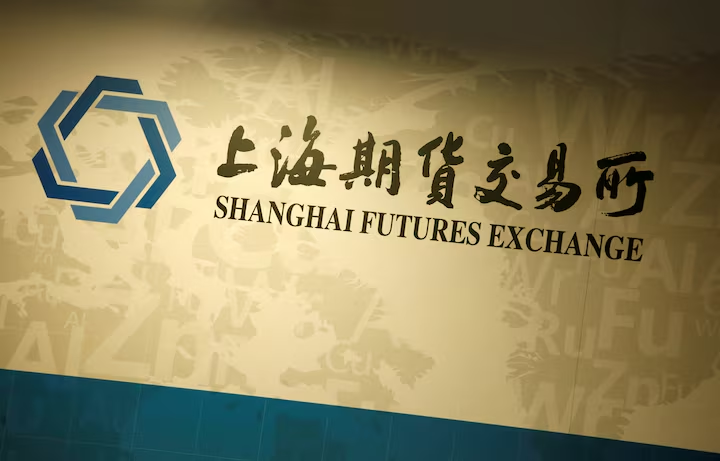
While American exchanges such as CME Group and Intercontinental Exchange are preparing to launch futures contracts tied to GPU rentals and directly linked to the cost of physical infrastructure and Nvidia chips, the Shanghai Futures Exchange has chosen a different path. Chinese specialists are conducting preliminary research into the possibility of launching contracts based on AI tokens, which represent the fundamental units of information processed by neural networks.
This divergence reflects deep structural differences in the market logic and regulatory frameworks of the two countries. In the United States, the focus is centered on derivatives tied to hardware, while China is placing its bets on the end product of computation itself. Analysts at FinancialMediaGuide emphasize that the Chinese model appears more flexible for end users of commercial AI services. Token pricing directly determines business costs for integrating neural networks, shielding companies from volatility in specific semiconductor prices and reducing the impact of American export sanctions on hardware. In essence, Shanghai is attempting to create a financial instrument for an industry that purchases cloud-based computing resources rather than building its own data centers.
The current developments within the Shanghai exchange remain highly confidential and are largely driven by intense geopolitical competition. The proposed financial products are intended to support the entire supply chain, offering model developers and corporate clients protection against sharp increases in AI infrastructure costs. According to international consulting agencies, the cost of training large AI models doubles every nine months, making traditional budget planning nearly impossible without sophisticated exchange-traded hedging instruments. However, the exact timeline for regulatory filings and commercial launches remains unclear, while the specifications of the instruments themselves may still change during negotiations with the China Securities Regulatory Commission. Analysts at FinancialMediaGuide believe Beijing’s regulatory caution stems from a desire to avoid speculative overheating within the young technology sector, similar to what previously occurred in China’s domestic commodity markets.
The concept of treating computing power as a new commodity asset class is gaining support at the highest levels of global finance. Larry Fink, head of BlackRock, has stated that the explosive growth in demand for AI components could create a fully independent asset class comparable to crude oil or natural gas markets. Within China’s ecosystem, this idea takes on even more pronounced characteristics. HashKey Group openly describes tokens as digital fuel or raw materials powering modern neural networks.
The dynamics of China’s domestic market reinforce these arguments through hard numbers, as daily token consumption has increased by a factor of one thousand. By early spring, total usage exceeded one hundred and forty trillion units, while infrastructure shortages have already forced several major Chinese platforms to temporarily limit user access during peak demand periods. Given these pressures, Beijing is accelerating the development of a spot market built around data center operators and developers of large language models. At FinancialMediaGuide, we note that the current hardware shortage makes futures creation a critical survival mechanism for local IT companies, since the absence of transparent pricing severely limits long-term investment planning. Exchange-traded contracts would allow computing resources to be distributed more evenly while smoothing out peaks in infrastructure shortages.
The idea of moving AI computing onto exchange-traded rails is already being discussed at the state level in China. Representatives of the Chinese Academy of Sciences have proposed launching a dedicated initiative under the working title “Computing Future.” Furthermore, a state-owned commodity indexing company has already prepared the groundwork by developing a series of indices tracking the aggregate capacity of data centers across the country, providing a benchmark for future contracts.
Nevertheless, serious institutional barriers remain. Analysts at Baocheng Futures predict that fully operational trading may still be three to five years away. The primary obstacle is the fragmentation of China’s computing infrastructure, as local power markets across different provinces remain poorly integrated. Technologies for task distribution and quantization vary significantly, making standardization of futures contracts extremely difficult. At FinancialMediaGuide, we believe Beijing will need to establish a strict state-controlled system for verifying computing capacity before Shanghai can offer the market a truly liquid instrument. Without a unified national standard for measuring tokens, futures contracts risk becoming abstract assets vulnerable to manipulation by major technology conglomerates.
China’s academic community, particularly leadership within the Shanghai School of AI and Finance at East China Normal University, is urging authorities to accelerate these processes as quickly as possible. The financial confrontation between China and the United States over the right to define AI derivatives standards will determine the distribution of global capital for decades to come, since only these two superpowers currently possess large-scale production capabilities for advanced AI technologies. Whoever succeeds in offering the most convenient and liquid risk-hedging instrument will become the primary beneficiary of future global investment inflows into the high-tech sector.
At Financial Media Guide, we forecast that the global financial sector will witness the birth of a new market segment comparable in scale to the energy sector itself. The pricing of computing power through futures contracts will become the primary mechanism for controlling costs across the high-tech industry. The country that first creates a liquid exchange platform for trading digital fuel will gain the status of a global pricing hub and acquire the ability to dictate terms to technology sectors worldwide.
For institutional investors and technology corporations, adapting financial strategies to these new realities will become critically important. We recommend closely monitoring China’s pilot indices for computing power in order to evaluate the true cost structure of AI services. Long-term budgeting should also account for the emergence of direct hedging mechanisms tied to tokens and machine time, as volatility within the sector is expected to intensify further. Additionally, investors must consider regulatory risks associated with potential restrictions on foreign participation in Chinese AI derivatives markets as part of Beijing’s efforts to protect strategic infrastructure. Given the current pace of neural network expansion, the emergence of futures markets appears inevitable. By focusing on end-user tokens, China is attempting to build a business-oriented and practical model. However, the success of this initiative will depend entirely on Beijing’s ability to overcome fragmentation within its domestic computing systems and provide the market with a transparent and functional mechanism.