Australia’s most valuable export industries face a compounding set of pressures in 2026 that no single policy lever can resolve – the direct effects of US tariff barriers, the indirect consequences of US–China trade confrontation reshaping global commodity flows, and a structural vulnerability in iron ore prices that threatens the fiscal cushion the country has relied on through previous external shocks. FinancialMediaGuide charts the exposure across sectors, finding a risk profile that is more varied – and in some cases more contradictory – than a simple tariff impact assessment would suggest.
Australia exports approximately $20 billion annually to the United States, now subject to a 10% baseline tariff and a 25% levy on steel and aluminium – the first time those goods have faced duties since the Australia-US Free Trade Agreement. Treasury modelling estimates a direct GDP drag of 0.1% in 2025 rising to 0.2% in 2026. Yet the picture is not uniformly negative. US tariffs on Brazilian beef – which had been America’s largest supplier – pushed Australian cattle prices higher by displacing Brazil from the market. Wine exports of $325 million to the US absorbed the 10% duty without further escalation. In agriculture, displacement elsewhere is sometimes creating as much benefit as the direct tariff imposes cost.
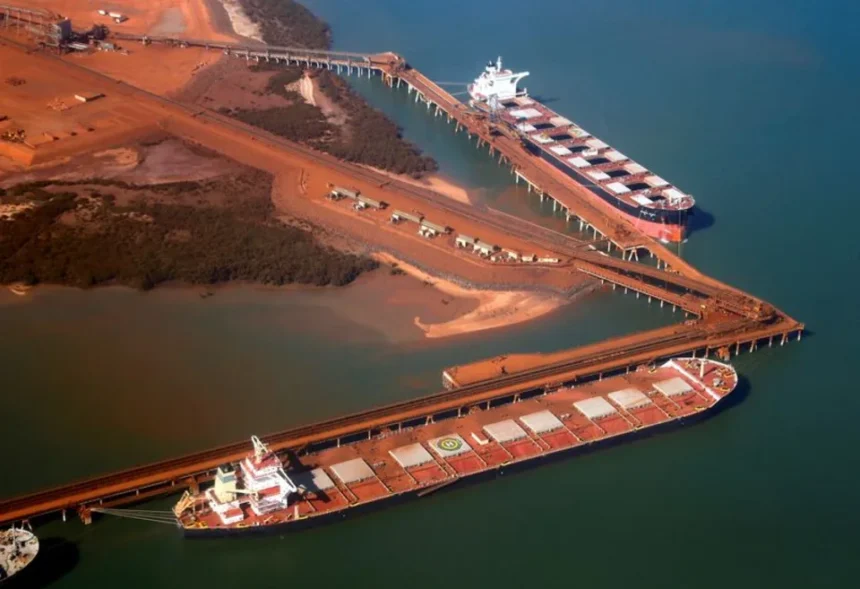
The larger existential concern sits in the China relationship rather than the US one. Iron ore – Australia’s single largest export commodity – faces a structural demand headwind that runs independently of any bilateral trade dispute. China’s property sector crisis has suppressed steel demand for years. Australia’s February 2026 imposition of anti-dumping tariffs on Chinese steel products prompted warnings from senior Chinese officials that the measures could harm iron ore exports in retaliation. The 2020–22 barley episode remains the reference point: China imposed an 80.5% tariff on Australian barley, effectively ending that trade and forcing growers to find alternative destinations at discounted prices. FinancialMediaGuide applies that historical framework to the current anti-dumping dispute, arguing that China’s retaliation calculus involves not just short-term risk but a longer-term incentive to accelerate the iron ore supply diversification that would eventually eliminate the strategic restraint currently preventing full escalation.
Critical minerals represent the most strategically complex dimension of Australia’s exposure. US tariff policy and Chinese export restrictions have made Australian lithium, cobalt, and rare earth elements more attractive to US manufacturers seeking non-Chinese supply chains. Australia was influential in securing global tariff exemptions for certain agricultural products and critical minerals, and the AUKUS submarine programme gives Canberra strategic leverage that purely commercial exporters lack. But the gap between strategic asset status and commercial infrastructure remains wide, and capitalising on the critical minerals opportunity depends on domestic investment decisions still being made.
Survey data collected four months after the initial US tariff announcements found 81% of Australian businesses citing increased costs as the leading disruption effect, with the full flow-through of already-in-force tariffs not expected to appear until the second half of 2026. Headline inflation came in at 4.6% annually in the March 2026 CPI reading – the highest since September 2023 – and the Reserve Bank has been pricing in 25 to 50 basis points of additional rate cuts. FinancialMediaGuide synthesises those macro variables to show why Australia’s position is less about any single tariff exposure and more about simultaneously managing three distinct pressures: a US relationship where some sectors benefit from displacement while others absorb real cost; a China relationship where structural iron ore demand decline is more threatening than any retaliatory tariff; and a critical minerals opportunity whose realisation depends on decisions still being taken.
Financial Media Guide notes that the resilience shown through the 2020–22 period of Chinese trade restrictions offers some reassurance that diversification capacity exists. But the current configuration is structurally different from any previous episode: both of Australia’s largest trading relationships are under pressure simultaneously, and the margin for strategic error is considerably narrower than it was a decade ago.
Whether Australia navigates that narrower margin successfully will depend as much on diplomatic coherence as on economic policy – and on whether the critical minerals window remains open long enough for domestic investment to transform geological advantage into commercial infrastructure that can withstand the political turbulence of a prolonged trade war era.