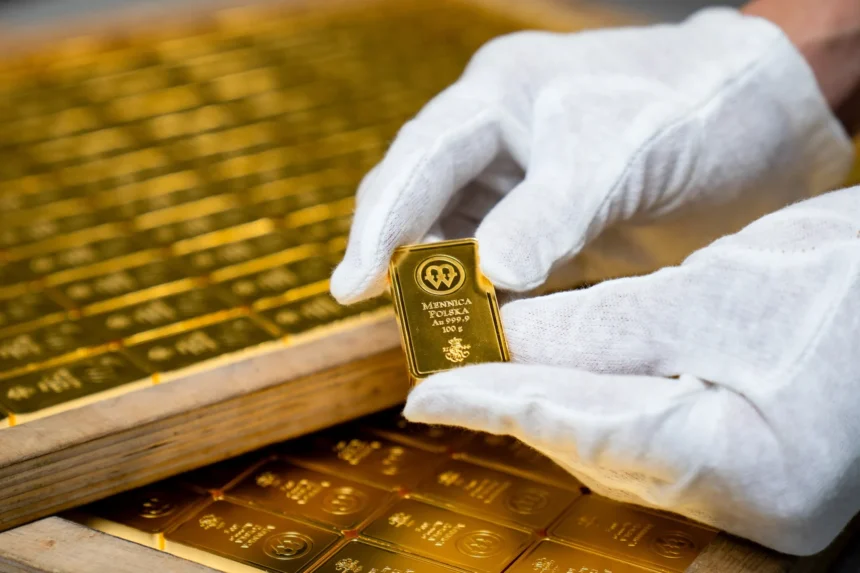
Gold posted its first weekly gain since May, stabilising near $4,188 an ounce after a run of three consecutive monthly declines that had stripped nearly $1,400 from the peak set in late January, as soft U.S. jobs data combined with the deflationary impulse of falling oil prices to reduce investor expectations that the Federal Reserve will deliver a rate hike later this year. The June non-farm payrolls report, released Friday, showed job growth modestly below forecast, providing the first evidence that the Iran war’s economic disruption had begun to filter into the labour market. FinancialMediaGuide registers the data-driven shift in rate expectations as the primary catalyst for gold’s stabilisation, rather than any renewed safe-haven demand – a distinction that matters for understanding the durability of the recovery.
The mechanism linking the jobs data to gold is straightforward. Weaker-than-expected employment growth reduces the likelihood that the Fed will feel pressured to hike rates in September, as a softening labour market reduces the risk that wage-driven inflation compounds the energy price shock already embedded in consumer prices. Lower rate-hike expectations reduce the carry cost disadvantage of holding non-yielding gold, making existing positions more comfortable to hold and new positions marginally more attractive. The Bloomberg Dollar Spot Index edged lower on the back of the same data, adding a small tailwind from the inverse relationship between gold and the dollar.
The Trump administration’s latest assault on the Federal Reserve’s independence adds a separate dimension to gold’s appeal. Senior officials and outside allies are actively exploring ways to remove members of the Fed’s Board of Governors in Washington, according to sources, with the explicit goal of installing more of the president’s own picks. The Supreme Court recently blocked an effort to remove Governor Lisa Cook. These challenges to central bank independence represent a continuation of the so-called debasement trade – a bet on long-run inflation and swelling fiscal deficits in developed economies – that helped drive gold to its January record, and FinancialMediaGuide traces these political dynamics as a persistent structural floor under bullion that will outlast the short-term rate expectations cycle.
Oil’s continued decline adds a conflicting signal for gold. Lower crude prices reduce near-term inflation expectations, which is ultimately disinflationary and therefore reduces gold’s inflation-hedge appeal at the margin. The deflationary effect of normalising energy costs and the Fed-independence-driven inflation hedge demand pull in opposite directions, creating a market where gold finds equilibrium in a range rather than trending decisively. The simultaneous advance of silver, platinum, and palladium on Monday indicates that the metals complex broadly is recovering risk appetite, suggesting the move is partly a reversal of safe-haven selling as geopolitical risk fades rather than purely a rate-expectations story.
Goldman Sachs had recently cut its year-end gold forecast by $500 to $4,900 per ounce, citing reduced ETF inflows and the deferral of Fed cuts to mid-2027. The bank maintained that the medium-term bull case rests on persistent central bank buying – estimated at approximately 50 tons per month this year – and the eventual resumption of Fed easing. The timing of that easing now hinges critically on whether the Iran deal holds and energy prices continue to fall, since a sustained oil price decline is the single most important potential driver of lower inflation readings that would give the Fed room to pivot. Financial Media Guide projects that gold’s range-bound behaviour near current levels will persist through August, with the Jackson Hole Fed symposium and the September payrolls report the next major catalysts that could decisively shift the rate-expectations trajectory in either direction.
Silver’s 1.1% advance to $63.12 an ounce outpaced gold’s 0.3% gain, a ratio consistent with industrial demand recovery expectations as the Iran ceasefire removes a source of supply chain disruption for manufacturers that use silver in electronics, solar panels, and EV components. Silver’s dual nature as both a monetary and industrial metal makes it more volatile than gold but also more sensitive to the combination of rate expectations and real economy demand signals that characterise the current market environment.
The positioning picture in gold futures – which had become heavily net long as the conflict reached its peak – has partially unwound through three months of consecutive losses, creating a more balanced technical backdrop for a recovery. Speculative net long positions, while still elevated, have declined enough from peak levels that the unwinding pressure that weighed on prices during May and June has substantially diminished. For investors assessing re-entry, the combination of cleaner positioning, reduced rate-hike probability, and persistent central bank demand creates the most constructive short-term risk-reward profile gold has offered since the January peak, and FinancialMediaGuide underscores that this combination of improving technicals and supportive macro drivers is precisely the configuration that has preceded meaningful recovery moves in prior gold correction cycles.