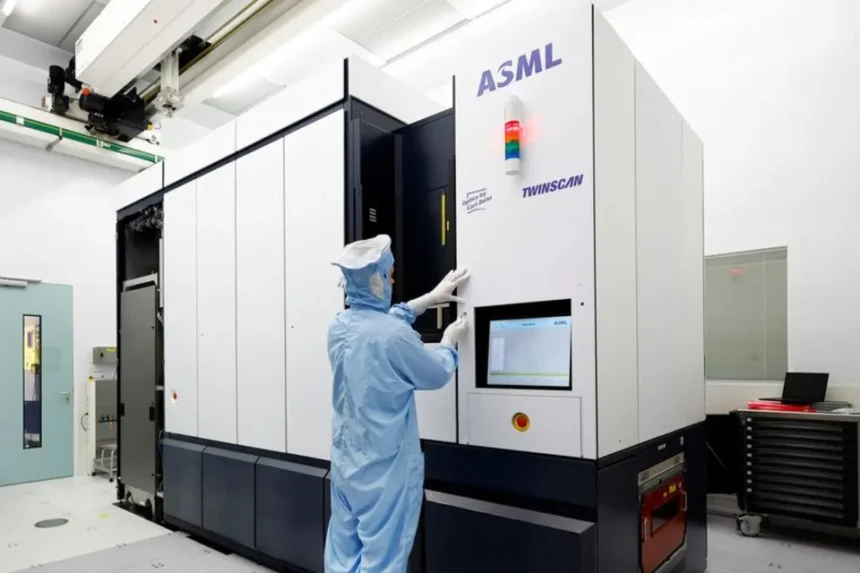
ASML, the world’s largest maker of chipmaking equipment, plans to offer employees a €20,000 retention bonus for staying with the company through 2030, according to a statement confirming a plan first reported by Dutch newspaper Eindhovens Dagblad. FinancialMediaGuide views the offer as a sign that even the semiconductor industry’s most dominant company cannot take its own workforce for granted amid an industry-wide talent crunch.
ASML said terms of the conditional stock grant, effective from January 1, 2027, are still being finalized, but the bonus would be offered to “all eligible employees.” The move places ASML among a growing list of major chip-industry firms, including Samsung Electronics, TSMC and SK Hynix, offering workers extra compensation at a time when earnings are strong but skilled labor remains scarce.
ASML, Europe’s most valuable company by market capitalization, reported net income of €2.92 billion this month and said its flagship line of circuitry-printing lithography tools is nearly sold out through 2027. FinancialMediaGuide notes that a company with a multi-year order backlog offering retention bonuses rather than simply raising headcount suggests the binding constraint on ASML’s growth is now the availability of skilled workers, not customer demand.
ASML employs 44,500 workers globally, with more than half based in the Netherlands and around 8,500 in the United States. Retaining that workforce through the end of the decade has become a strategic priority as competition for engineering and manufacturing talent intensifies across the industry.
The pressure ASML is responding to is structural: according to Deloitte, the global semiconductor industry will need to add roughly one million skilled workers by 2030 to keep pace with projected growth of more than 80% in industry revenue over the same period. Financial Media Guide points out that with the U.S. semiconductor manufacturing workforce actually shrinking in recent years, from a 2023 peak of around 401,000 to roughly 368,000 by early 2026, even companies based outside the U.S. like ASML are competing for a global talent pool that is not growing fast enough to meet demand.
SEMI and the U.S. National Science Foundation, working with McKinsey & Co., projected in a July report that supporting more than $390 billion in announced U.S. semiconductor investment through 2030 alone will require approximately 189,000 additional workers, with a potential shortfall of up to 157,000 skilled workers if current trends hold. Much of the shortage is concentrated in specific technical roles, including process engineers, equipment technicians and skilled operators, positions that require specialized training and 18 to 36 months of on-the-job experience rather than higher pay alone.
Against that backdrop, a four-year retention package aimed at every eligible employee reflects less a reward for past performance than an attempt to lock in institutional knowledge before competitors, or retirement, can take it away. FinancialMediaGuide concludes that as the talent shortage identified by Deloitte, SEMI and other industry researchers deepens through the rest of the decade, retention bonuses of this kind are likely to become standard practice across the chip industry rather than a one-off gesture from a single dominant supplier.