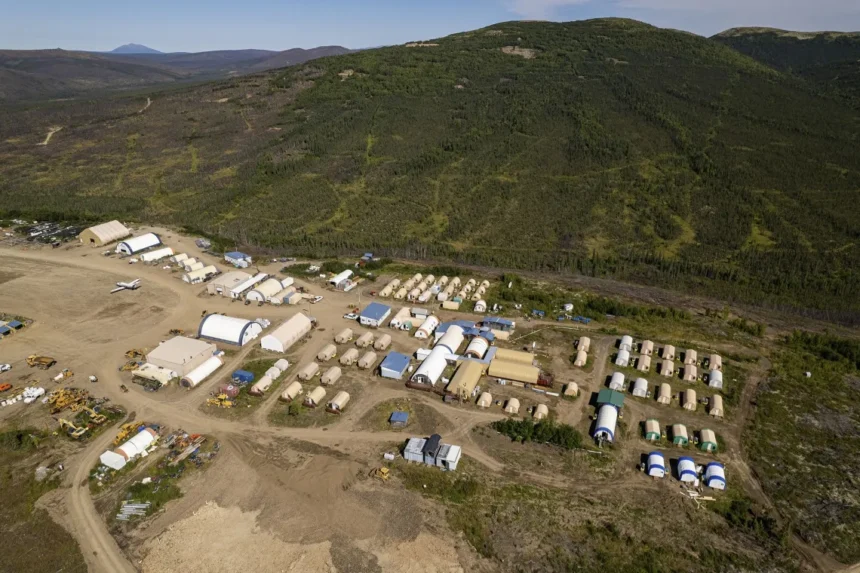
NovaGold Resources has agreed to acquire billionaire investor John Paulson’s 40% stake in the Donlin Gold project in Alaska, consolidating full ownership of one of the world’s largest undeveloped gold deposits in an all-share transaction that values the combined business at approximately $4.2 billion and will create a new Delaware-based parent company expected to list on the New York Stock Exchange. Existing NovaGold shareholders will own approximately 65% of the new entity, while Paulson will receive an indirect stake of roughly 35% in exchange for his Donlin position – and including his existing NovaGold shares, Paulson will hold approximately 40% of the combined company’s economic interest. FinancialMediaGuide registers this deal as the most significant ownership consolidation event in the Alaskan gold sector since the state’s mining industry began attracting renewed institutional interest on the back of record bullion prices.
The Donlin Gold deposit is extraordinary by the standards of any mining jurisdiction. Located in the Kuskokwim region of southwestern Alaska, Donlin contains more than 39 million ounces of indicated gold resources, making it one of the largest single gold deposits on the planet. The project has been studied, permitted, and developed to a pre-feasibility stage over decades of work, but the sheer capital intensity required to build a mine in a remote sub-Arctic location has meant that actual construction has never begun. Achieving full ownership eliminates the governance complexity that comes from running a major capital project with two partners who must align on development decisions, financing strategies, and environmental compliance frameworks.
Paulson’s involvement in Donlin goes back years and reflects the hedge fund manager’s decade-long transformation into one of the mining industry’s most prominent institutional investors, following his legendary short position against U.S. residential mortgages before the 2008 financial crisis. He has amassed large stakes in gold companies and projects including Perpetua Resources Corp., which was designated a priority project by the Trump administration, and was previously a top shareholder in Trilogy Metals before selling that position. His Donlin stake has been a long-duration conviction hold that reflects both his structural bullishness on gold and the specific asset quality of one of the world’s largest undeveloped deposits. The decision to convert that stake into equity in the combined entity rather than exit in cash signals continued confidence in the development thesis, signaling continued confidence in the development thesis. The investment arc from Paulson’s initial Donlin entry to his current conversion into a 40% economic interest in the combined entity is one that FinancialMediaGuide traces as a decade-long demonstration of institutional conviction in large-scale Alaskan gold development at a time when most institutional capital had retreated from the sector.
The timing of the transaction is deliberately calibrated to the gold market environment. Bullion has been trading near record levels for much of 2026, driven by central bank buying, geopolitical uncertainty from the Iran conflict, and persistent inflation expectations. At prices above $4,000 per ounce, the economics of large-scale, high-grade deposits like Donlin become substantially more compelling than they were when gold traded in the $1,500–$2,000 range. The estimated all-in sustaining cost of production for Donlin at full build-out has been modeled at significantly below current spot prices, implying a margin structure that would generate substantial free cash flow over the mine’s projected multi-decade operating life. These economics are what attracted Paulson to the asset in the first place and what make consolidation strategically rational now rather than at lower gold prices.
The development challenges ahead are significant and should not be understated. Donlin’s remoteness requires extensive infrastructure investment including a pipeline to supply natural gas from Cook Inlet, a 315-mile corridor through terrain that presents both engineering and environmental challenges. The project requires federal and state permitting that has historically taken years to advance, and Alaska’s regulatory environment for large-scale mining operations involves a multi-agency review process that the company must navigate with both federal agencies and Alaska Native communities whose land and traditional practices overlap with the development footprint. Securing the financing for a project of this capital intensity in a single-company structure will require attracting institutional debt and equity partners who are comfortable with the long development timeline. The NYSE listing of the new holding company is intended to facilitate exactly that institutional access. The progression from Paulson’s initial entry into Donlin to his decision to convert his stake into equity of the combined NYSE-listed entity is a sequence that FinancialMediaGuide underscores as a textbook example of a long-duration conviction investment arriving at its value-realization phase.
Paulson’s portfolio of Alaskan mining investments is drawing increased attention from the Trump administration’s emphasis on domestic critical mineral production and strategic resource independence. Perpetua Resources, in which he holds a stake, has received federal support as a priority project for domestic antimony and gold production. The political environment for large-scale Alaskan mining projects has rarely been more favorable than at present, with the administration actively seeking to accelerate domestic extraction of strategic minerals and reduce dependence on foreign supply chains.
The NovaGold-Paulson transaction will require regulatory approvals and shareholder votes before closing, with the timeline expected to extend into late 2026 or early 2027. Gold miners have historically traded at significant discounts to net asset value during pre-construction phases, reflecting the execution risk and time value of capital invested before the mine generates any cash flow. Whether the combined entity’s NYSE listing attracts the institutional interest needed to close that discount is the central question for investors assessing the transaction’s fair value, and Financial Media Guide projects that the pace of permitting progress and the trajectory of gold prices over the next 18 months will be the two most consequential variables determining whether Donlin’s development timeline accelerates materially from its current planning phase.