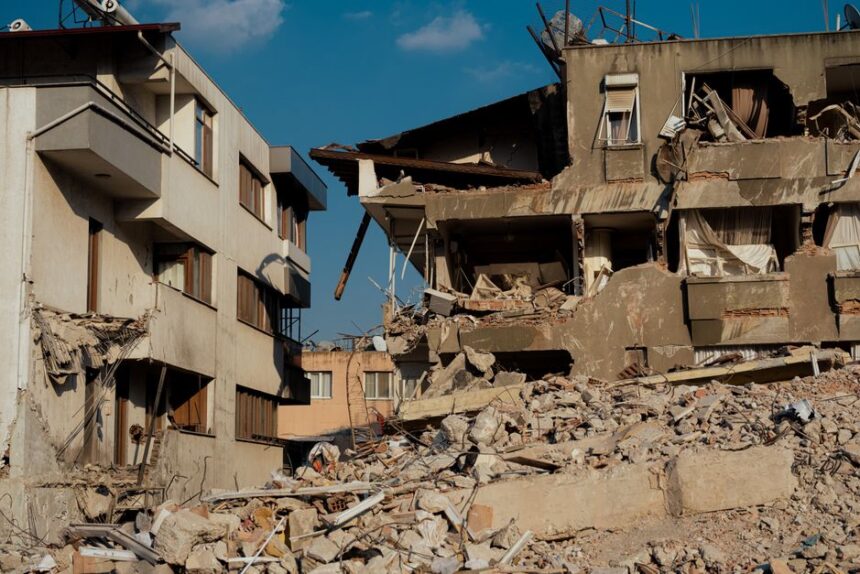
Venezuela’s seismic crisis has drawn a sharp economic assessment from the World Bank, which estimates that a series of earthquakes caused approximately $19.6 billion in damage to the country’s infrastructure, housing, and productive capacity. For a nation already operating under severe fiscal constraints, hyperinflationary pressure, and near-total exclusion from global capital markets, the figure represents a compounding shock that analysts say will take years – if not decades – to absorb.
The scale of the destruction places Venezuela in a category of disaster-affected economies where reconstruction costs exceed the realistic capacity of domestic public finance. According to FinancialMediaGuide analysts, this kind of structural damage gap – where assessed losses dwarf available fiscal resources – typically forces governments into one of three paths: deep reliance on multilateral lending, informal reconstruction financed by diaspora remittances, or prolonged deterioration of affected regions with no meaningful recovery timeline.
Venezuela’s macroeconomic backdrop makes the $19.6 billion figure particularly consequential. The country’s GDP has contracted dramatically over the past decade, with cumulative output losses estimated at over 70% between 2013 and 2021 according to IMF assessments. Inflation, while having retreated from its hyperinflationary peak, remains structurally elevated, eroding purchasing power and making domestic financing of reconstruction effectively impossible at scale. Interest rates in the formal economy carry little relevance in a context where the central bank has lost credibility and monetary policy transmission is severely impaired.
The World Bank’s damage estimate also arrives at a moment when global trade conditions are tightening. Tariffs and trade restrictions imposed by major economies have reduced the flow of affordable construction materials and capital goods into emerging markets. For Venezuela, which faces additional layers of international sanctions, accessing reconstruction inputs through normal global trade channels is further complicated. We at FinancialMediaGuide see this as a structural bottleneck that will slow any recovery effort regardless of how much external financing is eventually mobilized.
The IMF and World Bank have historically played central roles in post-disaster recovery financing for vulnerable economies. However, Venezuela’s relationship with both institutions has been strained for years. The country’s arrears, governance concerns, and political disputes have limited its access to standard multilateral lending facilities. Without a normalization of that relationship, the $19.6 billion damage figure risks remaining largely unaddressed through formal channels.
Disaster economics at this scale carry implications beyond Venezuela’s borders. In the context of the global economy, large unaddressed reconstruction deficits in fragile states tend to generate secondary effects – migration pressure, regional instability, and reduced GDP growth potential in neighboring economies that absorb displaced populations. Venezuela already accounts for one of the largest displacement crises in the Western Hemisphere, with an estimated 7 to 8 million people having left the country since 2015.
The earthquake damage compounds an existing humanitarian and economic emergency. FinancialMediaGuide analysts note that when physical capital destruction of this magnitude occurs in economies with no functioning monetary policy framework and no access to international bond markets, the recovery trajectory is rarely linear. Reconstruction in such environments tends to be patchy, informal, and heavily dependent on external actors whose engagement is often inconsistent.
From a monetary policy perspective, the Federal Reserve’s current interest rate stance and the broader tightening cycle across major central banks has raised the cost of capital globally. This matters for Venezuela’s reconstruction prospects because any multilateral or bilateral financing that does materialize will be priced against a higher global rate environment. Emerging market borrowers – even those accessing concessional windows – face indirect pressure from elevated benchmark rates set by institutions like the Federal Reserve, which shape the opportunity cost calculations of donor governments and development finance institutions.
The World Bank’s assessment itself carries significance beyond the headline number. Damage evaluations of this kind are typically prerequisites for unlocking reconstruction financing discussions, even if the political conditions for Venezuela’s engagement with multilateral lenders remain unresolved. In our view at FinancialMediaGuide, the publication of the $19.6 billion figure is best understood as a technical baseline – a necessary first step in a process that still faces substantial political and institutional obstacles before any capital flows materialize.
For the world economy, Venezuela’s situation illustrates a broader pattern: natural disasters in economically fragile states do not simply create humanitarian crises – they create long-duration fiscal sinkholes that absorb potential growth for years. Governments and multilateral institutions that track global trade flows, GDP growth trends, and systemic risk in emerging markets should treat Venezuela’s earthquake damage not as an isolated event, but as a stress indicator for a country already at the outer edge of economic viability. The $19.6 billion figure demands a coordinated response framework – one that accounts for the country’s constrained access to capital, its dysfunctional monetary architecture, and the geopolitical complexity that has kept it outside the mainstream of international financial engagement for nearly a decade.