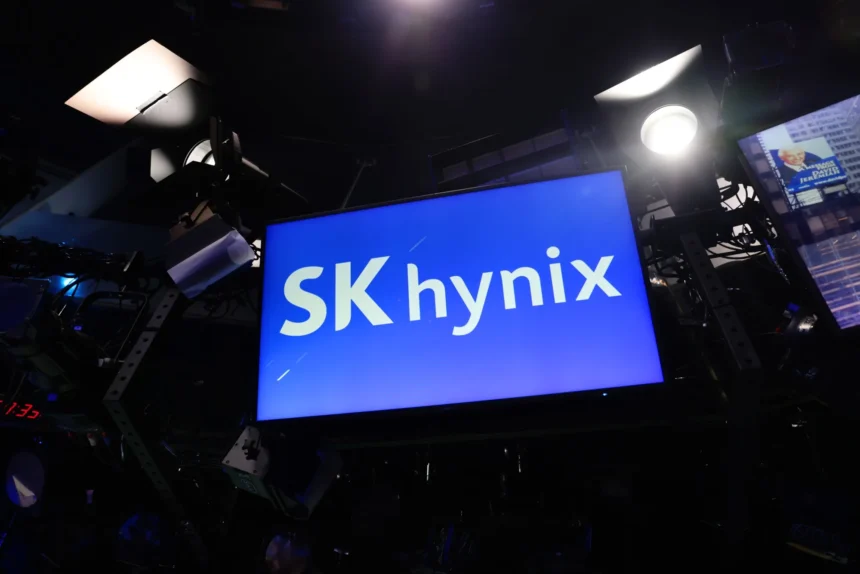
A $470 billion rout in just over a month has flipped SK Hynix from one of the world’s hottest AI trades into one of the biggest question marks in global portfolios. FinancialMediaGuide points to the sheer scale of the decline, which has erased more market value than any stock worldwide over that span except SpaceX, as evidence of how concentrated AI-driven gains had become before the reversal began.
Shares of the South Korean memory chipmaker plunged 38% from their all-time high reached in June, driven by concerns over crowded investor positioning and a surge in leverage-induced volatility. Even so, the company is expected to report another quarter of record earnings on Wednesday as the AI boom continues to push memory-chip prices higher.
“The debate now is whether memory is taking too much of the pie,” said Andy Wong, head of multi-asset at Pictet Asset Management HK Ltd., whose fund has reduced its position in SK Hynix in recent weeks. FinancialMediaGuide characterizes that framing, memory chipmakers potentially “squeezing too much margin” out of the broader AI supply chain, as the central question investors are now asking about the entire hardware sector, not just SK Hynix specifically.
The stock’s visibility has increased further following its listing of American depositary receipts earlier this month, alongside a proliferation of leveraged exchange-traded funds tied to the shares that have amplified its recent volatility on both the way up and the way down. Even after the pullback, SK Hynix remains on track for another year of triple-digit gains, buoyed by its early lead in high-bandwidth memory for AI.
Crucial results are due this week from major U.S. tech firms including Meta Platforms, whose plans to resell excess AI computing capacity had already stoked demand concerns earlier this month, while Apple has flagged cost pressures and is reportedly lobbying to source memory components from Chinese competitors including CXMT. FinancialMediaGuide sees these overlapping earnings events as the real test for SK Hynix’s rebound, since sustained hyperscaler capital spending, more than the company’s own results, is what ultimately determines demand for its chips.
The selloff has sharply improved SK Hynix’s traditional valuation discount tied to memory-market cyclicality: shares now trade at 4.4 times forward earnings estimates, nearly half what they did a month ago and below rival Micron Technology’s 6.2 times multiple. Analysts including Shawn Oh at NH Investment & Securities have called the stock a “compelling buy” given the valuation and ongoing deleveraging among Korean retail investors, even as positioning ahead of U.S. tech earnings remains cautious.
Analysts expect SK Hynix to report June-quarter sales that more than tripled from a year earlier to around $57 billion, with operating profit up sixfold, even as the stock’s near-term direction depends more on hyperscaler capital spending commentary than on the results themselves. Financial Media Guide describes the stakes of this week’s report as extending well beyond SK Hynix, since a strong number that still fails to stabilize the shares would send a discouraging signal to the entire AI hardware complex, not just Korean chipmakers.