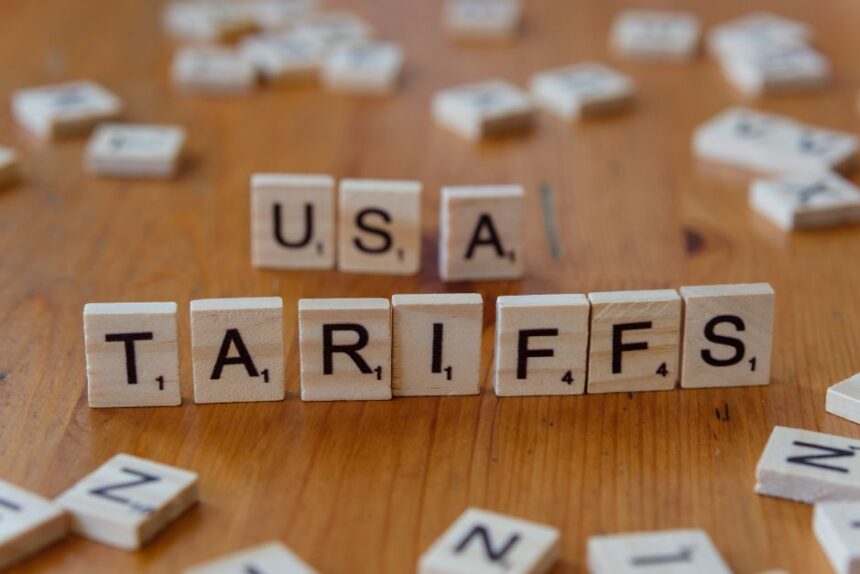
A coalition of 25 U.S. states filed a lawsuit against the Trump administration in May 2025, challenging the legal authority behind a sweeping set of tariffs imposed under the International Emergency Economic Powers Act, commonly known as IEEPA. The states argue that the executive branch overstepped its constitutional boundaries by using emergency powers to impose broad trade levies without explicit congressional authorization. The legal challenge references a Supreme Court precedent that limits the scope of executive authority when Congress has not clearly delegated such power – a doctrine sometimes called the “major questions” principle. The case has immediate implications not only for domestic policy but for the trajectory of global trade, and by extension, the broader global economy.
The tariffs at the center of the dispute are part of a wider package announced in early 2025, which included a baseline 10% duty on most imports and significantly higher rates on goods from specific trading partners, most notably China. These measures represent one of the most aggressive uses of tariff authority in modern U.S. history. According to the Peterson Institute for International Economics, a Washington-based research organization, broad tariff increases of this scale can raise consumer prices, disrupt supply chains, and reduce real GDP growth – effects that ripple well beyond U.S. borders.
The states’ legal challenge centers on whether the IEEPA, a 1977 law originally designed for targeted sanctions in genuine national security emergencies, can be stretched to justify economy-wide tariff regimes. The Supreme Court’s 2022 ruling in West Virginia v. EPA established that federal agencies cannot take actions of vast economic and political significance without clear congressional authorization. The plaintiff states argue that applying this standard to the current tariffs would render them unlawful. If a federal court agrees, the administration would face a significant constraint on its ability to use trade policy as a unilateral economic instrument.
From a market mechanics standpoint, the uncertainty created by this litigation is itself a cost. Businesses making sourcing, pricing, and investment decisions cannot easily plan around tariff structures that may be reversed by judicial order. According to FinancialMediaGuide analysts, this legal ambiguity functions as an invisible tax on corporate planning – compressing investment horizons and increasing the risk premium that companies attach to cross-border supply chains.
The macroeconomic consequences extend further. The IMF, in its April 2025 World Economic Outlook, revised global GDP growth projections downward, citing trade policy uncertainty as a primary driver. The Fund projected global growth at 2.8% for 2025, down from an earlier estimate of 3.3%, with advanced economies bearing a disproportionate share of the slowdown. The World Bank has similarly flagged tariff escalation as a structural headwind for developing economies that depend heavily on export-led growth models.
Central banks, including the Federal Reserve, are caught in a difficult position. Tariffs are inflationary by nature – they raise the cost of imported goods, which feeds into consumer price indices. At the same time, they can suppress economic activity by reducing trade volumes and business investment, which is disinflationary. This creates a policy dilemma: if inflation rises while GDP growth slows, the Federal Reserve faces pressure from both directions simultaneously, a scenario sometimes described as stagflation risk.
The Federal Reserve has held its benchmark interest rates steady in 2025 after a series of cuts in late 2024, citing persistent inflation above its 2% target. If tariff-driven price increases push inflation higher, the Fed may be forced to delay further rate cuts or even reverse course – a scenario that would tighten financial conditions for consumers, mortgage borrowers, and businesses carrying variable-rate debt. In our view at FinancialMediaGuide, the interaction between trade policy and monetary policy has become one of the most consequential and underappreciated dynamics in the current economic cycle.
Global trade volumes, which the World Trade Organization estimated grew by roughly 2.7% in 2024, face a more constrained outlook in 2025 if tariff barriers remain in place or expand. Retaliatory measures from trading partners – the European Union has signaled potential countermeasures, and China has already imposed reciprocal duties – could further compress trade flows and dampen corporate earnings in export-dependent sectors.
For investors, the litigation outcome carries direct portfolio implications. Equities in manufacturing, retail, and consumer goods sectors are particularly exposed to tariff cost pass-through. Bond markets are watching the Federal Reserve’s response function closely, since any shift in the interest rate path driven by tariff-induced inflation would reprice fixed-income assets across maturities. Currency markets have already reflected some of this uncertainty, with the U.S. dollar experiencing elevated volatility in early 2025 relative to historical norms.
The legal challenge will likely take months to resolve through the courts, and an appeal to the Supreme Court remains a plausible outcome regardless of the initial ruling. Until a definitive legal determination is reached, businesses, investors, and policymakers will be operating under a cloud of structural uncertainty. FinancialMediaGuide sees the trend as a signal that trade policy risk has become a permanent feature of the investment landscape rather than a temporary disruption – one that demands more rigorous scenario planning from both corporate strategists and portfolio managers. The indicators to watch are the pace of court proceedings, any congressional moves to codify or constrain tariff authority, and the Federal Reserve’s forward guidance on how it intends to balance inflation control against slowing growth in this environment.